Crunch On A Bench
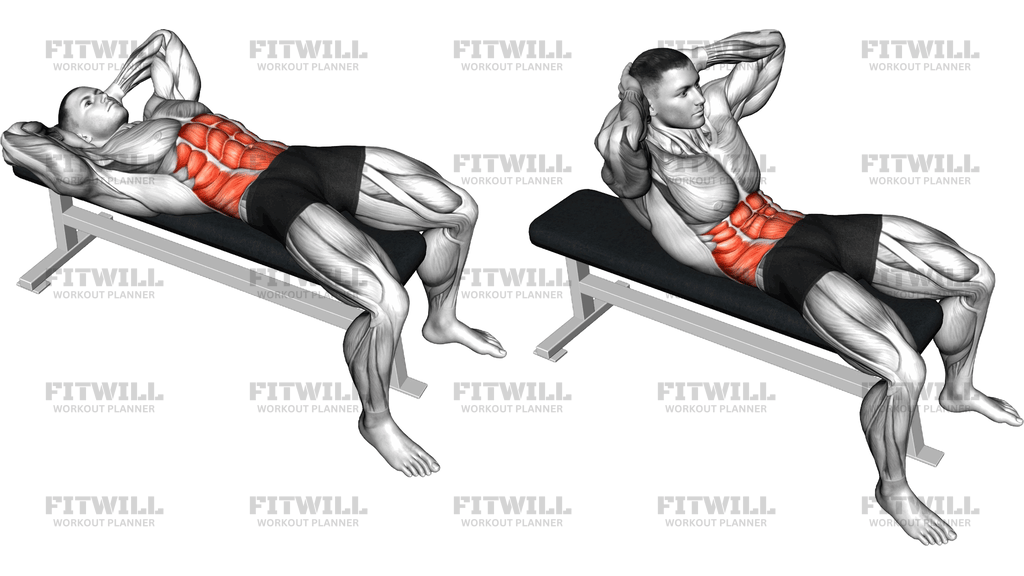
The Crunch On A Bench is a simple but precise abdominal exercise performed while lying face-up along a flat bench with your knees bent and feet planted on the floor. Instead of sitting all the way up like a full sit-up, you curl your ribcage toward your pelvis, lifting your head and shoulder blades off the bench while your lower back stays in contact with the surface. Your hands rest lightly behind your head for support, and the entire movement should come from the abdominal wall rather than momentum or a pull from the arms.
This movement trains the rectus abdominis, the muscle that runs down the front of the trunk and is responsible for flexing the spine. The obliques assist by stabilizing the ribcage and keeping the torso from twisting, while the deep core musculature works to control the position of the pelvis and lower back throughout the rep. Because the range is short and the emphasis is on spinal flexion rather than hip flexion, the exercise targets the abs more directly than a traditional sit-up.
The bench setup is what separates this version from a floor crunch. Elevating your torso on a bench gives you a stable surface to press your lower back against, which makes it easier to feel the abdominals doing the work and harder to cheat by arching or launching off the ground. The bent-knee, feet-on-the-floor position also helps disengage the hip flexors, so the crunch stays focused on the trunk rather than turning into a leg-driven movement.
To perform it well, lie back until your upper back and head are supported, plant your feet firmly, and place your fingertips lightly behind your ears or at the back of your head without interlacing your fingers. Exhale as you curl your shoulders up and forward, thinking about shortening the distance between your ribs and your hips. Pause briefly at the top, then lower slowly under control until your shoulder blades touch the bench again before starting the next rep.
The Crunch On A Bench suits a wide range of trainees. Beginners appreciate the guided range of motion and the feedback the bench provides, while more experienced lifters use it as a strict, higher-rep finisher at the end of a session or as a way to isolate the abs before weighted core work. It requires no extra load, making it easy to program at home or in a busy gym where only a bench is free.
The main safety point is protecting the neck and lower back. Never yank your head forward with your hands, and stop the set if you feel strain in your neck or a pinching sensation in your lumbar spine. Quality reps in a modest range will always beat fast, sloppy reps that travel further.
[ Workout Log & Planner ]
Put your next workout in Fitwill
Keep your plan and training log ready when you are.


Instructions
- Set a flat bench in a clear area and sit on it lengthwise so your torso can lie fully supported along the pad.
- Lie back until your head and upper back rest on the bench, bend your knees roughly 90 degrees, and place both feet flat on the floor.
- Position your hands lightly behind your head with your fingertips at your ears or the back of your skull; do not clasp your fingers and pull.
- Brace your abdominal wall gently and press your lower back into the bench so your pelvis stays neutral before you move.
- Exhale as you curl your ribcage toward your pelvis, lifting your head and shoulder blades off the bench while your lower back stays in contact with the pad.
- Pause for a beat at the top with your abdominals fully contracted, keeping your elbows wide and your neck relaxed.
- Inhale as you lower your torso slowly and under control until your shoulder blades touch the bench again.
- Let your head and shoulders settle for a moment, then re-brace and begin the next repetition without bouncing off the pad.
- Keep your feet planted and your knees still for every rep; if they drift, reset your stance before continuing.
Tips & Tricks
- If your neck burns before your abs do, you are pulling with your hands or leading with your chin — imagine holding an orange under your chin and curl from the ribcage instead.
- A common mistake is sitting up too far; once your lower back leaves the bench, the hip flexors take over, so stop the rep when your shoulder blades are only a few inches off the pad.
- Aim for a slow lowering phase of two to three seconds; dropping back to the bench and bouncing into the next rep removes most of the abdominal tension.
- Think about rounding your upper spine rather than lifting it straight up — the crunch is spinal flexion, not a stiff plank lifted off the bench.
- Keep your elbows open and wide; letting them collapse toward your knees shortens the movement and turns it into an arm-driven pull.
- If your feet lift or your knees wobble as you curl up, widen your stance slightly and drive your heels gently into the floor for stability.
- Higher reps with a deliberate pause at the top build more useful control here than adding external weight; keep it strict before making it heavier.
- Exhale hard on the way up — actively emptying your lungs helps the abdominal wall contract fully and makes the top position feel much sharper.
Frequently Asked Questions
What muscles does the Crunch On A Bench work?
The primary muscle is the rectus abdominis, which flexes the spine as you curl up. The obliques and deep core muscles assist by stabilizing the ribcage and pelvis throughout the rep.
Is the Crunch On A Bench better than a regular floor crunch?
The bench gives you a firm surface to press your lower back against and a slightly longer range before your shoulder blades return to the pad. Many people find it easier to isolate the abs and harder to arch or cheat compared to the floor.
Why do my hip flexors feel the Crunch On A Bench so much?
This usually means you are sitting up too high or pulling with your legs. Keep the movement to a curl where only your head and shoulder blades leave the bench, and keep your lower back in contact with the pad.
Should I put my hands behind my head or cross them over my chest?
Either works, but hands behind the head should be for support only — fingertips at your ears, never pulling. If you catch yourself yanking your head forward, switch to crossed arms over your chest until your form is strict.
How far should I come up during a Crunch On A Bench?
Lift just until your shoulder blades are clearly off the bench and you feel your abdominals fully shortened. Rising into a full sit-up shifts the work to the hip flexors and takes tension off the abs.
Is this exercise safe for beginners?
Yes — the bench supports your head and upper back, and the short range makes it easy to control. Beginners should focus on slow reps, relaxed hands, and steady breathing rather than rep count.
Can I add weight to the Crunch On A Bench?
You can hold a small plate or light dumbbell against your chest once strict bodyweight reps feel easy. Most trainees get better results from a slower tempo and a pause at the top than from added load.
What can I use if I don't have a bench?
A sturdy flat surface like an exercise mat works for a standard floor crunch, or you can lie across a stable ottoman or padded box that supports your head and shoulders. Just make sure the surface does not shift while you move.
How many reps and sets should I do?
Two to four sets of 10 to 20 controlled reps is a solid starting point. Stop the set when your form breaks down — particularly when you start pulling on your neck or bouncing off the bench.
How do I protect my neck during the Crunch On A Bench?
Keep a fist-sized space between your chin and chest, lead the movement with your ribcage rather than your head, and never interlace your fingers behind your skull. If neck discomfort persists, reduce the range or move your hands to your temples for lighter support.