Sternum Pull Up (Gironda)
The Sternum Pull Up (Gironda) is a bodyweight pull-up variation credited to legendary bodybuilding coach Vince Gironda. Instead of pulling your chin over the bar with an upright torso, you lean back sharply as you pull, arching your spine and drawing the bar down toward your sternum — the point where your lower chest meets your upper abdomen. This long lever and reclined path shifts the emphasis away from the upper arms and toward the lats and mid-back, making it one of the most demanding horizontal-meets-vertical pulling patterns you can do with just a bar.
The setup looks similar to a standard wide-grip pull-up: hands take a wider-than-shoulder grip, the body hangs straight, and the feet stay off the floor. From there, the movement diverges. As you pull, your head and shoulders travel back behind the bar while your hips push slightly forward, so your torso ends up nearly reclined beneath the bar at the top. In the finished position, your lower chest or sternum area is close to the bar and your upper back is deeply contracted.
This exercise suits intermediate to advanced lifters who already own solid chin-ups and want to build a wider back and thicker mid-back without adding equipment. Because the reclined torso removes much of the biceps' leverage, it is excellent for lifters whose arms tend to take over in normal pull-ups. Bodybuilders use it for back detail and lat spread; strength athletes use it as a difficult accessory that challenges scapular control under load.
The setup matters more here than in a standard pull-up. A grip that is too narrow turns it into a chin-up and lets the elbows drive the movement; a lean that is too shallow keeps it in vertical territory and the chest never approaches the bar. The bar needs enough clearance that your body can travel back and down without your feet or legs catching anything, and you should be able to hang freely with full arm extension before starting.
Execution should feel like a pull-over and a pull-up combined. Think of driving your elbows down and back while your chest lifts toward the bar and your head moves past it. The descent deserves just as much respect: lowering yourself in a controlled arc back to the hang keeps tension on the lats and protects the shoulders from a sudden stretch at full extension.
Because the sternum pull-up places the shoulders in a stretched, arched position under full bodyweight, it is not the place to push through fatigue. Stop the set when your form leans back to swinging, and treat strict quality reps as the standard. Anyone with shoulder discomfort at the bottom of a pull-up should work with easier regressions first, such as partial-range sternum pulls or assisted versions.
Fitwill
Log Workouts, Track Progress & Build Strength.
Achieve more with Fitwill: explore over 9600 exercises with images and videos, access built-in and custom workouts, perfect for both gym and home sessions, and see real results.
Start your journey. Download today!




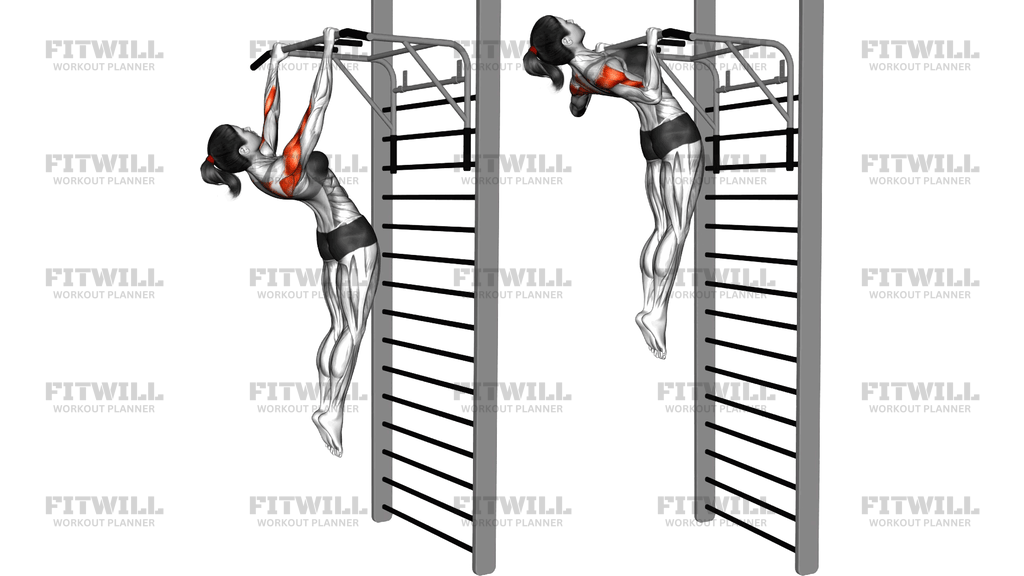
Instructions
- Grip a pull-up bar with a wide, overhand grip, roughly 8 to 12 inches wider than your shoulders on each side.
- Hang with your arms fully extended and your shoulders relaxed away from your ears, feet together and off the floor so your body can travel backward freely.
- Keep a slight bend in the knees and tuck the pelvis gently to brace your core before you start the pull.
- Initiate the pull by driving your elbows down and back toward your hips rather than straight down in front of your body.
- As you pull, lean your torso backward and arch your spine, letting your head travel back past the bar while your hips drift slightly forward.
- Continue until your sternum or lower chest is near the bar and your shoulder blades are fully retracted, with your torso reclined beneath the bar.
- Exhale as you pull up; inhale at the top or during the lowering phase, keeping the breath steady rather than holding it.
- Lower yourself in a slow, controlled arc, reversing the path so your torso returns to the vertical hang rather than dropping straight down.
- Reset the hang each rep: full arm extension, shoulders relaxed, legs quiet, before starting the next pull.
- Stop the set as soon as the chest stops approaching the bar or your body starts swinging to gain momentum.
Tips & Tricks
- Think 'chest to bar, head behind bar.' If your chin clears but your sternum does not approach the bar, you are doing a regular pull-up with a wide grip, not a Gironda pull-up.
- Most lifters use too narrow a grip. If your elbows stay in front of your torso the whole way up, widen your hands — the wide grip is what makes the backward lean possible.
- Watch for the elbows flaring straight out to the sides. Pull them down and back at roughly 45 degrees to protect the shoulders and keep the lats driving.
- If your body swings forward instead of leaning back, your hips are the problem: consciously push them slightly forward as your chest rises.
- The bottom position is the riskiest part of this movement. Never drop out of the top — control the arc down so the shoulders are not yanked into a stretched hang.
- Struggling to reach the sternum? Partial reps that bring the bar to the mid-chest are a legitimate regression; earn the full range over weeks rather than kipping your way up.
- Grip often fails before the back does on wide-grip work. If your hands slip mid-set, use chalk or a secure bar surface rather than shortening your sets entirely.
- Keep the legs quiet. Bent, kicking legs usually mean the core is not braced and momentum is replacing back strength.
- Because the reclined path is unfamiliar, film one set from the side. You will immediately see whether your torso actually leans back or you are pulling vertically out of habit.
Frequently Asked Questions
What muscles does the Sternum Pull Up (Gironda) work?
The lats are the primary movers, with strong contribution from the rhomboids, middle traps, and rear shoulders because of the arched, reclined torso path. The biceps assist but get less leverage than in a standard pull-up, and the forearms work hard to hold the wide grip.
Why does the Sternum Pull Up (Gironda) pull to the chest instead of the chin?
Vince Gironda designed the movement so the bar travels toward the sternum while the torso leans back, turning a vertical pull into a more horizontal one. This path favors lat and mid-back development over the arm-dominant pull of a regular chin-up.
Can beginners do the Sternum Pull Up (Gironda)?
It is a poor starting point — most beginners cannot yet perform strict standard pull-ups, and this version is harder due to the wide grip and reclined path. Build up with lat pulldowns and regular pull-ups first, then use partial-range sternum pulls as a bridge.
How wide should my grip be on the Sternum Pull Up (Gironda)?
A comfortable overhand grip roughly 8 to 12 inches beyond each shoulder works for most people. If your elbows stay in front of your body during the pull, the grip is too narrow to allow the backward lean the exercise depends on.
Is it okay if my head goes behind the bar?
Yes — the head passing behind the bar as the chest rises is actually the correct path for this exercise, not a fault as it can be in standard pull-up cueing. The key is that the lean comes from a controlled arch, not from swinging.
My chest never reaches the bar. What should I change?
First check that you are leaning back enough — a vertical torso simply cannot bring the bar to the sternum. If the lean is correct and you still fall short, use partial reps to mid-chest or add assisted work until your back strength catches up.
What can I substitute if I cannot do the Sternum Pull Up (Gironda) yet?
Wide-grip lat pulldowns performed with a backward torso lean mimic the same path, and chest-supported rows train the mid-back in a controlled setting. Assisted sternum pull-ups on a machine are the closest bodyweight-style regression.
Is the Sternum Pull Up (Gironda) safe for the shoulders?
For healthy shoulders with good overhead mobility and existing pull-up strength, it is generally fine when performed with control. The stretched, arched bottom position is demanding, so avoid dropping out of reps and stop if you feel pinching or sharp discomfort.
How many reps and sets should I do?
Because strict reps are hard to accumulate, 3 to 4 sets of 3 to 8 quality reps is a realistic working range. Prioritize the full lean-back path over chasing higher numbers with swing or shortened range.