Wrist Roller
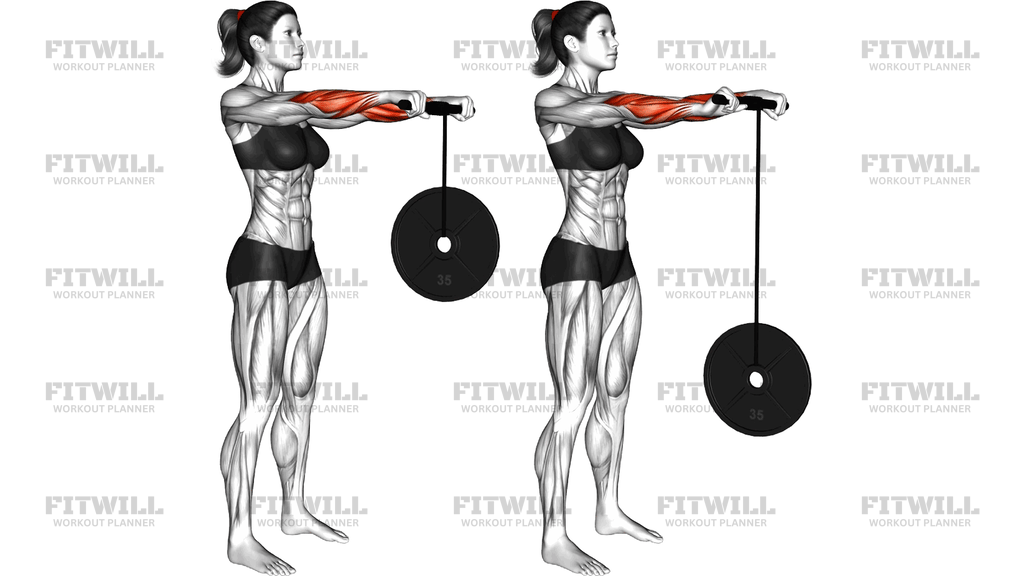
The Wrist Roller is a classic forearm and grip builder: a short handle with a rope tied to its center and a weight plate hanging from the other end of the rope. You stand holding the handle straight out in front of your shoulders, then roll it up hand over hand until the plate reaches the handle, and slowly roll it back down. Because each turn of the handle must be earned through pure wrist flexion and extension, the entire forearm musculature works continuously from the first rotation to the last.
This movement trains the wrist flexors on the underside of the forearm, the wrist extensors on the top, and the brachioradialis along the forearm's thumb side, while your grip works overtime just to keep the handle from slipping. Holding your arms extended in front of you also keeps the front shoulders under steady tension, which is why many lifters feel them working long before the plate touches down.
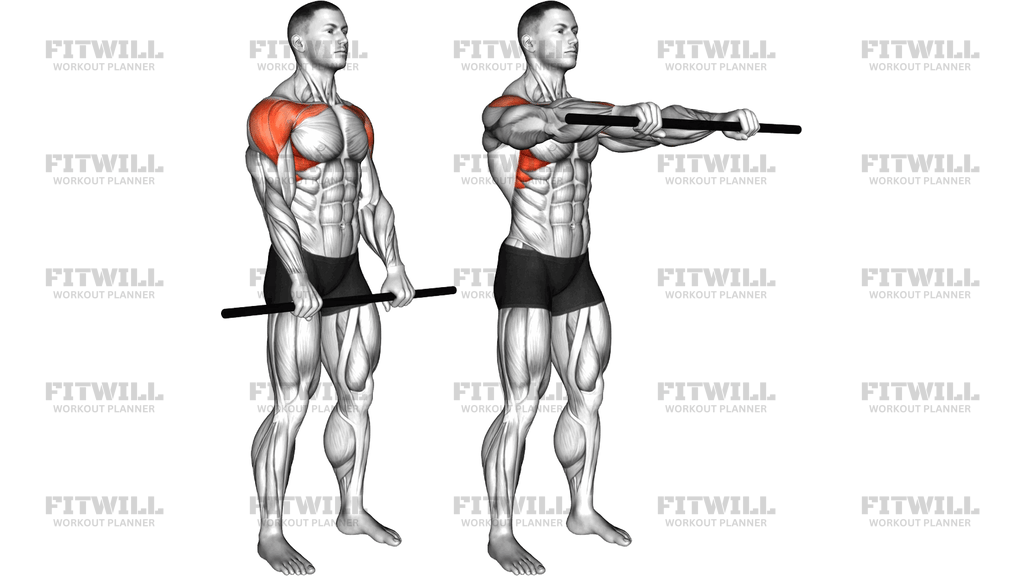
Setup matters more than most people expect. The height of your arms, how close your feet are to the anchor point, and the length of rope between the handle and the plate all change how hard the hold is before you even start rolling. Arms held level with the shoulders, as shown here, make the exercise strict and honest; dropping the arms turns it into something easier and less specific.
Execution comes down to controlled, alternating wrist turns. Roll the handle toward you one hand at a time, letting each full twist wrap an even layer of rope, and avoid jerking the shoulders or shrugging to help the plate along. On the way down, resist the plate rather than letting it unwind freely - the lowering portion builds just as much forearm strength as the winding portion.
The Wrist Roller suits anyone whose sport or training leans on grip endurance: climbers, golfers, tennis players, martial artists, and lifters whose forearms give out before their back or biceps do. Start with a light plate - even 2.5 to 5 kilograms feels heavy within a few turns - and treat it as a finishing movement at the end of an upper body or arm session rather than the first exercise of the day.
Keep the wrists warm before you start, keep the plate path clear of your legs and feet, and stop the set when your grip starts to fail rather than when your form breaks down. Forearms respond well to consistent, moderate-volume work, so two or three quality sets per week beat a single all-out burnout session.
[ Workout Log & Planner ]
Put your next workout in Fitwill
Keep your plan and training log ready when you are.


Instructions
- Stand with feet about hip-width apart and secure the wrist roller device so the rope hangs freely with the weight plate near the ground.
- Grip the handle with both hands using an overhand grip, hands slightly wider than shoulder-width, and raise your arms straight forward until they are level with your shoulders.
- Set your shoulders down and back, brace your trunk, and keep a soft bend in the knees so the plate hangs still before you begin.
- Exhale and roll the handle toward you by flexing one wrist at a time, alternating hands so the rope wraps evenly around the center of the handle.
- Keep your arms extended and level - do not bend the elbows or let the shoulders creep up toward the ears as the plate climbs.
- Continue turning hand over hand until the plate reaches the handle and the rope is fully wound.
- Pause for a beat at the top, holding the full weight on the wrapped rope with steady tension in the forearms.
- Inhale and reverse the motion slowly, extending one wrist at a time to lower the plate under control instead of letting it free-fall.
- Once the plate touches down, reset your grip and shoulder position before starting the next set.
Tips & Tricks
- Choose a plate you can roll up in 15 to 25 seconds; if your wrists give out after two turns, the weight is too heavy to learn the pattern properly.
- If your front shoulders fatigue before your forearms, lower your arms slightly toward hip height or rest between sets - the shoulders are holding an isometric position the whole time.
- Avoid letting the plate swing; a pendulum motion means you are jerking the handle instead of turning it with smooth wrist movement.
- Do not lean your torso back as the plate gets heavy - that shift signals the forearms have stopped controlling the load.
- Chalk or a dry towel on your hands helps when sweat makes the handle slip; a slipping grip ends the set early without fully working the forearms.
- Roll the rope in even layers across the handle. Piling it on one side changes the leverage and twists one wrist more than the other.
- Take the descent just as seriously as the climb - lowering the plate in slow, controlled turns builds eccentric strength in the wrist flexors and extensors.
- Skip this exercise on days your wrists are already sore from heavy pulling work; fatigued wrists lose position control and the rope path gets sloppy.
- Keep the plate directly under the handle and away from your shins, especially on the lowering half of each rep.
Frequently Asked Questions
What muscles does the Wrist Roller work?
It primarily targets the forearm flexors and extensors, with strong involvement from the brachioradialis and the grip muscles holding the handle. Holding the arms extended also keeps the front shoulders under continuous isometric tension.
Is the Wrist Roller good for beginners?
Yes, as long as the starting weight is light. Beginners should use a small plate and focus on smooth, even wrist turns before chasing time under tension.
Why should my arms stay extended at shoulder height during the Wrist Roller?
Holding the arms level makes the forearms work without assistance from the torso or elbows. Dropping the arms shortens the resistance path and reduces how much the wrists and grip have to do.
How heavy should the plate be on the Wrist Roller?
Start with 2.5 to 5 kilograms and progress only when you can roll the plate up and back down under full control. Most people are surprised how quickly a light plate fatigues the forearms.
Should I roll the plate up fast or slow?
Roll up at a steady, deliberate pace and lower even more slowly. Rushing turns the set into a shoulder and momentum exercise instead of a forearm one.
What is the most common mistake with the Wrist Roller?
Bending the elbows and cranking the handle against the body, which shifts work away from the wrists. Keep the arms extended and let each hand's wrist do the turning.
Can I do the Wrist Roller if I have wrist discomfort?
If your wrists are irritated or recently injured, check with a qualified professional before adding it. Even without an injury, a thorough warm-up of the wrists is wise before rolling.
What can I use instead of a wrist roller?
Barbell wrist curls and reverse wrist curls train the flexors and extensors separately, while thick-handle holds and farmer's carries build grip endurance. None match the continuous rolling pattern exactly, but they cover the same muscles.
How often should I include the Wrist Roller in my training?
Two to three sets at the end of an upper body session, once or twice per week, is enough for most people. Forearms need recovery just like any other muscle group.