Dumbbell Jump Box
The Dumbbell Jump Box is a loaded plyometric exercise where you hold a dumbbell in each hand at your sides and explosively jump onto a sturdy box or step platform, landing softly with both feet on top. It takes the classic box jump and adds external load, which raises the demand on your quads, glutes, and calves while forcing your trunk and grip to stay locked in throughout the movement.
This exercise suits intermediate lifters and athletes who already own a solid unweighted box jump and want to build more explosive leg power. Sprinters, jumpers, and field-sport athletes benefit from the added resistance, and general strength trainees can use it to break through plateaus when bodyweight jumps have stopped feeling challenging. It also fits well into conditioning circuits where you want power output and elevated heart rate at the same time.
The loaded version changes the mechanics in ways that matter. Because the dumbbells travel with you, any wasted sway or hitch in your jump costs you height, so the movement rewards clean triple extension at the ankles, knees, and hips. Your traps, forearms, and grip work isometrically to keep the weights hanging steady, and your core braces hard to stop the load from pulling you forward as you drive up.
Setup is where most people go wrong with this exercise. The box height must be lower than what you would use for a bodyweight jump, because the dumbbells reduce how high you can get your feet. A platform that is slightly too tall turns a power exercise into a risky shin-scraping scramble, so start conservative, around 12 to 18 inches, and only progress when every landing looks and feels quiet.
Execution should feel crisp rather than grinding. Stand about a foot in front of the box, hinge slightly at the hips and knees, then punch the floor away and stick the landing on top in a quarter squat with a tall chest. Step back down one foot at a time rather than jumping off, which keeps your Achilles tendons and knees out of harm's way and lets you reset fully before the next rep.
Keep the dumbbells light to moderate. The goal is a fast, aggressive jump, not a slow grind; if the load forces you to swing the weights or cut your depth short, drop the weight until your jump looks identical to your unweighted version.
[ Workout Log & Planner ]
Put your next workout in Fitwill
Keep your plan and training log ready when you are.


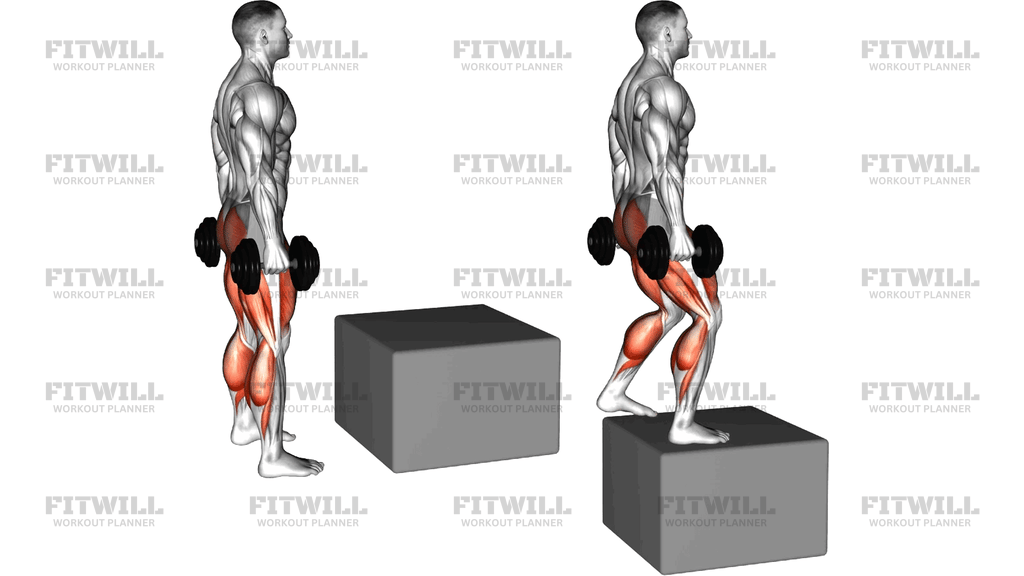
Instructions
- Stand facing a sturdy box or step platform about 30 to 45 centimeters in front of you, holding a dumbbell in each hand with your arms fully extended at your sides and palms facing your thighs.
- Set your feet roughly hip-width apart with your toes pointing forward and your weight spread evenly across both feet.
- Brace your abdominal muscles, pull your shoulder blades back slightly, and squeeze the dumbbell handles so the weights hang still rather than swinging.
- Drop into a shallow quarter squat by pushing your hips back and bending your knees, keeping your chest up and the dumbbells close to your body.
- Explosively extend your ankles, knees, and hips and jump forward and up onto the box, driving through the balls of your feet.
- Land on top of the box with both feet at the same time, absorbing the impact by sinking into a small squat with your knees tracking over your toes.
- Stand fully upright on the box with your hips and knees extended, keeping the dumbbells hanging at your sides and your trunk tall.
- Step back down one foot at a time with control, never jumping off the box while holding weights.
- Exhale as you jump and land, then inhale during the reset before the next rep.
- Set the dumbbells down or rest briefly between reps so every jump is performed fresh and at full effort.
Tips & Tricks
- Choose a box noticeably lower than your bodyweight jump height; the dumbbells blunt your vertical lift, and a too-tall box invites scraping your shins mid-jump.
- If the dumbbells swing forward as you jump, you are bending your arms or shrugging on the drive; lock your elbows and let your lats and grip hold the weights against your thighs.
- A loud, slapping landing means you are letting gravity do the work on the way down; aim for a quiet, cushioned landing by bending at the hips and knees together.
- Do not let your knees cave inward as you land; cue your knees out over your pinky toes to protect them and keep the glutes engaged.
- Step down, never jump down, with dumbbells in hand; the repeated impact of loaded landings from height is where ankles and Achilles tendons get hurt.
- Reset completely between reps rather than jumping in rapid rhythm; quality of each individual jump matters more than rep speed in this exercise.
- Start with light dumbbells, around 5 to 10 kilograms per hand, and only add weight when your jump height and landing look unchanged from your unweighted version.
- If your grip fatigues before your legs, use straps or switch to a lighter pair; the point of the load is leg power, not a forearm endurance test.
- Skip this exercise entirely on days when your legs are sore or your landing mechanics look sloppy; loaded jumps amplify whatever flaws are already there.
Frequently Asked Questions
What muscles does the Dumbbell Jump Box work?
It primarily targets the quads and glutes, with strong contributions from the hamstrings and calves during the explosive extension. Your forearms, traps, and core work isometrically to control the dumbbells and keep your trunk stable.
How heavy should the dumbbells be for the Dumbbell Jump Box?
Start with a light pair, roughly 5 to 10 kilograms per hand, and progress only when your jump height and landing quality match your bodyweight box jump. If the weight makes your jump slower or forces you to swing the dumbbells, it is too heavy.
Can beginners do the Dumbbell Jump Box?
It is not the best starting point; beginners should first master the bodyweight box jump and be able to land quietly and consistently. Once that is solid, a very light dumbbell load and a lower box are a safe way to introduce resistance.
How high should the box be when holding dumbbells?
Use a box noticeably lower than your bodyweight jump height, often 12 to 18 inches to start. The load cuts into your vertical lift, and a box that is too tall turns the jump into a risky shin scrape instead of a clean landing.
Why should I step down instead of jumping off the box?
Stepping down one foot at a time removes the repeated impact of loaded landings from height, which stresses the Achilles tendons, knees, and lower back. It also gives you a moment to reset your brace and grip before the next jump.
What is the most common mistake in the Dumbbell Jump Box?
Using a box that is too high or dumbbells that are too heavy, which turns the jump into a half-effort hop or a scramble onto the platform. Both mistakes kill the power benefit and sharply raise the risk of catching a shin on the box edge.
How many reps and sets should I do?
Keep the reps low and the quality high, typically 3 to 5 sets of 3 to 6 jumps with full rest between sets. This is a power exercise, so stop the set as soon as your jump height or landing control drops.
What can I substitute for the Dumbbell Jump Box?
A bodyweight box jump, a dumbbell jump squat without a box, or a kettlebell swing all train similar explosive hip and leg extension. If you lack a box entirely, dumbbell jump squats onto flat ground are the closest match.
Should my arms move during the jump?
No; unlike a bodyweight box jump where you swing your arms, your arms stay extended at your sides holding the dumbbells still. Swinging or shrugging the weights wastes energy, disturbs your balance, and signals that the load is too heavy.
Is it safe to do the Dumbbell Jump Box when fatigued?
It is best avoided late in a workout or when your legs are sore, because landing mechanics deteriorate quickly under fatigue. Place it early in your session when you are fresh, and drop the set if your landings become loud or stiff-legged.