Stick Standing Shoulder Press
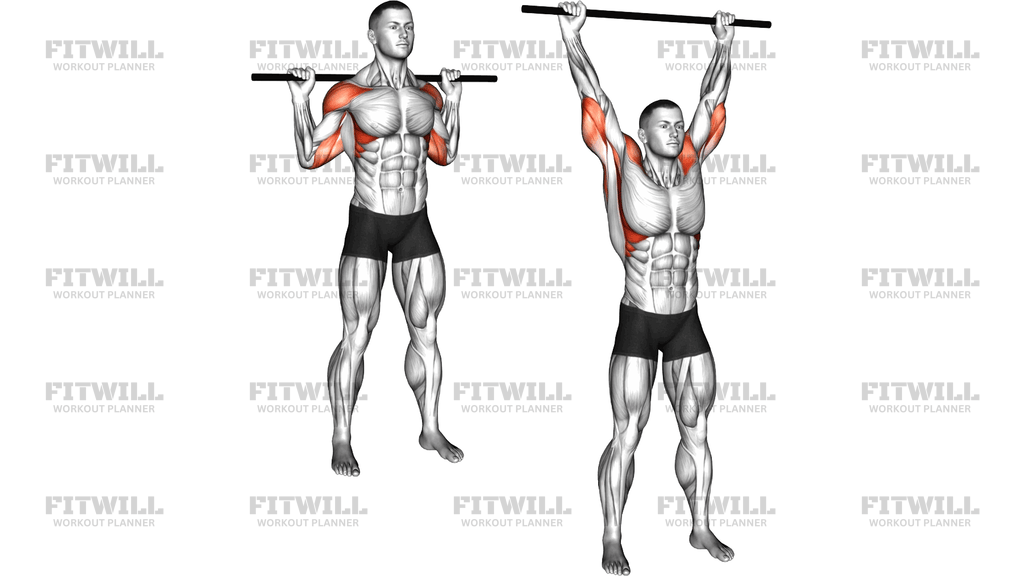
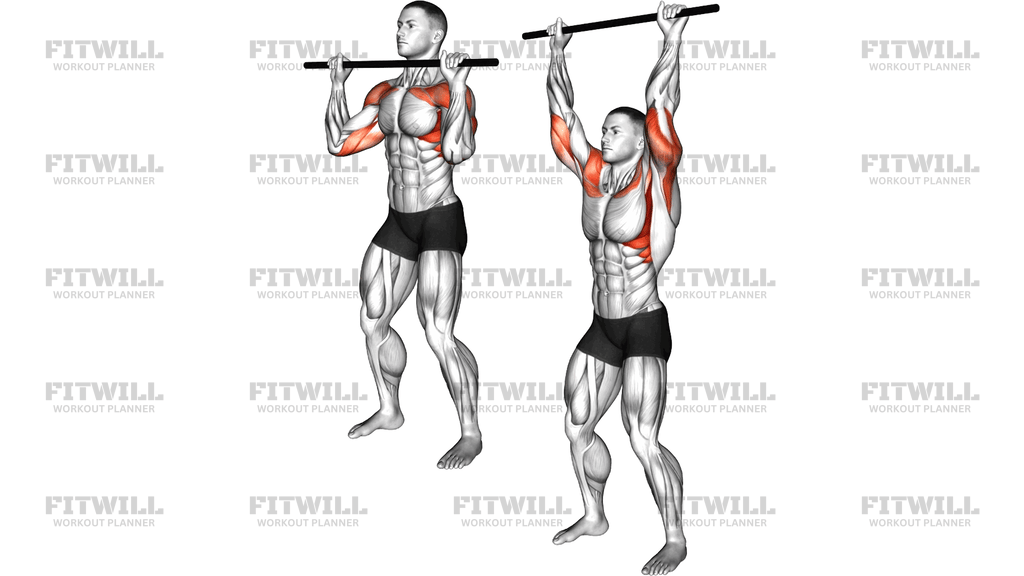
The Stick Standing Shoulder Press is an overhead press performed while standing, using a light stick such as a broomstick, PVC dowel, or training bar held with an overhand grip. You start with the stick resting across the front of your shoulders at collarbone height, then press it straight up until your arms are fully extended overhead before lowering it back to the shoulders under control. Because the load is light, this variation is ideal for learning and refining overhead press technique without the joint stress of a heavy barbell.
This movement primarily works the front shoulders, with the side shoulders assisting through the middle of the press and the triceps taking over as you lock the arms out overhead. Standing rather than seated also means your core, upper back, and legs must stabilize your torso the entire time, which is exactly what makes it valuable as a teaching tool. The upper traps and serratus anterior help you finish the lockout with the stick stacked over your mid-foot.
The setup matters more with a stick than people expect. Since there is almost no weight to pull you into position, any flaws in your posture become obvious: an arched lower back, ribs flaring forward, or a head that juts toward the stick all show up immediately. Practicing with a stick lets you build a straight, repeatable pressing path before you ever load the movement with a barbell or dumbbells.
To execute it well, grip the stick slightly wider than shoulder width so your forearms stay roughly vertical at the start. Brace your abdominal wall, squeeze your glutes lightly, and press the stick up and slightly back so it travels over the crown of your head rather than out in front of your face. At the top, your arms should be in line with your ears and your shoulders should not shrug up toward your neck.
This exercise suits beginners learning the overhead press pattern, lifters warming up before heavier pressing, and anyone correcting a press that drifts forward or loses torso position under load. It is also a common drill in mobility and posture work, since it exposes restrictions in shoulder and upper back range of motion. Because the load is minimal, you can perform higher repetitions and focus entirely on the quality of each rep.
From a safety standpoint, the light load makes this a low-risk exercise, but the same rules apply as with a weighted press: keep your lower back from over-arching, avoid pressing through a painful range, and stop if the stick forces your head or neck into an awkward position. If your shoulders cannot reach full extension overhead without compensating, limit the range to what you can achieve with a straight torso and work on the restriction separately.
[ Workout Log & Planner ]
Put your next workout in Fitwill
Keep your plan and training log ready when you are.


Instructions
- Stand with your feet about hip-width apart, toes pointing forward, and hold the stick with an overhand grip slightly wider than your shoulders.
- Bring the stick up to your front shoulders at collarbone height, elbows pointing down and slightly forward, with your forearms close to vertical.
- Stand tall and brace your abdominal wall as if bracing for a light push, then squeeze your glutes to lock your pelvis in a neutral position.
- Take a breath into your belly and hold it briefly as you begin the press.
- Press the stick straight up, letting it travel slightly back so it passes in front of your face and finishes over the crown of your head.
- At the top, extend your arms fully so the stick sits directly over your mid-foot, in line with your ears, and pull your shoulders slightly down away from your neck.
- Lower the stick back to your front shoulders along the same path, keeping your elbows tracking down rather than flaring wide.
- Exhale at the top of the press or as the stick descends, then take your next breath at the shoulders before the following rep.
- Keep your head neutral throughout; instead of craning your neck back, let the stick move around your face as it travels up.
- Reset your brace and stance at your shoulders between reps if you feel your torso position slipping.
Tips & Tricks
- A common mistake is arching the lower back to finish the lockout. If the stick drifts forward of your mid-foot at the top, squeeze your glutes harder and brace your abs before pressing rather than leaning back.
- If your elbows flare out to the sides at the start, your grip is likely too narrow. Widen your hands until your forearms are vertical when the stick rests on your shoulders.
- Do not let your head jut forward to meet the stick. Keep your neck neutral and move the stick around your face instead of moving your face toward the stick.
- Watch for shrugging your shoulders toward your ears during the press. Finish each rep by reaching tall through the stick while keeping space between your shoulders and neck.
- Because the stick is light, tempo is your main tool. Take two to three seconds to lower it and pause briefly at your shoulders so you cannot bounce through sloppy reps.
- Check your wrist position: bent-back wrists shift stress away from the press. Keep your knuckles stacked over your forearms as if punching the ceiling.
- Film yourself from the side. The pressing path should be a straight vertical line or a slight backward angle; any pronounced S-curve around your head signals a mobility or technique issue to address.
- Use this drill as a warm-up before barbell or dumbbell overhead pressing. Ten to fifteen smooth reps will groove the pattern and highlight how your shoulders feel that day.
- If you cannot reach a full lockout without your ribs flaring up, press only as high as you can keep a straight torso and work on shoulder and upper back mobility separately.
Frequently Asked Questions
What muscles does the Stick Standing Shoulder Press work?
The front shoulders are the primary movers, supported by the side shoulders through the middle of the press and the triceps during lockout. Your core, upper back, and traps stabilize the torso and control the stick overhead.
Is the Stick Standing Shoulder Press good for beginners?
Yes, it is one of the best first exposures to overhead pressing. The light stick lets you learn a straight pressing path and solid torso positioning before adding weight with a barbell or dumbbells.
How wide should my grip be on the stick?
Grip slightly wider than shoulder width so that when the stick rests on your front shoulders, your forearms are close to vertical. Too narrow and your elbows flare; too wide and you lose pressing strength at lockout.
Why press with a stick instead of a barbell?
The stick removes the load so any form breakdown, such as an arched lower back or a forward-drifting press path, becomes obvious and easy to correct. It is also gentler on the shoulder and elbow joints during high-repetition technique work.
Should my head move back during the press?
Only slightly, if at all. The stick should travel around your face with a neutral neck, finishing over the crown of your head; pushing your head far back usually goes hand in hand with arching your lower back.
How many reps should I do with the Stick Standing Shoulder Press?
Because the resistance is minimal, sets of 10 to 20 slow, deliberate reps work well for groove and warm-up purposes. Focus on path quality rather than speed or fatigue.
What can I substitute if I do not have a stick?
Any long, light object of similar length works: a PVC pipe, an unweighted training bar, or even a resistance band held taut under your feet to add light overhead resistance.
Can I do this exercise if my shoulders are tight overhead?
Yes, but limit the range to where you can keep a straight torso and neutral ribs. Pressing through a restricted range usually forces your lower back to compensate, which defeats the purpose of the drill.
Is it safe to do the Stick Standing Shoulder Press every day?
With no meaningful load, daily practice is generally fine and is often used as a mobility and movement-quality drill. Stop if you notice persistent shoulder or neck discomfort, and progress to weighted pressing only once your path is consistent.