Weighted Plate Crunch (Hands Overhead) (Version 2)
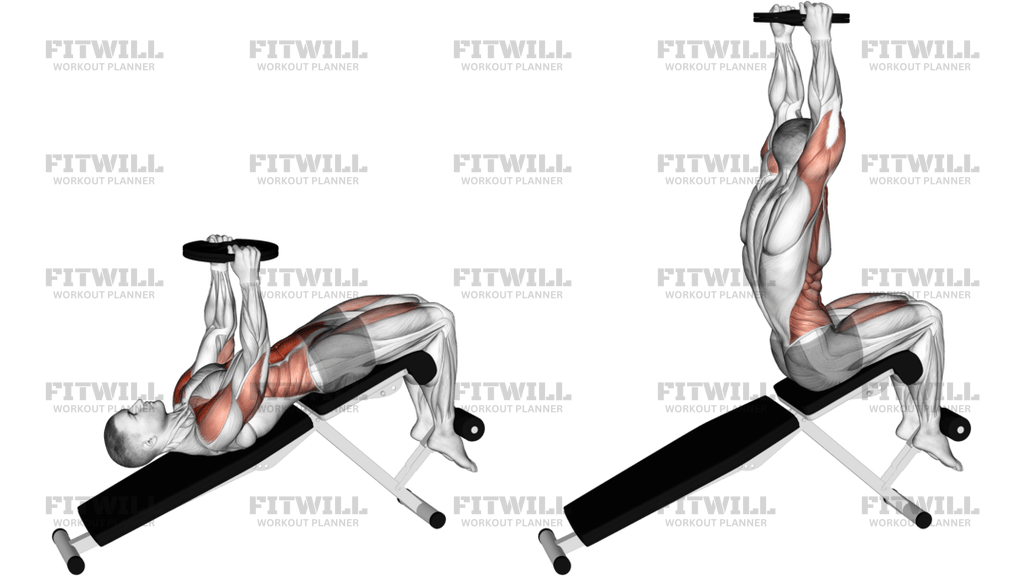
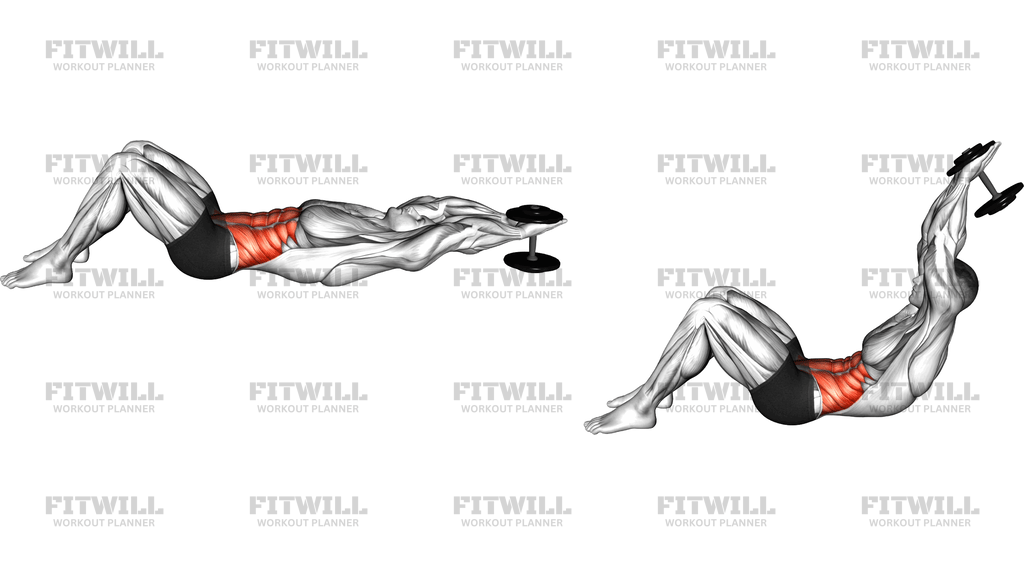
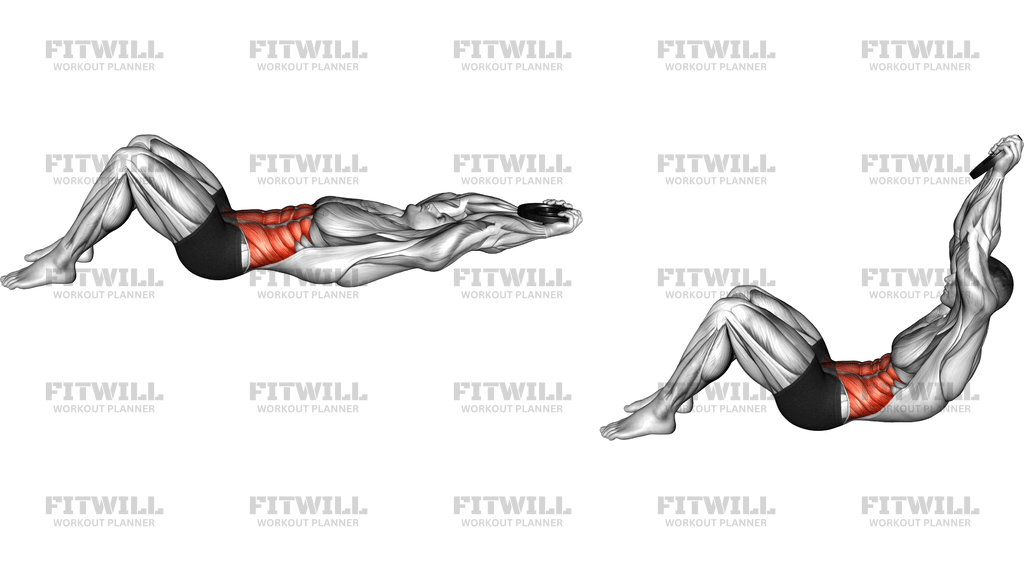
The Weighted Plate Crunch (Hands Overhead) is a floor-based abdominal exercise where you lie on your back with your knees bent and hold a single weight plate in both hands, arms extended straight overhead behind you. From that stretched position, you curl your torso up until you are sitting upright with the plate reaching toward the ceiling, then lower back down under control. Because the weight starts behind your head, your abs work from a lengthened position, which makes the movement noticeably harder than a standard crunch with the same load.
This variation suits lifters who have outgrown bodyweight crunches and want a simple way to add resistance without cables, machines, or complex setups. All you need is a weight plate and a bit of floor space. It fits well at the end of a core session, as a finishing movement on a push or pull day, or in a minimal-equipment routine where a single plate is the only load available.
The main muscle worked is the rectus abdominis, the sheet of muscle running down the front of your abdomen that pulls your ribs toward your pelvis. The obliques assist by stabilizing your trunk and keeping the plate from drifting side to side, and the hip flexors help once you move into the taller part of the sit-up. Holding the plate overhead with straight arms also places a light demand on the shoulders and upper back as they keep the weight positioned over you.
Setup matters more here than in most crunch variations. With your arms extended overhead, the plate acts as a long lever, so any looseness in your grip or wobble in your arm position gets amplified through your spine. Your lower back should stay neutral as you begin the rep, and the curl should start from your ribcage rather than from yanking with your arms or throwing the plate forward. Feet stay flat on the floor with knees bent, which keeps the hips from dominating the movement.
To execute it well, think of peeling your upper back off the floor first, then continuing the arc until your torso is upright and the plate is stacked over your shoulders. Exhale hard on the way up, pause briefly at the top, and take two to three seconds to return so your abs control the descent instead of gravity. Keep your arms locked in the same relative position throughout; swinging the plate forward for momentum is the most common way this exercise loses its value.
Because the loaded stretch at the bottom is demanding, start with a light plate, such as 5 or 10 pounds, and only add weight when you can complete your target reps without your lower back arching off the floor or your arms bending. If you feel the work shifting into your hip flexors or neck rather than your midsection, shorten the range or reduce the load before progressing again.
[ Workout Log & Planner ]
Put your next workout in Fitwill
Keep your plan and training log ready when you are.


Instructions
- Lie flat on your back on the floor with your knees bent and your feet flat, about hip-width apart.
- Hold a weight plate by its edges with both hands and extend your arms straight overhead so the plate rests on or just above the floor behind your head.
- Squeeze the plate firmly and keep your elbows soft but essentially straight, locking your arms into one fixed line for the whole set.
- Brace your abdominal wall and take a breath in before starting the first rep.
- Initiate the rep by curling your ribcage toward your pelvis, lifting your head, shoulders, and upper back off the floor while the plate continues traveling overhead.
- Keep curling until you are sitting upright with the plate reaching toward the ceiling directly over your shoulders, and squeeze your abs at the top for a beat.
- Lower yourself back down slowly, reversing the path so your upper back and then your head touch down before the plate returns behind you.
- Exhale forcefully as you curl up and inhale as you lower back to the start.
- Reset your grip and brace, make sure the plate is stable behind your head, and begin the next rep.
Tips & Tricks
- Choose a plate with a lip or grip you can hold securely; a slippery plate overhead at the stretched position is the biggest safety risk in this exercise.
- If your lower back arches hard as you sit up, the plate is too heavy or your hip flexors are taking over, so drop the load a step.
- Do not bend your elbows to help toss the plate forward, since turning it into an arm throw removes tension from the abs.
- Keep the plate traveling in a single vertical arc over your face and chest; side-to-side drift means your obliques and grip are fighting the load unevenly.
- Curl your spine one segment at a time on the way up rather than hinging straight into a sit-up from the hips.
- Press your lower back gently into the floor at the start of each rep to set a neutral spine before the plate travels back.
- Stop each rep fully at the bottom with the plate behind your head rather than bouncing out of the stretch, which robs you of the hardest part of the range.
- If your neck strains, focus on leading with your ribcage instead of jutting your chin toward your knees.
- Progress by adding small plate increments or extra reps, not by swinging harder, because momentum hides the point of the overhead arm position.
Frequently Asked Questions
What muscles does the Weighted Plate Crunch (Hands Overhead) work?
The rectus abdominis across the front of your abdomen does most of the work, since it curls your ribcage toward your pelvis. The obliques stabilize the trunk, the hip flexors assist in the upright portion, and the shoulders and upper back hold the plate in position.
Why hold the plate overhead instead of on the chest?
With your arms extended behind your head, the abs work from a stretched position and the plate acts as a longer lever, making the same weight considerably harder. It also removes the option of hugging the weight for momentum.
Is the Weighted Plate Crunch (Hands Overhead) suitable for beginners?
Beginners can do it with a very light plate or no plate at all, keeping the same overhead arm path. If the bottom position feels unstable or the lower back arches, master the bodyweight version first.
How big should the plate be when starting?
Start with a small plate, around 5 to 10 pounds, and only increase once you can complete all reps with straight arms and no lower back arch. Because of the long lever arm, small jumps in weight feel large.
How is this different from a full sit-up with a plate?
The intent is a spinal flexion crunch: your abs curl your ribcage toward your pelvis and the rep finishes as you reach upright. The focus should stay on abdominal contraction rather than simply hinging at the hips to get to a seated position.
Why do my hip flexors burn during this exercise?
The hip flexors assist strongly once you move past the crunch portion toward sitting upright, especially when the load is too heavy or fatigue sets in. Shorten the range so you stop just after your shoulder blades leave the floor, or lighten the plate.
What can I use instead of a weight plate?
A dumbbell held in both hands by one end, a kettlebell held by the horns, or a medicine ball all work with the same overhead arm position. The key is a secure two-handed grip on a compact load.
Should my feet be anchored during the Weighted Plate Crunch (Hands Overhead)?
Keep your feet flat and unanchored so the movement stays abdominal; hooking your feet under something makes it easier for the hip flexors to pull you up. If you cannot stay grounded, that is a sign to reduce the weight.
How do I stay safe holding a plate behind my head?
Use a plate you can grip firmly, keep your arms in a fixed line, and never lower the plate faster than you can control. Stop the set if your grip starts to slip or your arms drift out of position.
How many reps and sets should I do?
Because it is a loaded core movement, 2 to 4 sets of 8 to 15 controlled reps works well, usually placed at the end of a workout. Add weight only when the top end of that range feels smooth and stable.