Elastic Bed Toe Jump
The Elastic Bed Toe Jump is a rebounder exercise performed on a small trampoline, where you stay on the balls of your feet and produce quick, low bounces driven almost entirely from the ankles. Instead of jumping up with the whole leg, you press through the toes and forefoot so the elastic bed does the cushioning and returns a small rebound with each contact. The calves and the deeper muscles around the ankle do most of the work, which is why this movement is often highlighted as a lower-leg exercise rather than a full jump drill.
This exercise suits a wide range of people. Because the trampoline absorbs a large share of the landing force, it is much gentler on the knees, hips, and lower back than toe hops on hard ground, making it a sensible option for runners and court-sport players who want calf conditioning without extra pounding. It also works well as a low-impact cardio finisher and as a warm-up to wake up the ankles before heavier training.
The main muscles trained are the calves, with the gastrocnemius taking the bigger share and the soleus working underneath it. The small stabilizing muscles around the ankle joint are constantly active to keep you aligned on an unsteady, springy surface, and the arches of the feet get continuous low-level work. Because every landing requires a small correction, balance and foot control improve alongside the strength work.
Setup matters more than it might seem. Stand near the center of the trampoline, since bouncing too close to the edge changes the bed tension and can pitch you forward or backward. Feet should be about hip-width apart, weight over the forefoot, with the heels lightly brushing the mat rather than fully loaded. Keep the body tall, arms relaxed at your sides, and eyes fixed on a point ahead of you to stay oriented.
To execute well, think of the bounce coming from the ankle joint only. Press the balls of the feet into the bed, let the heels rise slightly, and allow the bed to lift you a few centimeters before you land softly back on the forefoot. The knees stay mostly quiet, the hips stay tall, and the rhythm should feel light and springy rather than forced. Land quietly; a loud, heavy contact means you are letting the whole foot slap down instead of catching yourself on the toes.
For practical use, start with short sets of twenty to forty seconds and build volume gradually, since calf tendons respond slowly to new loads. Wear flat shoes or go barefoot depending on the trampoline surface, keep your steps small if you drift from center, and step off the bed rather than jumping off when you finish. If your calves or Achilles area feel unusually tight the next day, reduce the number of contacts before your next session rather than pushing through.
[ Workout Log & Planner ]
Put your next workout in Fitwill
Keep your plan and training log ready when you are.


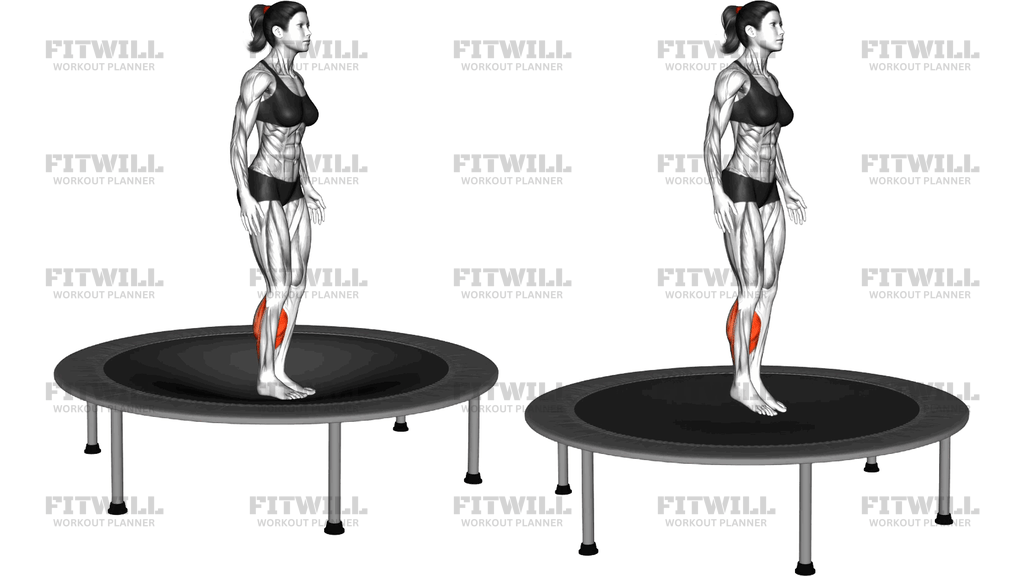
Instructions
- Step onto the center of the mini trampoline with feet about hip-width apart and stand tall with your arms relaxed at your sides.
- Shift your weight onto the balls of your feet so the heels hover just above or lightly touch the mat, and soften the knees a small amount.
- Brace your core lightly and pick a fixed point straight ahead at eye level to keep your balance on the springy surface.
- Press down through the toes and forefoot, extending the ankles to push into the elastic bed without bending the knees much.
- Let the bed rebound you upward a few centimeters, keeping the legs long and the movement driven purely from the ankle joint.
- Land back on the balls of your feet first, catching your weight quietly before the heels drop anywhere near the mat.
- Exhale on each press down and inhale during the brief airborne moment, keeping the breathing steady as the rhythm settles.
- Maintain a quick, light cadence rather than trying to bounce high; the rebound should feel continuous, not like separate effortful jumps.
- When the set ends, slow the bounces down over two or three contacts, let the heels settle onto the mat, and step off the side of the trampoline.
- Reset your stance at center before starting the next set, checking that your weight is back on the forefoot.
Tips & Tricks
- If you hear heavy slaps on the mat, you are landing flat-footed; catch each contact on the toes and let the calf absorb the landing.
- Keep the knees from bouncing up and down with the jumps. If the quads start doing the work, the calves stop being the driver, so think of the knees as slightly soft but still.
- Drifting toward the edge of the bed usually means your eyes are down. Fix your gaze on a spot at eye level and take two small bounces to walk yourself back to center.
- Keep the heels close to the mat rather than snapping them high. Lifting the heels aggressively turns this into an uncontrolled hop and loads the Achilles sharply at the bottom.
- Barefoot works well for foot strength, but if the mat surface is abrasive or your arches cramp, wear flat flexible shoes instead of cushioned running shoes.
- Start each session with slower, lower bounces for the first fifteen to twenty seconds so the calf tendon warms up before you pick up the cadence.
- If your ankles wobble side to side, narrow your focus rather than your stance. Wider feet usually make control worse on a rebounder, not better.
- Count contacts instead of watching the clock. A set of sixty light toe jumps gives you a consistent target that is easier to progress than time.
- Stop the set if you feel your calves tightening or cramping mid-bounce. Stretch them briefly and resume with a smaller range rather than grinding through.
Frequently Asked Questions
Which muscles does the Elastic Bed Toe Jump work?
The calves are the primary muscles, with the gastrocnemius doing most of the visible work and the soleus contributing underneath. The ankle stabilizers and the muscles of the foot arches also work continuously to keep you aligned on the springy surface.
Is the Elastic Bed Toe Jump suitable for beginners?
Yes, because the trampoline absorbs much of the landing impact, it is one of the more forgiving ways to train the calves. Beginners should start with short sets of twenty to thirty seconds and keep the bounce height very low while they learn the rhythm.
How high should I bounce on the Elastic Bed Toe Jump?
Only a few centimeters. The goal is a quick ankle-driven bounce, not a jump, so if you feel your knees and hips contributing to the lift, you are going higher than the exercise intends.
Should my heels touch the trampoline during the Elastic Bed Toe Jump?
The heels can brush or hover just above the mat, but they should not fully load at the bottom of each bounce. Keeping the weight on the forefoot is what keeps the tension on the calves.
Can I do the Elastic Bed Toe Jump if I have ankle or Achilles problems?
Be cautious. The rebounder reduces impact compared to a hard floor, but the Achilles and ankle still handle repeated loading, so it is wise to check with a healthcare professional or coach before adding it to your routine if you have a history of trouble in that area.
What is the most common mistake with the Elastic Bed Toe Jump?
Landing flat-footed with a heavy contact, which removes the work from the calves and sends shock through the knees. Fix it by deliberately catching every landing on the balls of the feet and keeping the contacts quiet.
Can I substitute the Elastic Bed Toe Jump with regular calf raises?
Calf raises train a similar musculature but lack the reactive, spring-like element and the ankle-stabilizing demand of the rebounder. A hard-floor version with a small hop at the top is the closest land-based substitute if no trampoline is available.
Why do I drift toward the edge of the trampoline during the Elastic Bed Toe Jump?
The bed tension varies near the springs, so any small lean gets amplified and pushes you off center. Keep your eyes level, stay tall, and use small, light bounces to steer yourself back to the middle rather than taking big corrective steps.
How long should a set of the Elastic Bed Toe Jump last?
Twenty to forty seconds per set is a good working range for most people, building toward longer durations as the calves adapt. Because the muscle works on every contact, longer sets become a conditioning challenge quickly.
Does the Elastic Bed Toe Jump count as cardio or strength work?
It can serve both roles depending on how you program it. Short, crisp sets with rest between them emphasize calf strength and ankle reactivity, while continuous longer bouts raise the heart rate and act as low-impact cardio.