Chinese Plank
The Chinese Plank is an isometric core hold performed between two flat benches. You position your upper back on one bench and your heels or calves on the other, leaving your hips, lower back, and entire torso suspended in mid-air. From there, you brace hard and hold your body in a straight, rigid line, fighting gravity the entire time. Because nothing supports your midsection, every second of the hold forces the abdominal wall, deep core, glutes, and spinal stabilizers to work together just to keep you level.
What makes this exercise distinct from a floor plank is the lack of contact under your hips and stomach. In a standard plank, the forearms and toes share the load and the rectus abdominis only has to resist extension. Here, the entire span between your shoulder blades and heels hangs unsupported, so your trunk has to act like a bridge. That makes the Chinese Plank one of the most demanding anterior core holds you can do with nothing but two benches and your body weight.
This hold is popular among strength athletes, especially powerlifters and strongman competitors, who use it to build the kind of bracing strength that transfers to heavy squats and deadlifts. It is also useful for anyone who has plateaued on regular planks and needs a harder progression without adding equipment like weighted plates. Because the position is static, it is easy to measure progress: when you can hold a clean, flat body position for a set time, you make the exercise harder by widening the gap between the benches or adding weight to your hips.
Setup matters more than anything in this movement. The two benches must be stable, level, and spaced so your body spans the gap with only your upper back and lower legs in contact. Too narrow a gap and the hold is easy; too wide and you lose position or strain your lower back. Your body should form one straight line from head to heels, with hips neither sagging toward the floor nor piked toward the ceiling.
Execution is simple but intense. Lie back so your shoulder blades rest on the first bench, place your heels on the second, and squeeze your glutes and abs before removing any assistance. Hold that rigid line while breathing shallowly and steadily, then step or lower down carefully when the set ends. Most people should start with short holds of 15 to 30 seconds rather than grinding out long, sloppy reps.
Safety-wise, the main risks come from a sagging lower back, unstable benches, or pushing a hold long after your position has broken down. If you feel the arch in your lower back or your hips start to drop, end the set. The exercise is demanding on the trunk, so treat it like a heavy lift: quality holds, full recovery between sets, and no ego timing.
[ Workout Log & Planner ]
Put your next workout in Fitwill
Keep your plan and training log ready when you are.


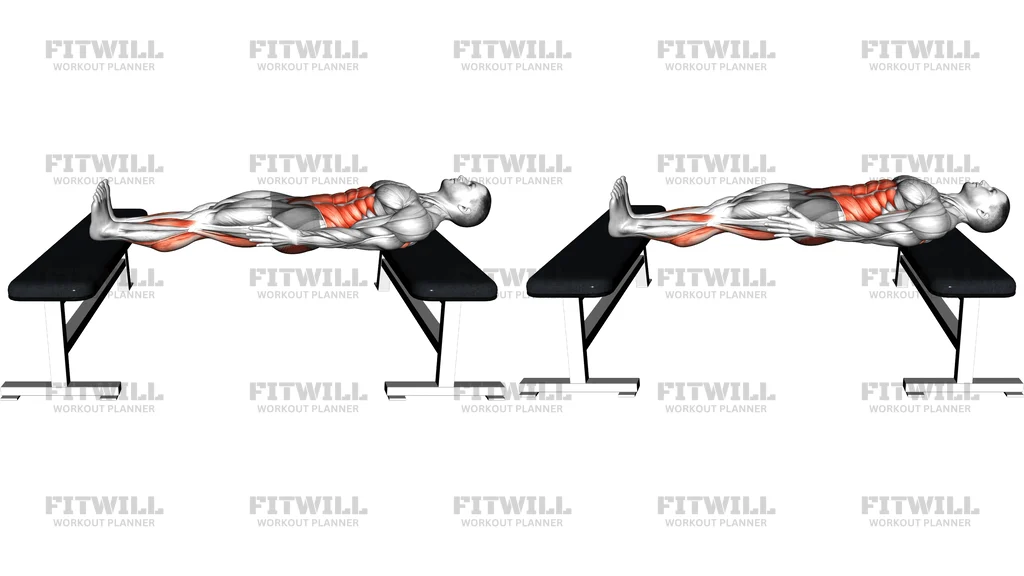
Instructions
- Place two flat benches parallel to each other, roughly one to two feet apart, and press on each one to confirm they will not slide or tip.
- Sit in the gap between the benches, then lie back so your upper back and shoulder blades rest flat on the first bench.
- Extend your legs and place your heels or lower calves on the second bench, leaving your hips, lower back, and torso fully suspended in the gap.
- Let your arms rest at your sides with palms down, or cross them over your chest if that helps you feel the brace.
- Before you settle, exhale slightly and brace your abs as if preparing for a punch, then squeeze your glutes to lock your pelvis in a neutral position.
- Hold a straight line from your head through your knees to your heels — no sagging hips and no piked waist — and keep your neck relaxed.
- Breathe in short, controlled breaths through the hold without letting your ribcage flare or your lower back arch.
- Keep your heels planted and your legs straight; if your hips begin to drop or your back starts to arch, end the hold.
- To finish, brace one more time, then carefully lower your hips to the floor between the benches or sit up onto the bench behind you before standing.
- Rest fully between holds and repeat for the planned number of sets, adjusting the gap between benches to match your strength.
Tips & Tricks
- The most common mistake is letting the hips sag into the gap, which shifts the load from the abs to the lower back. Film yourself from the side once to learn what a straight line actually looks like.
- Do not space the benches too far apart too soon. A wider gap increases the lever length on your trunk and can turn a core hold into a lower back strain.
- Squeeze your glutes deliberately at the start of every hold. If the glutes switch off, the pelvis tilts forward and the arch in your lower back follows within seconds.
- Keep the weight on your shoulder blades, not your neck or the back of your head. If your chin juts, reposition so the bench sits under your upper back.
- Time your holds honestly. A 20-second hold with a rigid, flat body is worth more than a 60-second hold where your hips drift and your back arches.
- When bodyweight holds become easy, have a partner place a light plate on your hips rather than stretching the benches farther apart. Weighted Chinese Planks build bracing strength without changing your leverage.
- Point your toes up or keep your feet neutral on the far bench — pushing through your heels helps keep the hamstrings and glutes engaged instead of letting the legs go slack.
- Do not hold your breath for the entire set. Short, rhythmic breaths behind a firm brace keep you stable far longer than a full Valsalva on a timed hold.
- If your hamstrings cramp, shorten the gap slightly or bend the knees a few degrees until your trunk strength catches up with the position.
Frequently Asked Questions
What muscles does the Chinese Plank work?
The primary work is done by the rectus abdominis and deep core, which hold your suspended trunk level. The glutes, hamstrings, and lower back stabilizers work hard to keep the pelvis neutral and the legs straight.
How is the Chinese Plank different from a regular plank?
A regular plank is supported at the forearms and toes, so your midsection never fully hangs. In the Chinese Plank, only your shoulder blades and heels touch the benches, which forces the abs and bracing muscles to support the entire unsupported span of your torso and hips.
Why are two benches used for the Chinese Plank?
The two-bench setup creates a gap under your hips and stomach, which is exactly what makes the hold hard. One bench cannot create that unsupported span, so two stable, level surfaces are needed for the position.
How far apart should the benches be for the Chinese Plank?
Start with roughly one to two feet of space so your body spans the gap with only your upper back and lower legs supported. As you get stronger, widening the gap makes the hold significantly harder.
Is the Chinese Plank safe for beginners?
It can be, but most beginners should master floor planks first and start with a narrow bench gap and short 15 to 20 second holds. If your lower back arches or your hips sag immediately, the position is too advanced for now.
How long should I hold the Chinese Plank?
Aim for sets of 15 to 45 seconds with a perfectly flat, rigid body line rather than chasing long, sloppy holds. End the set as soon as your hips drop or your lower back starts to arch.
Why do my lower back and hamstrings cramp during the Chinese Plank?
Cramping usually means the glutes are not doing their job, so the lower back and hamstrings take over to hold the pelvis. Squeeze the glutes harder at the start, shorten the gap slightly, and keep the knees fully straight.
What can I use instead of two benches for the Chinese Plank?
Any two stable, level, hip-height surfaces work, such as two plyo boxes or a bench paired with a sturdy box. Avoid soft or rolling surfaces, because a shift mid-hold drops your hips straight into the gap.
How do I make the Chinese Plank harder?
Widen the gap between the benches to lengthen the unsupported span, or have a partner place a light plate on your hips. Both options increase the demand on the abs without changing the movement itself.
Does the Chinese Plank help with squat and deadlift strength?
Many strength athletes use it because holding a rigid trunk under tension mimics the bracing demand of heavy compound lifts. It will not replace heavy squatting and pulling, but it is a useful accessory for building trunk stiffness.