Dumbbell Single Leg Calf Raise Off Step
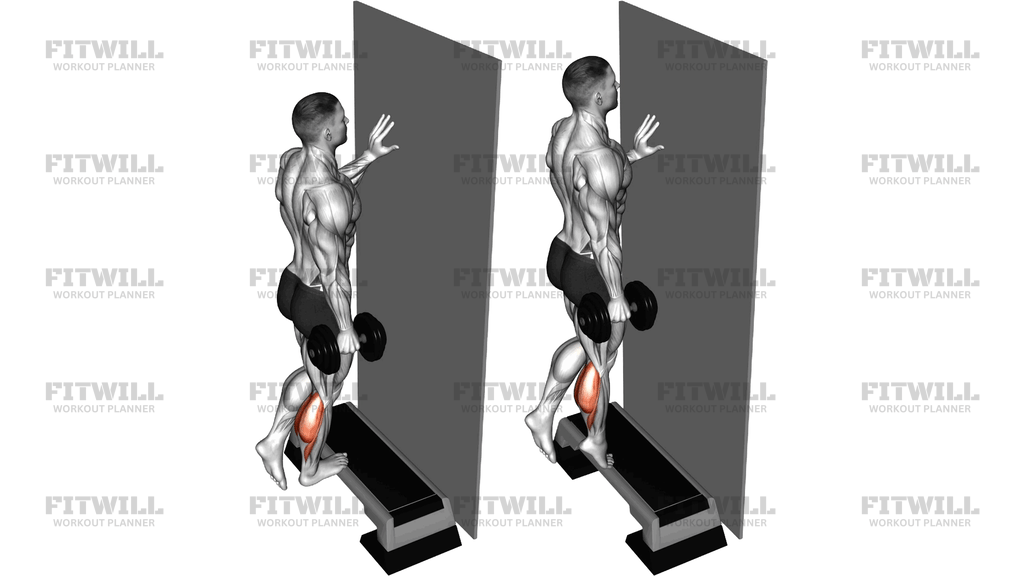
The Dumbbell Single Leg Calf Raise Off Step is a unilateral calf builder performed with the ball of one foot planted on a step platform, the heel hanging freely below the edge, and a dumbbell held in the same-side hand. The free hand rests against a wall for light balance support, and the non-working leg is tucked behind the working ankle. Because the heel can drop below the level of the step, you get a deeper stretch at the bottom and a fuller contraction at the top than you can achieve from flat ground.
This movement primarily targets the gastrocnemius, the visible two-headed muscle of the upper calf that fires hardest when the knee is straight. The soleus underneath contributes throughout, and the smaller stabilizers around the ankle work overtime to keep you balanced on one foot while holding load. That balance demand is part of the value: single-leg calf work exposes and corrects side-to-side differences in strength and ankle range of motion that two-legged versions can hide.
The setup matters more here than in most calf exercises. Standing on the edge of a step with weight in one hand changes your base of support and your center of mass, so the wall contact is not optional comfort — it is what lets you focus on calf effort instead of wobbling. Keep the wall touch light, though. If you lean on it or pull yourself up with the hand, you siphon load away from the calf you are trying to train.
Execution is simple but unforgiving. Lower the heel slowly toward the floor until you feel a genuine stretch along the back of the lower leg, then drive up through the ball of the foot as high as your ankle allows, pausing briefly at the top. The tempo should stay controlled in both directions; bouncing out of the stretch uses elastic recoil and robs the muscle of tension.
This exercise fits well for lifters who want bigger, more symmetrical calves, runners and jump athletes who need resilient single-leg ankle strength, and anyone whose left and right calves have drifted apart in size or capability. Start with a light dumbbell until your balance and ankle mobility are solid, and keep your repetitions deliberate rather than fast. If your calf cramps at full range — common in this stretched position — reduce the weight and slightly shorten the range for a few sessions before working back down.
[ Workout Log & Planner ]
Put your next workout in Fitwill
Keep your plan and training log ready when you are.


Instructions
- Place a stable step platform next to a wall and hold a dumbbell in your right hand, letting it hang at arm's length by your side.
- Position the ball of your right foot on the edge of the step so your heel can drop below the platform, and tuck your left foot behind your working ankle.
- Place your free left hand flat against the wall at roughly shoulder height for light balance support only, and stand tall with your shoulders back.
- Brace your core and keep your working knee straight but not locked, with your hips level and squared forward.
- Inhale and slowly lower your right heel toward the floor until you feel a firm stretch through the calf.
- Exhale and press up through the ball of your foot, rising as high as your ankle will let you, and squeeze the calf for a beat at the top.
- Lower under control to the stretched position without bouncing or dropping the heel.
- Complete all repetitions on the right side, then switch the dumbbell to your left hand, place your left foot on the step, and work the left calf.
- Rest, reset your balance against the wall, and begin the next set only when you are stable on the edge of the step.
Tips & Tricks
- Keep the wall hand as a light touch, not a crutch. If you feel your weight shifting into the palm, move your hand further away or drop the dumbbell weight.
- Hold the dumbbell on the same side as the working leg. Holding it on the opposite side changes your balance and can pull your hips out of line over the step.
- Do not let the knee bend as you fatigue. A bending knee shifts work from the gastrocnemius toward the soleus and changes the feel of the movement.
- Control the bottom two seconds of each rep. Many lifters bounce the heel off the stretch, which turns the exercise into a tendon bounce instead of muscle work.
- If your foot rolls outward at the top, spread your big toe against the step and think of pushing through the base of the big toe, not just the outer ball of the foot.
- Use a full but pain-free range: heel well below the step at the bottom, up onto the toes as high as possible at the top. Short, choppy reps at mid-range are a common fault here.
- Warm the calves up with bodyweight raises on the step first. The stretched position under load is where cramps tend to hit, especially in tight ankles.
- Keep your torso vertical and your hips stacked over the working foot. Leaning forward or twisting toward the wall reduces the stretch and the load on the calf.
- Match reps between sides, and start with your weaker leg so the stronger side does not set an inflated standard.
Frequently Asked Questions
Which muscles does the Dumbbell Single Leg Calf Raise Off Step work?
The gastrocnemius is the main mover, with the soleus assisting throughout. The ankle stabilizers also work hard to keep you balanced on one foot on the step edge while holding a dumbbell.
Why perform this exercise on a step instead of flat floor calf raises?
The step edge lets your heel drop below the level of your toes, giving a deeper calf stretch at the bottom and a higher rise at the top. That extended range is difficult to achieve from the floor.
Which hand should hold the dumbbell in the Dumbbell Single Leg Calf Raise Off Step?
Hold the dumbbell in the hand on the same side as the working leg, and use the opposite hand against the wall for balance. This keeps your center of mass directly over the working foot.
Can beginners do this exercise safely?
Yes, but beginners should start with just bodyweight to learn the balance on the step edge, then add a very light dumbbell. Keep the wall contact available and stop if balance breaks down.
How can I stop my calf from cramping during the Dumbbell Single Leg Calf Raise Off Step?
Cramping usually comes from the deep stretched position under load, especially when the calf is untrained in that range. Reduce the weight, shorten the range slightly for a week or two, and warm up with bodyweight reps before working back to full depth.
Should I use the wall to help push myself up during the raise?
No. The wall is for balance only. Pressing off it transfers effort away from the calf, so keep the contact light enough that you could lift your hand at any point in the rep.
What can I substitute if I do not have a step platform?
Any stable, low, raised surface such as a sturdy low box or a stair works, as long as it will not tip. A Smith machine with a small foot plate and a barbell or weight plate are common alternatives.
How many reps and sets should I do of the Dumbbell Single Leg Calf Raise Off Step?
Because each leg works alone and the range is long, moderate reps in the 10 to 15 range per side for 2 to 4 sets suit most lifters. Use a weight you can control through the full stretch and full rise without bouncing.
Is it a problem if my knee bends during the raise?
A slight bend creeps in as fatigue sets in, and it shifts emphasis toward the soleus. Keep the working knee essentially straight to keep the gastrocnemius as the primary driver.
Is it safe to do this exercise every day?
Daily training is unnecessary and can irritate the Achilles area, especially with the loaded stretch at the bottom of the step. Treat the calves like any other muscle and allow a day or more of recovery between hard sessions.