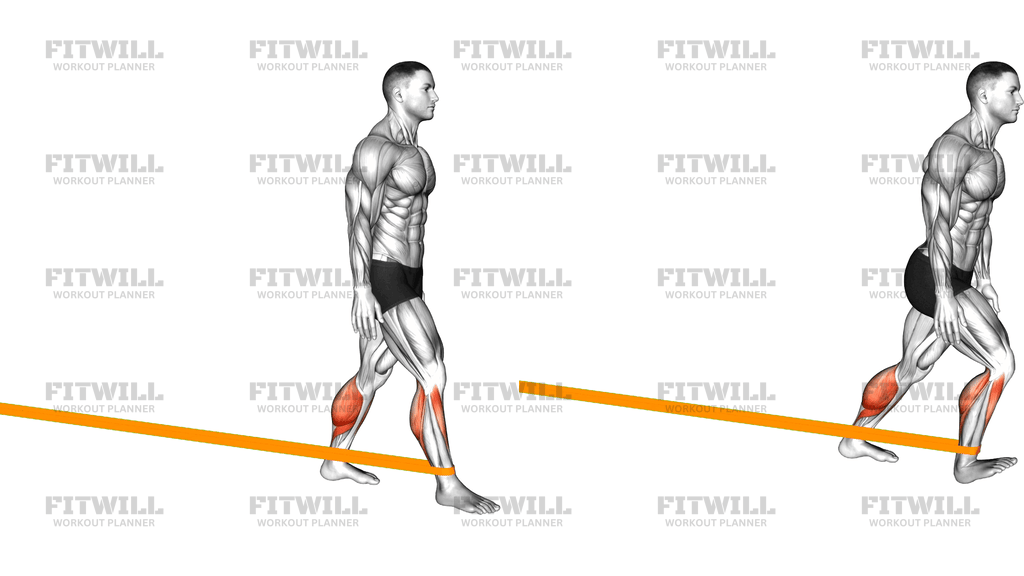
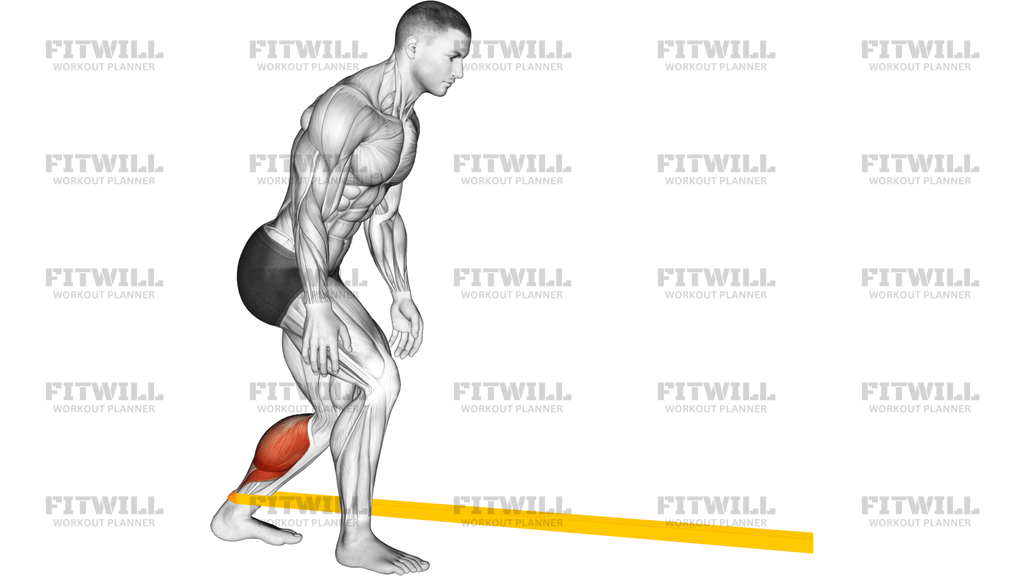
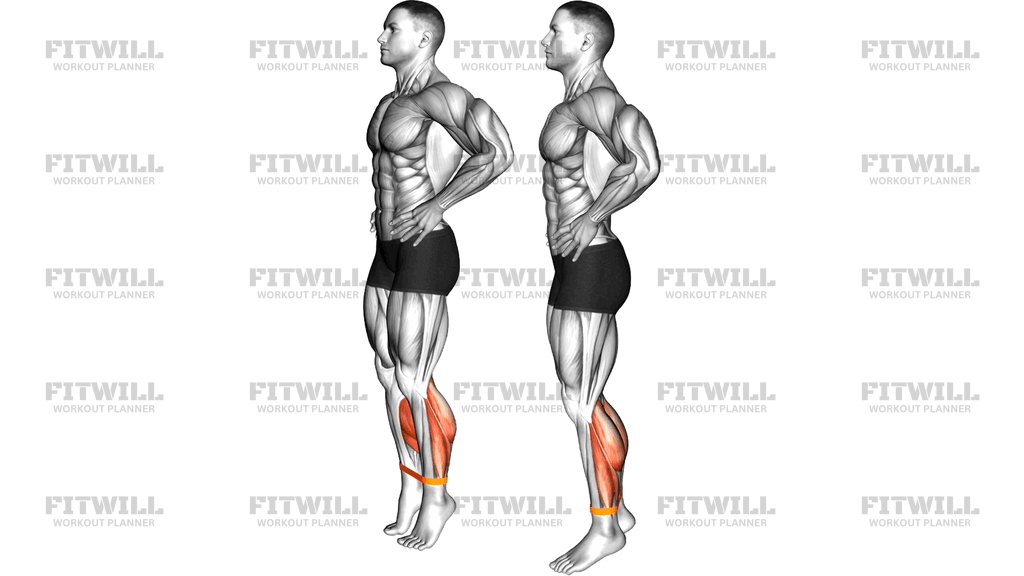
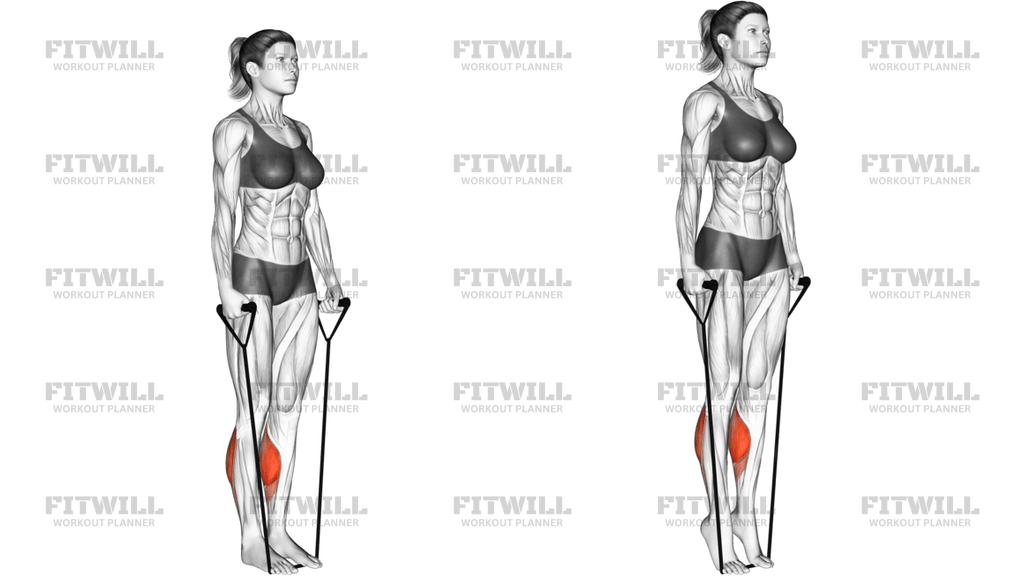
Resistance Band Calf Press Sitting On Chair
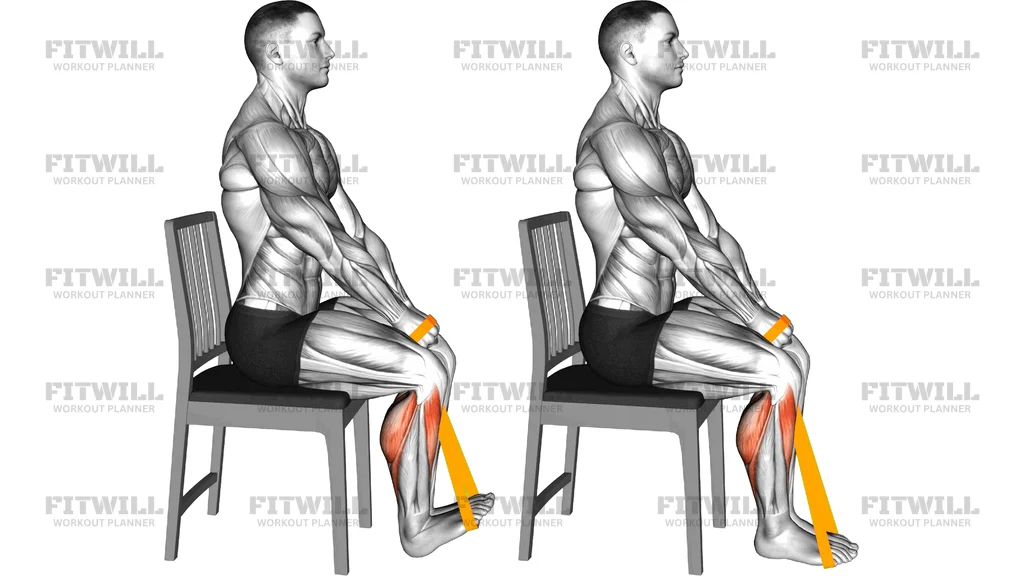
The Resistance Band Calf Press Sitting On Chair is a seated calf exercise where you loop a resistance band around the ball of your foot and press your toes away from your body against the band's pull. You sit upright on a chair with the band anchored in your hands near your thighs, which lets you adjust the tension on the fly simply by gripping more or less slack. It is one of the simplest ways to load plantar flexion without a machine, weights, or standing position.
Because the knee stays bent at roughly ninety degrees, this exercise places more demand on the soleus, the deeper calf muscle that sits beneath the gastrocnemius. The gastrocnemius still contributes, as the highlighted calf musculature in the movement shows, but the bent-knee position shortens it across the knee and shifts the workload downward. This makes the exercise a good complement to standing calf raises, which favor the gastrocnemius more heavily.
This is a particularly useful movement for beginners, older adults, and anyone rehabilitating or strengthening around the ankle joint. The band provides smooth, joint-friendly resistance that is easy on the Achilles tendon compared to heavy loaded presses, and the seated position removes any balance requirement. Office workers can even perform it at a desk during breaks, since all you need is a chair and a band.
Setup matters more than it might seem. The band should sit across the ball of the foot, not the middle of the foot or the toes, so the resistance acts at the correct point for ankle plantar flexion. Your hands hold the band ends near your knees with enough tension that the heel can drop below the toes at the start and the toes can press fully down at the finish. Too little tension robs you of the stretch at the top of the movement, while too much makes the end range hard to reach cleanly.
Execution is straightforward: keep your torso upright and still, press the ball of the foot down and forward so the ankle extends fully, pause briefly at the pointed position, then let the foot rise back up under control until the heel drops and you feel a stretch through the calf. The calf works through a fairly small joint range, so tempo and full range matter far more than speed here.
A common use case is higher-repetition calf training, ankle strengthening after long periods in a boot or cast, and adding calf volume without stressing the knees or lower back. Work within a range you can complete with a full stretch at the top and a full point at the bottom, and keep the movement smooth rather than bouncy to stay safe with the Achilles tendon.
[ Workout Log & Planner ]
Put your next workout in Fitwill
Keep your plan and training log ready when you are.


Instructions
- Sit upright on a sturdy chair with your feet flat on the floor and your knees bent about ninety degrees.
- Loop the resistance band around the ball of one foot, holding one end of the band in each hand near your knee or thigh so there is steady tension when your foot is flat.
- Sit tall with your back against the chair, shoulders relaxed, and brace your core lightly so your torso stays still throughout the set.
- Start with your foot flat and let the heel drop slightly toward the floor so the calf is on a gentle stretch.
- Press the ball of your foot down and away, extending your ankle fully until your toes point down and your calf is fully contracted.
- Pause for a second at the pointed position and squeeze the calf without letting the band slip off the foot.
- Slowly return your foot to the starting position, letting the heel rise and drop under the band's tension rather than letting it snap back.
- Exhale as you press the foot down, and inhale as you return to the start.
- Complete all repetitions on one leg, then reposition the band around the other foot and match the reps.
- After the set, release the band tension from your hands before sliding it off your foot.
Tips & Tricks
- The band should sit across the ball of the foot just behind the toes. If it rides onto the toes, the press becomes a toe scrunch instead of a true ankle extension.
- A common mistake is pressing so far down that the heel lifts off the floor and the whole leg pushes forward. Keep your heel tracking in place and let only the ankle move.
- If you feel the band biting into your foot, wear a shoe or place a small towel between the band and the sole for comfort.
- Use your grip to fine-tune resistance mid-set. Choking up on the band makes the press harder; letting slack out makes it easier without stopping the exercise.
- Avoid fast, bouncy reps. The Achilles tendon stores and releases energy easily, so bouncing lets momentum do the work the calf should be doing.
- Pause for a full second at the pointed position. Many people cut the end range short, which is exactly where the soleus does its best work in this seated position.
- Do not let your torso lean forward or rock with each press. If your upper body is moving, the resistance or range is too demanding for your current control.
- The stretch at the top, where the heel drops below the toes, is just as valuable as the press. Lower the foot slowly through that portion instead of dumping it.
- If one calf is noticeably weaker, always start with the weaker side and match the reps with the stronger side rather than the other way around.
Frequently Asked Questions
Which muscles does the Resistance Band Calf Press Sitting On Chair work?
It primarily targets the calves, with the bent-knee seated position placing extra emphasis on the soleus while the gastrocnemius assists. The small muscles that stabilize the ankle joint also work throughout the press.
Why is the exercise done with a bent knee instead of standing?
The gastrocnemius crosses the knee joint, so bending the knee to about ninety degrees reduces its contribution and shifts more load to the soleus. This makes it a good partner to standing calf raises, which hit the gastrocnemius harder.
Where exactly should the resistance band sit on my foot?
Loop it across the ball of the foot, just behind the toes. Placing it on the arch or the toes changes the leverage and makes the movement less effective or uncomfortable.
How do I make the Resistance Band Calf Press Sitting On Chair harder?
Shorten the band between your hands and your foot to increase tension, use a thicker band, or slow down the lowering phase and add pauses at the pointed position. You can also press one foot while the other leg rests, keeping all the focus on a single calf.
Is this a good exercise for beginners?
Yes. The chair removes any balance demand and the band resistance is easy to adjust, so beginners can learn full ankle range of motion with light load before progressing to standing raises or machine calf presses.
Can I do this exercise at a desk or while traveling?
Absolutely. Any stable chair and a light loop or flat band are enough. It is a discreet movement that fits well into workday breaks or hotel room training.
How many repetitions should I perform?
Because the resistance is light to moderate, sets of 15 to 25 controlled reps per side work well. Focus on a full stretch at the top and a full point at the bottom rather than chasing heavy tension.
What is the most common mistake with this exercise?
Rushing the reps and bouncing at the bottom, which shifts the work onto the Achilles tendon's rebound instead of the muscle. Another frequent error is letting the band slide toward the toes, which shortens the effective range.
Is it safe if I have ankle or Achilles discomfort?
The band provides gentle, adjustable loading, which many people tolerate well, but you should reduce the range and tension to stay within comfortable limits and consult a healthcare professional if discomfort persists or worsens.