Resistance Band Lying Leg Press
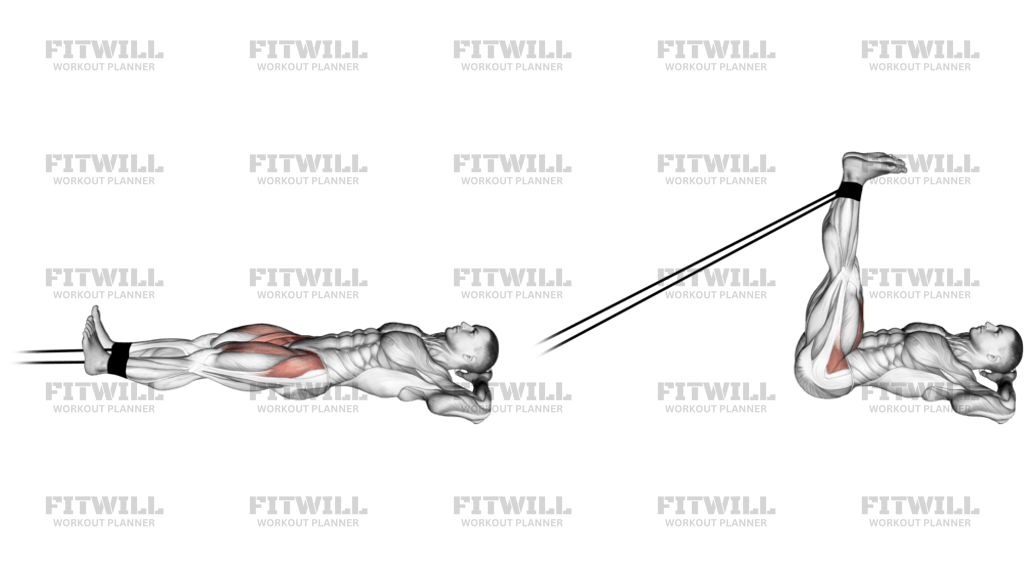
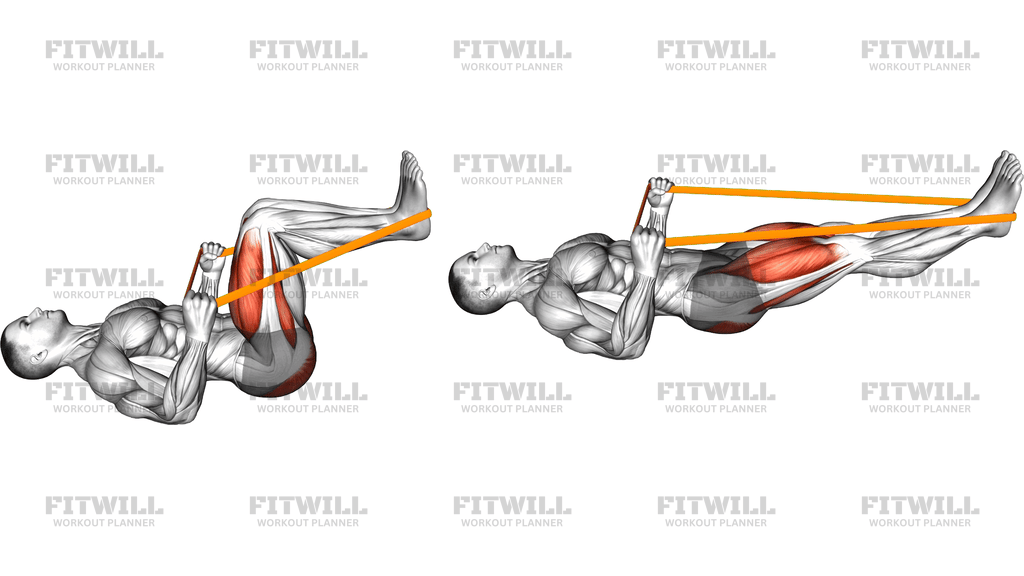
The Resistance Band Lying Leg Press is a floor-based exercise that recreates the leg press pattern using nothing but a resistance band and your own body. You lie on your back, hook the band around both feet, and hold the ends of the band at your upper chest. From there, you press your feet away until your legs are straight, then bend your knees back down under control. The band supplies the resistance, and your hands act as the anchor point that a leg press machine's platform would normally provide.
This movement is especially useful for people who train at home, travel often, or want a joint-friendly leg exercise without loading the spine the way a barbell squat does. Because you are lying down, your lower back stays supported by the floor, and the band's tension is smooth rather than gravity-dependent, so the resistance stays consistent through the whole range. It is also a practical option for beginners learning the knee extension and hip drive pattern before moving to a machine or free-weight leg press.
The primary work comes from the quadriceps, which straighten the knees as you press out. Your glutes and hamstrings help drive the hips and control the knee bend on the way back, while the calves assist at the ankle. Holding the band in place also asks your arms and trunk to stay braced, so there is a small stabilizing demand through the core even though the legs do the real work.
Setup matters more than it might seem. The band must be secured firmly across the sole of each foot, and the slack needs to be removed before you begin pressing, otherwise the first portion of the rep does nothing. Your hands should stay pinned near your upper chest or shoulders throughout the set. If your hands drift forward as your legs press out, the band loosens and the tension on your legs drops off.
To execute the press well, pull your knees toward your chest, keep your heels planted against the band, and drive your feet away until your legs are nearly straight. Stop just short of locking the knees hard, then bend the knees slowly back down, keeping tension on the band the entire time. The return is where many people lose the exercise, so treat the lowering phase as real work rather than a rest.
Use this exercise as a main leg movement in a home workout, as a warm-up or burnout finisher alongside heavier lifts, or as a rehab-friendly option when you want leg pressing mechanics with light, adjustable load. Choose a band thickness that lets you complete your target reps with two or three left in the tank, and progress by using a stronger band or slowing the tempo.
[ Workout Log & Planner ]
Put your next workout in Fitwill
Keep your plan and training log ready when you are.


Instructions
- Lie on your back on an exercise mat with your head and shoulder blades resting on the floor.
- Loop the resistance band around the sole of both feet so it sits securely across the arch, then hold one end of the band in each hand.
- Bend your knees toward your chest and press your hands down to your upper chest so the band is taut with no slack before the first rep.
- Brace your abdominal muscles and keep your lower back in contact with the floor.
- Press your feet up and away from you, extending the hips and knees together as the band stretches over your toes.
- Finish the press with your legs nearly straight, heels pushed into the band, but without snapping the knees into a hard lock.
- Pause briefly at full extension, then bend your knees slowly and lower them back toward your chest, keeping the band tight the whole way.
- Exhale as you press your feet out and inhale as you return your knees to the start position.
- Keep your hands anchored at chest height and your elbows fairly still for the entire set; do not let them creep forward as your legs extend.
- Complete your reps, then bend both knees fully before sliding the band off your feet to release it safely.
Tips & Tricks
- If the band slips off your heels, reposition it so it crosses the sole of the foot closer to the arch rather than the toes, and keep your feet flexed throughout the press.
- The most common fault is letting the hands drift up and forward as the legs extend, which steals tension from the quads; pin your hands against your chest like you were holding them there.
- Take up all band slack before the first rep by pre-bending the knees fully, or your first several reps will feel like nothing is happening.
- Avoid straightening the legs so hard that the knees snap into full lock; stopping just short keeps continuous tension and protects the joint.
- If your lower back arches or lifts off the floor as you bring the knees down, shorten the range slightly and control the return more slowly.
- A band that is too light makes the top of the rep feel empty and a band that is too heavy pulls your shoulders off the floor; adjust the thickness before changing anything else.
- Push through the whole foot, keeping the heels in contact with the band, rather than letting the toes take over at the top of the press.
- Tempo is your easiest progression at home: a three-second return with the same band will load the quads noticeably more than rushing reps.
- Keep your head resting on the mat instead of lifting it to watch your legs, which helps keep the neck relaxed and the trunk braced.
Frequently Asked Questions
Which muscles does the Resistance Band Lying Leg Press work?
The quadriceps on the front of the thigh do most of the work as you extend the knees. The glutes and hamstrings assist the hip drive and control the return, and the calves help at the ankle.
How does the Resistance Band Lying Leg Press differ from a machine leg press?
Instead of pushing against a weighted platform, you press against the tension of a band anchored in your own hands. The load is lighter and more adjustable, and lying on the floor keeps your back supported without a machine.
Is the Resistance Band Lying Leg Press good for beginners?
Yes, it is one of the friendliest ways to learn the leg press pattern. Start with a light band, keep the range comfortable, and focus on pressing evenly with both legs before progressing.
Why do I need to hold the band at my chest instead of letting my arms move?
Your hands are the anchor for the entire exercise. If they drift forward as your legs press out, the band loosens and your legs stop working against meaningful resistance.
Should my knees lock out at the top of the Resistance Band Lying Leg Press?
Extend fully but stop just short of a hard, snapped-out lock. Full extension trains the quads completely while keeping steady tension and avoiding unnecessary stress on the knee joint.
How do I make the Resistance Band Lying Leg Press harder?
Use a thicker band, slow down the lowering phase to three or four seconds, add a pause at full extension, or move to a single-leg version where one foot presses at a time.
The band keeps sliding off my feet during the press. What should I fix?
Place the band across the sole of each foot near the arch and keep your toes pulled back toward your shins so the heels stay covered. Also check that you are not creating slack by letting your hands drift.
Can I do the Resistance Band Lying Leg Press if squats bother my knees?
Many people find the lying band version more comfortable because the resistance is smooth, the back is fully supported, and the load is easy to scale down. Keep the range pain-free and stop if the knee feels sharp or unstable.
What can I use if I do not have a long resistance band?
A shorter loop band stretched across both feet and held in the hands can work for lighter sets, or you can substitute Resistance Band Squats or glute bridges to train the legs with whatever band you have.
How should I breathe during the Resistance Band Lying Leg Press?
Exhale as you press your feet out to extension and inhale as you bend the knees back down. Keep the breathing steady rather than holding your breath through the rep.