Resistance Band Assisted Single Arm Pull Up
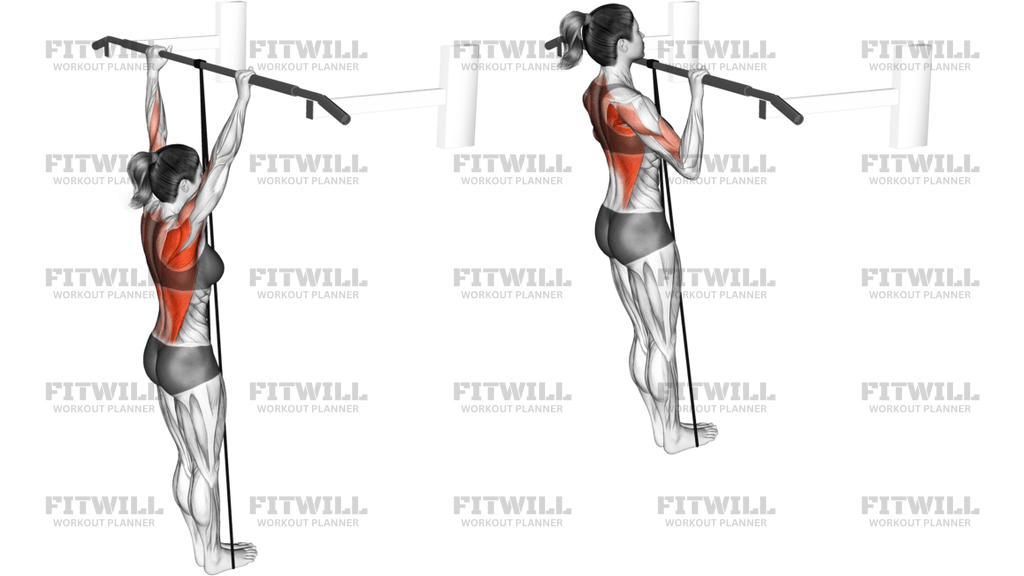
The Resistance Band Assisted Single Arm Pull Up is a progression exercise that lets you train the one-arm pull-up pattern while a band supplies part of the lifting force. You loop a resistance band over the pull-up bar, place one foot in the band, hang from the bar with a single overhand or neutral grip, and pull your chin above the bar while the free arm stays at your side. The band reduces the load on the working arm, which makes an otherwise elite-level movement accessible in measurable steps.
This exercise is aimed at intermediate to advanced lifters who already own solid two-arm pull-ups and want to build toward a full one-arm pull-up, as well as anyone dealing with a strength imbalance between sides. Because only one arm pulls, each rep exposes how much work your weaker side has been hiding during bilateral sets. The band's assistance can be scaled simply by choosing a lighter or heavier band, so you can reduce assistance gradually as your pulling strength grows.
The main demands land on the lats, which drive the arm down and back toward the torso, with strong support from the biceps, forearm flexors, and grip. Your mid-back muscles, including the rhomboids and mid-traps, work to keep the shoulder blade stable against the ribcage, and the core fights the rotation that naturally tries to twist your body as you pull from one side. The hanging leg position also challenges hip and trunk control more than most people expect.
Setup quality determines whether this exercise builds strength or just produces sloppy reps. The band should hang vertically from the bar under your working side, and your foot should sit securely in it so the assistance stays consistent from bottom to top. A wider grip, such as a neutral grip on parallel handles, shortens the lever slightly and is friendlier to the shoulder than a very narrow one-arm position. Keep the free arm relaxed at your side rather than grabbing the bar or band with it, since that defeats the purpose of single-arm work.
Execute the rep by starting from a full hang with the shoulder drawn slightly down away from the ear, then pull your elbow down toward your ribs until your chin clears the bar. Lower yourself under control rather than dropping, because the lowering phase is where much of the single-arm strength is actually built. Common use cases include one-arm pull-up progressions, correcting left-right imbalances, and adding volume to pulling muscles without needing a second arm to contribute.
For safety, test the band's rating before trusting it with your body weight, inspect it for wear, and make sure your foot cannot slip out at the top of the movement. If you cannot complete at least a few controlled reps with a chosen band, move to a thicker one rather than grinding through twisted, partial reps.
[ Workout Log & Planner ]
Put your next workout in Fitwill
Keep your plan and training log ready when you are.


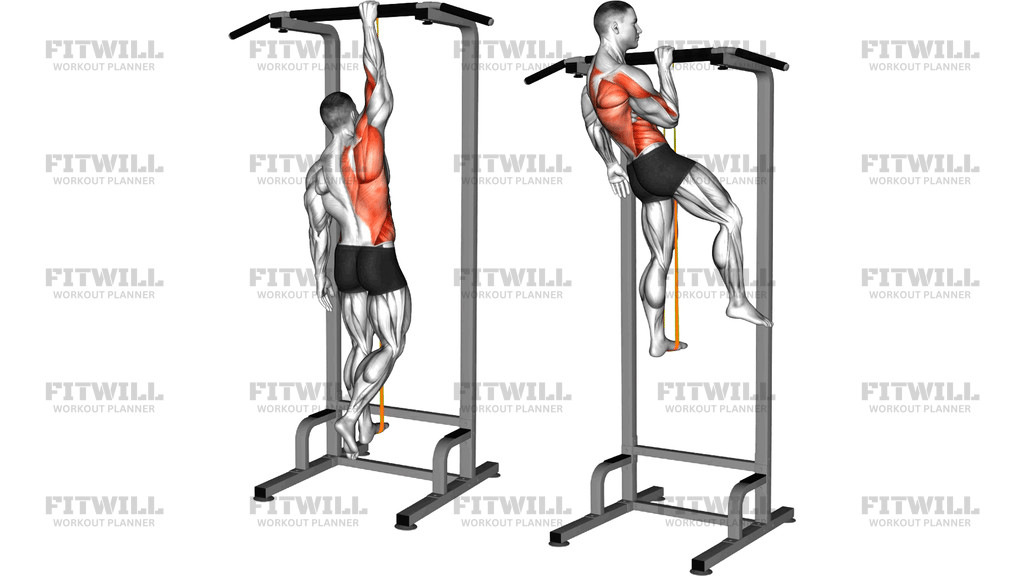
Instructions
- Loop a resistance band over the center of the pull-up bar and let both ends hang down, or hook one end over the bar so a single loop hangs below it.
- Grip the bar with one hand using an overhand or neutral grip, roughly shoulder-width or slightly wider, then place the foot on your working side securely into the hanging band so it supports that leg.
- Hang with the free arm relaxed at your side and both feet clear of the floor, letting the band take a portion of your body weight.
- Pull the working shoulder down away from your ear and brace your abdominal muscles to stop your torso from twisting toward the pulling side.
- Pull your elbow down toward your ribs and drive yourself upward until your chin rises above the bar, keeping the free arm from grabbing anything for help.
- Pause briefly at the top with your chin over the bar and your shoulder blade pulled down and in.
- Lower yourself slowly over two to three seconds until the working arm reaches a full hang again, resisting the descent instead of dropping into the band.
- Exhale as you pull up and inhale on the way down, keeping your breathing steady rather than holding your breath through the rep.
- Complete all reps on one side, then switch hands and place the opposite foot in the band so both sides get the same assistance.
- Step out of the band carefully while still holding the bar, then release one hand at a time to dismount.
Tips & Tricks
- If your torso rotates toward the pulling arm at the top, the band is too strong for your single-arm strength or your core is switching off—brace harder first, and if twisting persists, move to a thicker band.
- Choose a band tension that leaves you able to do five to eight controlled reps; if you are grinding out single twisted reps, the assistance is too low for productive practice.
- Do not let the working shoulder shrug up to your ear at the bottom of the hang—start each rep by actively pulling the shoulder blade down before the elbow bends.
- Keep the free hand open and away from the bar; touching the bar or band with the free arm turns the exercise into an assisted two-arm pull-up and hides the imbalance you are trying to expose.
- Control the lowering phase deliberately—slow negatives from a single-arm position are one of the most effective parts of one-arm pull-up training, so never dump into the stretch at the bottom.
- Check the band's contact point on your foot at the bottom of every set; a band sitting near your toes can slip at the top of the rep, so seat it across the midfoot.
- Match assistance exactly between sides by using the same band, the same foot, and the same grip width—otherwise your left-to-right comparison is meaningless.
- If your grip fails before your back does, use chalk or a bar with a neutral handle rather than cutting the set short; grip is often the limiting factor in single-arm hanging work.
- Rest plenty between sides—two to three minutes—since one-arm pulling fatigues the nervous system and grip far more than the rep count suggests.
Frequently Asked Questions
Which muscles does the Resistance Band Assisted Single Arm Pull Up work?
The lats do most of the pulling, supported heavily by the biceps, forearms, and grip. The rhomboids and mid-traps stabilize the shoulder blade, and the core works to keep your trunk from rotating as one side pulls.
Can beginners do the Resistance Band Assisted Single Arm Pull Up?
It is best treated as an intermediate progression. Beginners should first build several strict two-arm pull-ups and single-arm hangs, then start with a very thick band that removes a large share of their body weight.
How much assistance does the band provide in the Resistance Band Assisted Single Arm Pull Up?
It depends on the band's thickness and how far it stretches—at the bottom of the hang it assists the most, and the help decreases as you approach the bar. Stacking or switching bands lets you dial the load up or down in small increments.
Should my foot go in the band on the same side as my pulling arm?
Yes, placing the band foot on the working side keeps the assistance aligned under your pulling arm and produces a straighter, more stable pull. Putting the opposite foot in the band shifts the load unevenly and makes the reps harder to control.
Why does my body twist during the Resistance Band Assisted Single Arm Pull Up?
One-side pulling naturally rotates the torso, and a loose core or an overreliance on the biceps makes it worse. Brace your abdominals, pull the elbow down toward the ribs instead of straight up, and reduce the weight by using a stronger band if twisting persists.
What can I use instead of a resistance band for single-arm pull-up assistance?
An assisted pull-up machine with a single-hand grip, self-assistance from the free leg pushing off a platform, or slow single-arm negative pull-ups stepping off a box all work. Each changes the assistance profile slightly, so treat them as complementary progressions rather than identical swaps.
Overhand or neutral grip for the Resistance Band Assisted Single Arm Pull Up?
A neutral grip on parallel handles is usually the most shoulder-friendly starting point because it aligns the upper arm better in a single-arm position. Move to an overhand grip once your single-arm strength and shoulder comfort are established.
How do I progress the Resistance Band Assisted Single Arm Pull Up over time?
Gradually move to lighter bands as reps become easy, then add slow lowering phases and partial single-arm reps at the end of sets. The long-term goal is reducing assistance until a band-less single-arm rep becomes realistic.
Is it safe to trust a resistance band with my full body weight?
Only if the band is rated for body weight training and shows no cracks, thinning, or worn spots. Inspect it before each session, anchor it securely over the bar, and keep your foot fully seated so it cannot slip out mid-rep.