Bodyweight Single Leg Deadlift Hold
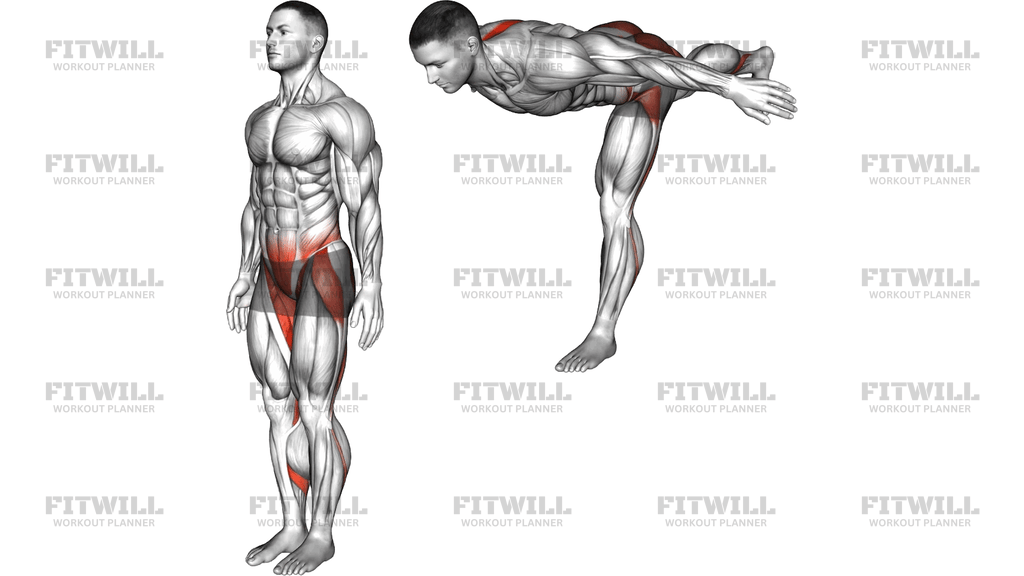
The Bodyweight Single Leg Deadlift Hold is an isometric balance and hip-hinge exercise performed on one leg. From a standing position, you hinge forward at the hips while one leg lifts and extends behind you, arms reaching out, and you hold that T-shaped position with your torso and rear leg forming roughly one long line. Because there is no load and no repetition, the entire challenge comes from controlling the position: the standing hip, knee, and ankle must stay steady while the back of the body works isometrically to keep you from collapsing or tipping over.
This movement is especially useful for anyone who wants to build single-leg stability without equipment. Runners, cyclists, and field-sport athletes rely heavily on the ability to control one hip at a time, and this hold trains exactly that. It is also a common assessment and teaching tool: if you wobble, twist, or lose your back position within a few seconds, it usually points to weak glute activation, poor ankle stability, or an under-braced core that will show up in your loaded deadlifts, lunges, and single-leg work.
The primary muscles working are the glutes and hamstrings of the standing leg, which hold the hip extended and the torso hinged. The glute of the lifted leg works to keep that leg up and in line with the torso, while the lower back and deep core stabilize the spine against rotation. Smaller muscles around the standing ankle and foot are constantly adjusting to keep your balance, which is why this exercise feels far harder than it looks despite using only your body weight.
Setup matters more here than in most exercises because there is no external load to mask position errors. Your standing foot should be planted with weight spread across the whole foot, your hips squared forward, and your soft knee slightly bent rather than locked. If your hips rotate open or your standing knee caves inward, the hold loses its training effect on the intended muscles and starts stressing the knee and lower back instead.
To execute it well, hinge at the hips rather than bending at the waist, letting the chest travel forward and down as the rear leg swings up and back. Reach your arms out in front or along your sides to help you find the long, level line from head to heel. Hold for a set number of breaths, keeping the hips as level as possible, then return to standing with control before switching sides.
Because it requires no equipment and minimal space, the Bodyweight Single Leg Deadlift Hold fits easily into warm-ups, balance-focused sessions, or recovery days. Start with short holds of ten to twenty seconds per side, and only extend the duration once you can hold each rep without your hips twisting or your standing foot wandering.
A few practical safety points: keep a slight bend in the standing knee instead of forcing a deep stretch at the back of the leg, and stay near a wall or sturdy object when first practicing so you can touch it for balance if needed. Stop the set when your form starts to drift — wobbling through a long hold trains poor positions, not stability.
[ Workout Log & Planner ]
Put your next workout in Fitwill
Keep your plan and training log ready when you are.


Instructions
- Stand tall on one leg with your weight spread evenly across the whole foot, and lift the other foot an inch or two off the floor behind you.
- Soften the standing knee to a slight bend and grip the floor gently with your toes to wake up the ankle stabilizers.
- Brace your core and pull your hips square so both hip points face forward before you start the hinge.
- Push your hips back and let your chest travel forward and down toward the floor, keeping your back flat rather than rounded.
- Allow the free leg to rise behind you until your torso and rear leg form one long line, and reach your arms out for balance.
- Hold the position for a set number of breaths, keeping the hips level and resisting any twist in the lower back.
- Keep your eyes on a fixed point on the floor about a meter ahead of you to steady your balance throughout the hold.
- Breathe steadily through the hold — inhale through the nose, exhale slowly without letting the ribs flare or the core soften.
- To finish, drive the standing hip forward and return to a tall stand with control, then reset your stance before switching legs.
Tips & Tricks
- If your hips rotate open toward the lifted leg, place a hand on a wall and consciously turn your hip points back toward the floor — rotation is the most common fault in this hold.
- A rounded back usually means you are hinging farther than your hamstrings allow; shorten the range to a modest forward lean and build up over weeks.
- Do not lock the standing knee. A locked knee shuts off the quad and makes the ankle work harder to correct wobble, which shows up as shaking within seconds.
- Point the toes of the lifted leg down and reach back through the heel — this keeps the rear leg active instead of letting it sag and pull your lower back into extension.
- If you cannot stop wobbling, shorten the lever by bending the lifted knee and drawing the foot closer to your torso, then extend it as control improves.
- Practice barefoot or in flat shoes when possible; thick cushioned soles make ankle corrections slower and the hold less precise.
- Time your holds rather than guessing. When your hips start to twist or the standing foot drifts, that is the end of the set, even if the clock says otherwise.
- Film yourself from the side once in a while. From your own view the position often feels level, but a side view will show whether your back and rear leg truly form one line.
- Do this early in a workout as activation, not at the end when you are fatigued — balance errors multiply once you are tired, and fatigue holds reinforce bad positions.
Frequently Asked Questions
Which muscles does the Bodyweight Single Leg Deadlift Hold work the most?
The glutes and hamstrings of the standing leg do the main work of holding the hinged position, while the glute of the lifted leg keeps that leg extended. Your lower back, core, and the small stabilizing muscles around the standing ankle handle the balance demands.
Is the Bodyweight Single Leg Deadlift Hold good for beginners?
Yes, and it is one of the better starting points for single-leg training because there is no load to manage. Beginners should hold near a wall for light support and start with ten to fifteen seconds per side.
How long should I hold the Bodyweight Single Leg Deadlift Hold?
Start with two or three holds of ten to twenty seconds per side. Once you can hold thirty seconds without your hips twisting or your standing foot wandering, progress by adding a light load or moving to full single-leg deadlift reps.
Why do I wobble so much during the Bodyweight Single Leg Deadlift Hold?
Wobbling usually comes from a locked standing knee, unbraced core, or hips that have rotated open. Soften the knee, brace your midsection, and fix your eyes on one spot on the floor — these three adjustments resolve most balance problems.
Should my back stay flat during the hold?
Yes. Your back should stay long and neutral from head to hip, with the hinge coming from the hips rather than the spine. If you feel your lower back rounding or arching hard, reduce how far you lean forward.
What can I use instead of the Bodyweight Single Leg Deadlift Hold?
Good substitutes include the single-leg glute bridge, standing cable or banded single-leg reach, or a supported single-leg Romanian deadlift with one hand on a rack. Each trains one-sided hip stability with a different balance requirement.
Can I do the Bodyweight Single Leg Deadlift Hold every day?
Because it is low-load isometric work, it can be done most days as part of a warm-up or standalone balance practice. Just keep total hold time modest and stop if the standing ankle or hip feels irritated rather than challenged.
How far forward should my torso lean in the Bodyweight Single Leg Deadlift Hold?
Aim for a torso position close to parallel with the floor, with the rear leg extended so head, hips, and heel form one line. If you cannot get there with a flat back, work at a forty-five-degree lean and progress gradually.
Is it safe for my lower back?
When performed with a braced core and a neutral spine, the hold is generally well tolerated and actually teaches you to control your back position. Avoid letting the lumbar spine round or over-arch, and keep holds short enough that you can quit with clean form.