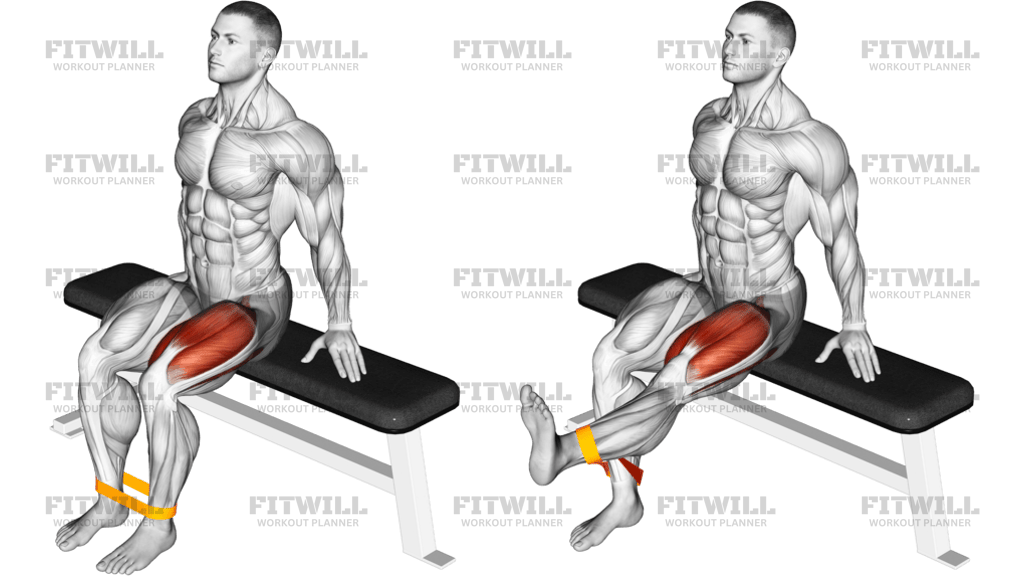
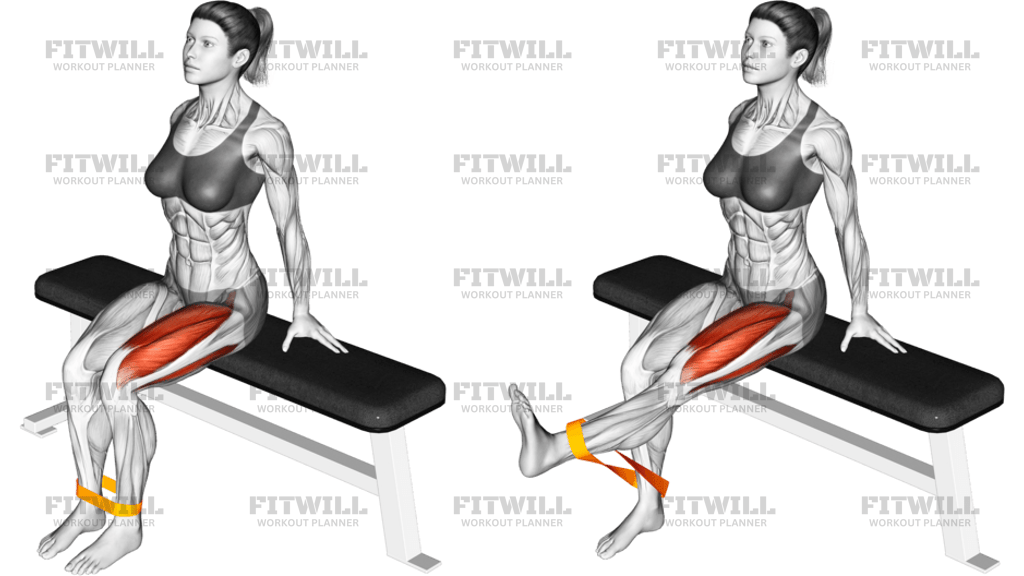
Resistance Band Seated Single Leg Knee Extension
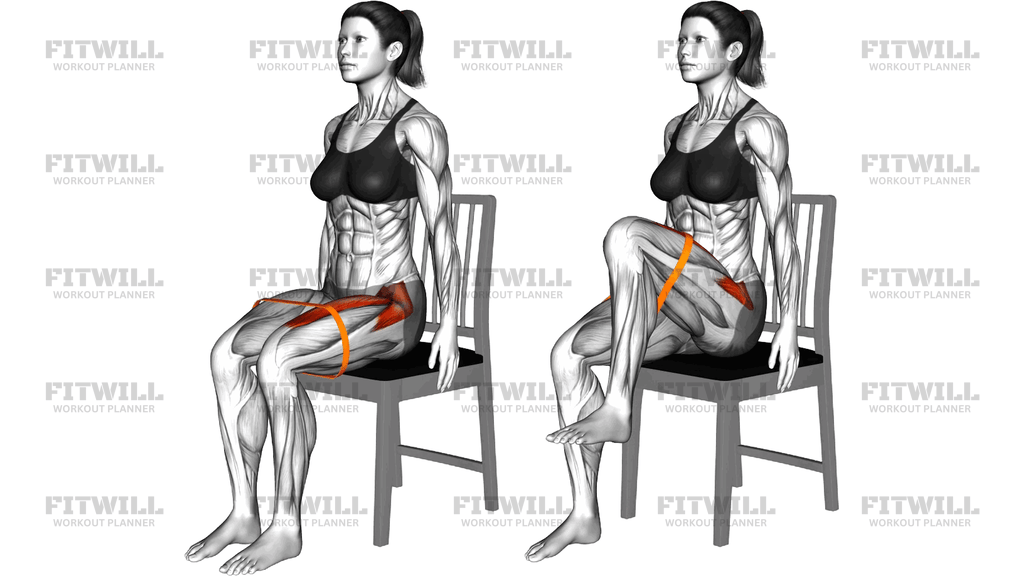
The Resistance Band Seated Single Leg Knee Extension is a simple, joint-friendly quad exercise performed from a chair or bench. A loop of resistance band is placed around the forefoot of your working leg, with the opposite end secured under your other foot, which stays planted on the floor. You then straighten the working knee against the band's pull, extending the leg forward and up until it is roughly level with your hip, before lowering it back down under control.
Because the resistance comes from an elastic band rather than a weight machine, the tension is gentle at the start of the rep and builds as the leg straightens. This makes the movement particularly well suited to people rehabbing a knee, older adults who want to maintain leg strength without loading the joint, or anyone training at home who has no access to a leg extension machine. It is also a useful accessory for lifters who want extra quad volume with minimal fatigue.
The primary muscle at work is the quadriceps on the front of the thigh, which extends the knee against the band. The anchored foot and your seated position also demand a degree of stability: your trunk stays upright, your hips stay square, and the supporting leg keeps the band anchored so it cannot slip. Unlike two-legged leg extensions, training one side at a time lets you notice and correct any left-to-right strength difference.
Setup matters more than it might seem. The band must sit securely across the forefoot of the moving leg and stay pinned firmly under the stationary foot, because a band that slips mid-rep can snap the foot forward unexpectedly. Sit tall on the front half of the chair with your hands resting on your hips or the seat, so your torso does not slouch as you push. The further you shorten the band, the harder the extension becomes, so adjust slack before your first rep.
Execution should be smooth and deliberate: extend the knee fully, pause briefly at the top where the band tension peaks, then resist the band on the way down instead of letting the leg snap back. Two to three sets of 10 to 15 slow reps per leg is a practical starting point. Stop the set if the band begins to slide, or if you feel pinching at the kneecap rather than muscular effort.
[ Workout Log & Planner ]
Put your next workout in Fitwill
Keep your plan and training log ready when you are.


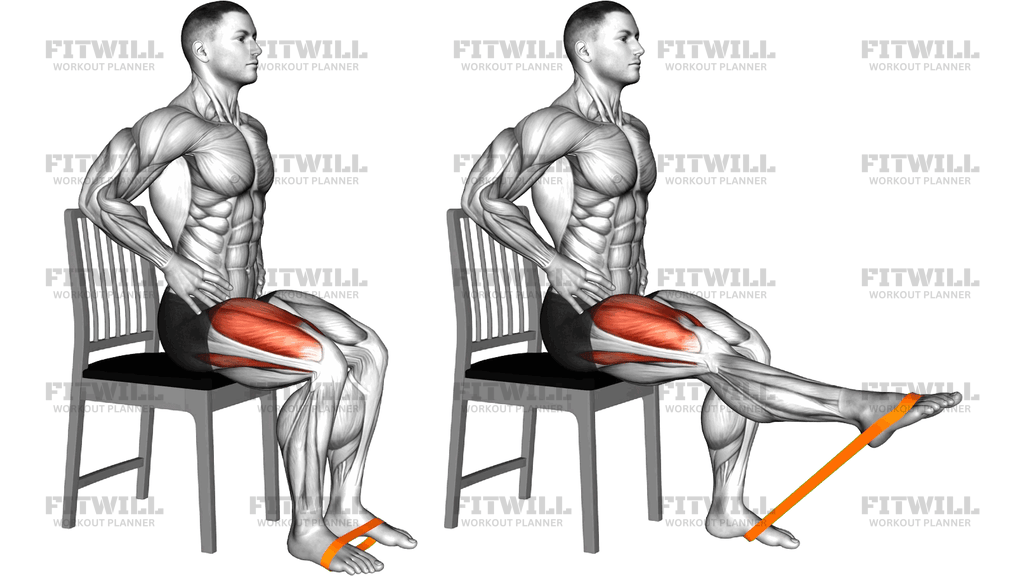
Instructions
- Sit on a sturdy chair or bench with your knees bent to about 90 degrees and both feet flat on the floor.
- Loop a resistance band around the forefoot of your working foot, then place the other end of the band under your opposite foot and press down firmly so the band is anchored.
- Sit tall with your hands resting on your hips or the edge of the seat, and brace your trunk so your torso stays upright throughout the set.
- Check the band tension before starting: there should be noticeable pull on the band with the working foot on the floor, but enough slack that you can extend the knee fully.
- Exhale and straighten the working knee, sweeping the foot forward and up until the leg is nearly parallel to the floor and the knee is fully extended.
- Pause for one second at the top of the movement, squeezing the thigh muscle while the band tension is highest.
- Inhale and lower the foot back toward the floor slowly, resisting the band's pull rather than letting it snap your leg down.
- Complete all repetitions on one leg, then re-anchor the band under the planted foot and switch to the other side.
- Keep the planted foot pressing down on every rep; if the band ever feels like it might slip off the forefoot, stop and reset it before continuing.
Tips & Tricks
- If the band slides off your toes during the extension, move it back so it sits across the middle of the forefoot rather than right behind the toes, and keep your foot flexed as you lift.
- Do not lean back or arch your low back to force the leg higher; if your torso tips backward, the band is too tight or the range is more than your hip flexors can comfortably allow.
- A short band or too much slack is the most common setup error: with almost no tension at the bottom, the first half of the rep does nothing. Shorten the band until the working leg feels resistance almost immediately.
- Control the lowering phase for two to three seconds; the eccentric part of the extension is where much of the quad strength benefit lies, and rushing it also lets the band yank the knee back.
- Keep your kneecap tracking toward the ceiling; if the lower leg drifts inward as you extend, consciously push the knee slightly outward and extend in a straight line.
- Hold the chair seat lightly with your hands if you find yourself bouncing or losing posture — but avoid pushing down through the seat, which can turn the exercise into a hip lift.
- The last few degrees before full straightening are the hardest because band tension peaks there; do not stop short of full extension unless you feel pinching at the front of the knee.
- Use a lighter band for your first session and take note of reps; you can progress by adding reps, slowing the tempo, or stepping up band resistance later.
Frequently Asked Questions
Which muscles does the Resistance Band Seated Single Leg Knee Extension work?
The quadriceps on the front of the working thigh are the main movers, straightening the knee against the band. The rectus femoris, which crosses both the hip and knee, works alongside the other quad heads during the lift.
How do I anchor the resistance band correctly for this exercise?
Place the loop around the forefoot of the leg you are training, and press the opposite end of the band under your other foot, which stays flat on the floor. The planted foot must keep constant downward pressure so the band cannot slide out during the set.
How high should I raise my foot at the top of the Resistance Band Seated Single Leg Knee Extension?
Extend until the knee is fully straight and the leg is roughly level with your hip. The exact height matters less than achieving full knee extension with the quadriceps squeezed against the band's peak tension.
Is this exercise suitable for beginners?
Yes, it is one of the most approachable quad exercises because the chair provides support and the band load is light and smooth. Beginners should start with a light band, focus on slow reps, and master the band anchoring before increasing resistance.
Why train one leg at a time instead of extending both knees together?
The single-leg setup lets each side work independently, which exposes and helps correct a stronger or weaker leg. It also halves the required band tension, making the setup easier to anchor securely under one planted foot.
What is the most common mistake with the Resistance Band Seated Single Leg Knee Extension?
Letting the anchored foot relax so the band slips, and dropping the leg back down in a rush instead of resisting the band. Slouching the torso to gain extra leg height is another frequent fault that shifts work away from the quads.
Can I do the Resistance Band Seated Single Leg Knee Extension every day?
Light-band versions are low in fatigue and often used as daily knee-care or warm-up work. If you are training with a heavier band close to muscular fatigue, treat it like any strength exercise and allow a day of recovery between sessions.
What can I use if I do not have a resistance band?
An ankle weight cuff works well: sit the same way and extend the knee against the weight's pull. A long-loop band, a therapy band tied into a loop, or a cable set to a low position with a foot strap are all workable substitutes.
Should I feel this exercise at the front of my knee?
You should feel the muscles on the front of the thigh working, not sharp pressure or pinching under the kneecap. If the knee itself complains, use a lighter band, avoid locking out forcefully, and reduce the range slightly to a pain-free arc.
How many sets and reps should I do of the Resistance Band Seated Single Leg Knee Extension?
Two to three sets of 10 to 15 slow reps per leg is a solid starting point for strength and muscle. For endurance or rehabilitation-style work, lighter bands with 15 to 20 controlled reps per side are more appropriate.