Resistance Band Assisted Muscle Up
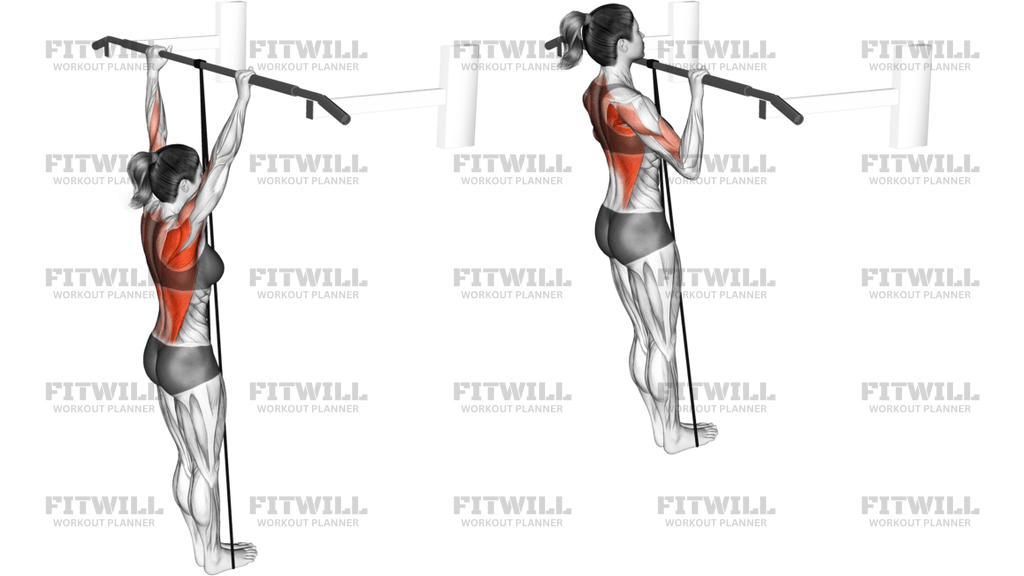
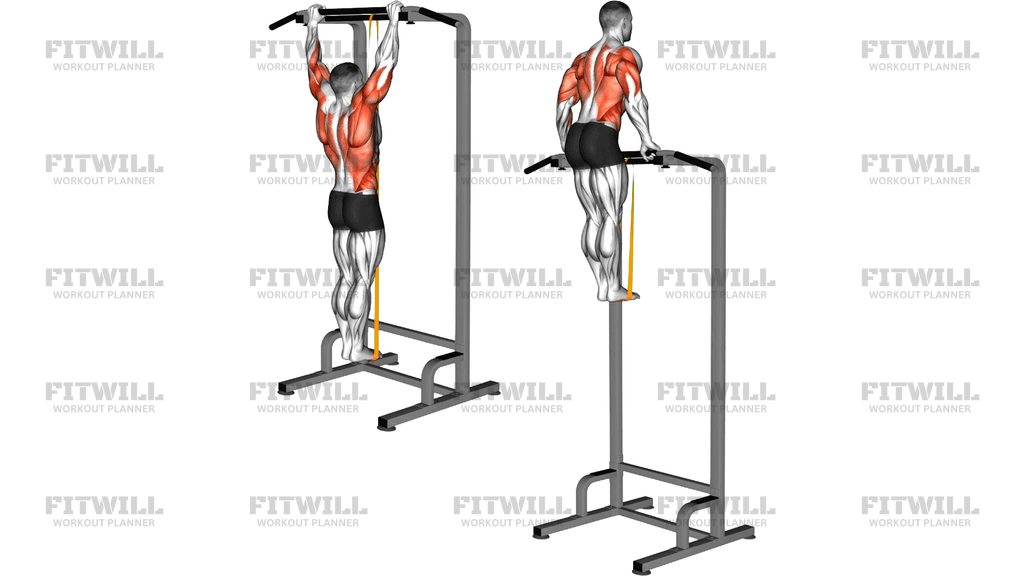
The Resistance Band Assisted Muscle Up is a progression exercise that teaches you to move from a dead hang below a pull-up bar into a supported position on top of the bars, using a looped resistance band to reduce the load you have to lift. One end of the band is anchored around the pull-up bar and your foot sits inside the lower loop, so the band stretches as you descend and helps drive you upward through the hardest part of the transition. It is one of the most practical ways to practice the muscle up before you can perform one with your full body weight.
This movement trains the entire pulling chain: the lats and upper back initiate the pull, the biceps and forearms control the bar path, and the shoulders and triceps take over during the transition and the press into support. Because the assistance is greatest at the bottom and decreases as you rise, the band challenges you most where the muscle up is actually hardest to start and lightens the load near the top, which is the opposite of what most people need. Choosing the right band tension and foot position is therefore the key variable in every set.
The setup matters more here than in a normal pull-up. The band must run from the bar down through your foot, not your knee, so the assistance stays connected through the full range, including the moment you release and re-grip onto the dip handles. A foot loop keeps the band attached when your body rotates over the bar; a knee placement often slips or changes the assistance mid-rep. You also need a station with parallel dip handles above and slightly outside the pull-up bar, since the end position is a supported hold on those handles rather than the top of the bar.
To execute it well, start from a full dead hang with the band under the ball of your foot and your leg relatively straight. Pull with intent toward the bar, drive your chest up and over as the band assists, then transition your grip from the bar to the dip handles and press down until your arms are locked in support. The descent is where most of the learning happens: lower yourself under control back to the hang rather than dropping, so you build the negative half of the muscle up as well.
This exercise suits intermediate lifters and calisthenics practitioners who already own several strict pull-ups and some dip strength but cannot yet link the two through the transition. It is also a useful conditioning tool for higher-rep muscle up practice without excessive fatigue. Keep the reps crisp, reset the band under your foot before every rep, and stop the set as soon as your band foot starts slipping or your pulls turn into swings.
[ Workout Log & Planner ]
Put your next workout in Fitwill
Keep your plan and training log ready when you are.


Instructions
- Loop a resistance band over the pull-up bar of a power tower and pull one end down through the other so it hangs in a single loop below the bar.
- Place the ball of one foot inside the lower loop of the band, then grip the pull-up bar with a shoulder-width or slightly wider overhand grip and let yourself settle into a full dead hang with the band stretched.
- Keep your other leg close to the band-side leg and brace your midsection so your body hangs as one piece instead of swinging.
- Pull your elbows down and back toward the bar, driving your chest up as the band assists you through the first half of the movement.
- As your chest reaches bar height, lean forward over the bar and let the band lift your torso through the transition point.
- Release one hand at a time from the bar and re-grip the dip handles, keeping your elbows high and close to your body as you move over the top.
- Press down hard through the handles until your arms are fully locked and your hips and legs hang below you in a stable support position.
- Reverse the path under control: lower from the dip handles back to the bar grip, then resist the band on the way down until your arms are straight in the hang.
- Exhale on the way up through the pull and press, and inhale during the controlled descent.
- Before each new rep, check that the band is still seated under your foot and reset your hang position if you drifted or swung.
Tips & Tricks
- If the band slips off your foot during the transition, you are pointing your toe or letting the leg go slack; keep the foot flexed upward so the band stays trapped against your instep.
- A common mistake is pulling straight up like a pull-up; the muscle up needs you to pull toward your lower chest and then lean forward over the bar, or you will stall at chest height.
- If you cannot reach the dip handles after the pull, the band is too light. Move to a thicker band or anchor two bands together before adding reps.
- Do not let the band do all the work on the way down. The negative from support back to hang is where most people build the strength to eventually do an unassisted muscle up.
- Keep your band-side hip from hiking up as the band pulls; if you notice a sideways tilt in the hang, squeeze your glutes and legs together to stay square to the station.
- Gripping the bar too narrow makes the transition to the dip handles awkward; a shoulder-width grip leaves your hands closer to where they need to land on the handles.
- If your kip or swing grows with fatigue, cut the set. Swinging into the transition changes the exercise and puts your shoulder in a weaker position at the catch.
- Change foot position before you change bands: sliding the band closer to your ankle reduces assistance, while the arch of the foot gives more, letting you fine-tune the difficulty within one band.
Frequently Asked Questions
What muscles does the Resistance Band Assisted Muscle Up work?
The lats and upper back drive the pull, the biceps and forearms control the bar path, and the shoulders, chest, and triceps handle the transition and press into support on the dip handles. The core works throughout to keep the hanging body from swinging.
Can beginners do the Resistance Band Assisted Muscle Up?
It is best suited to people who can already perform several strict pull-ups and hold a dip support. If you cannot yet do that, build pull-up and dip strength first, since the band alone will not carry you through the transition skill.
Why should the band go under my foot instead of my knee?
A foot loop stays attached when your body rotates over the bar and re-grips the dip handles, while a knee placement tends to slip or shift the assistance mid-rep. Keep the ball of the foot in the band with the toes flexed up to lock it in place.
How do I choose the right band tension for the Resistance Band Assisted Muscle Up?
Pick a band that lets you complete the full transition to the dip handles without swinging, but still leaves the last few reps challenging. If you stall at chest height, go heavier; if the press at the top feels effortless, go lighter.
What is the most common mistake in this exercise?
Most people pull vertically like a pull-up and stop when the bar reaches their chest. The muscle up requires pulling toward the lower chest and leaning the torso forward over the bar so the shoulders pass above the hands.
Can I use the Resistance Band Assisted Muscle Up to build toward an unassisted muscle up?
Yes, and the controlled lowering phase is a big part of that. Progress by using lighter bands over time and by emphasizing slow negatives from the dip support back to the dead hang.
Is it safe to drop from the support position back to the hang?
Dropping lets the band snap you down abruptly and can irritate the shoulders and elbows. Lower yourself back to the bar grip deliberately and resist the descent until your arms are straight.
What can I use instead of a power tower for this movement?
Any setup with a pull-up bar and parallel dip handles positioned above and outside the bar will work, such as a rig with dip bars. A doorway bar without dip handles will not allow the full transition to support.
How many reps and sets of the Resistance Band Assisted Muscle Up should I do?
Work in low-rep, high-quality sets of about 3 to 6 reps for 3 to 5 sets, resting fully between sets. Stop the set once your form breaks down into swinging or the band starts slipping off your foot.