Sprawl Squat
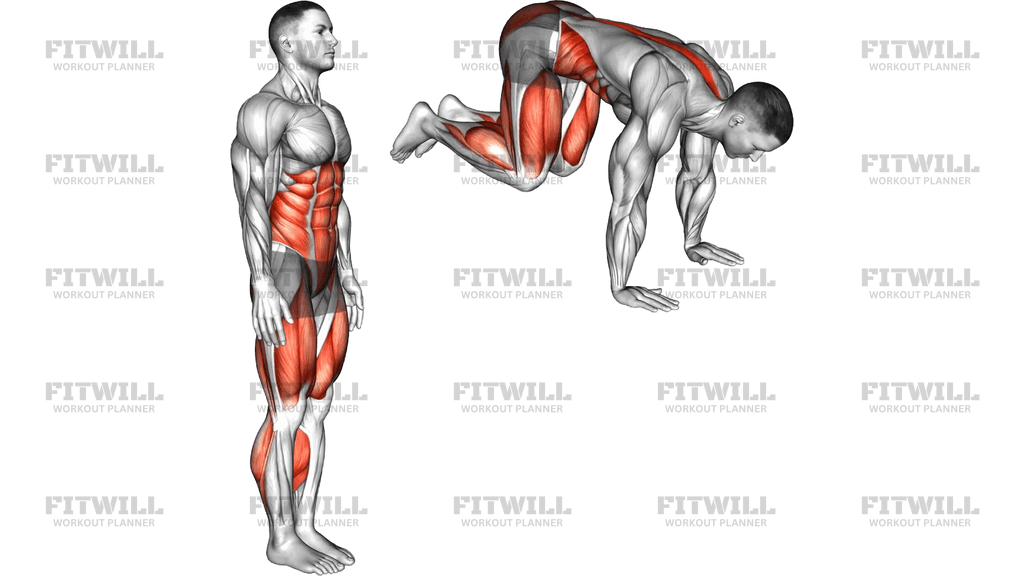
The Sprawl Squat is a full-body conditioning movement that combines a squat, a hand-planted sprawl, and a return to standing in one continuous flow. Think of it as a burpee stripped down to its essentials: you drop your hands to the floor, kick your legs back behind you into a low sprawled position, snap the feet back under your hips, and stand up tall. There is no push-up and no jump required, which makes it easier to learn and easier on the joints than a full burpee while still delivering a serious conditioning stimulus.
Because the legs kick back and the hips drop low, the sprawl phase loads the quads, glutes, and hamstrings through a wide range of motion, while the trunk works hard to keep the spine from sagging as weight shifts onto the hands. The shoulders and triceps support you briefly in the sprawled position, and the calves and hip flexors fire during the kick back and the return. Done for reps or timed intervals, the Sprawl Squat drives the heart rate up quickly, making it a go-to for circuits, warm-ups, and conditioning finishers.
This movement suits a wide range of trainees. Beginners use it to build the floor-to-standing coordination needed for burpees and grappling-style conditioning. Combat athletes, CrossFit-style trainees, and anyone who needs fast, repeatable hip-to-floor transitions rely on sprawls as a staple. Because it requires no equipment and very little space, it fits well into home workouts, hotel-room sessions, and partner conditioning drills.
Setup matters more than it looks. Hand placement just inside shoulder width gives you a stable base to receive the kick back, and keeping the hips low as the feet shoot back prevents the pike position that turns the move into a hamstring stretch instead of a sprawl. The transition out of the sprawl should be just as deliberate: pull the feet back under the body rather than letting them land wherever they fall, then finish through a full squat to standing.
For safety, keep the elbows soft when the hands contact the floor and avoid slamming the knees down in the sprawled position. If your wrists are sensitive, distribute weight across the whole palm and fingers rather than dumping it into the heel of the hand. Start at a controlled pace to groove the footwork, then build speed only once the pattern is consistent under fatigue.
[ Workout Log & Planner ]
Put your next workout in Fitwill
Keep your plan and training log ready when you are.


Instructions
- Stand tall with your feet about shoulder-width apart, arms relaxed at your sides, and brace your core lightly.
- Bend your knees into a short squat and hinge forward, placing both palms flat on the floor just inside shoulder width with fingers spread.
- Let your weight shift onto your hands and shoot both feet straight back behind you in one motion, keeping your hips low so your body stays long rather than piked.
- In the sprawled position, keep your knees tracking toward the floor without actually slamming into it, elbows soft but not locked, and your neck relaxed with your gaze slightly ahead of your hands.
- Without pausing, pull both feet back in so they land under your hips, roughly in your original stance.
- Rise through a squat and drive the floor away to stand fully upright, opening the hips and pulling the shoulders back at the top.
- Exhale as you kick back and again as you return to standing; use the moment at the top to take a quick breath if you are pacing longer sets.
- Re-set your stance and brace before starting the next rep, and keep the rhythm even rather than sprinting the first few reps.
Tips & Tricks
- The most common fault is piking the hips high as the feet kick back, which shifts the load to the hamstrings and turns the sprawl into a pike jump; consciously drive the hips toward the floor as the feet travel back.
- Letting the chest collapse so the shoulders sit behind the wrists strains the shoulder joint; keep the weight balanced over the palms with the elbows roughly over the wrists.
- If your feet land too narrow or too wide on the return, mark a shoulder-width position with your heels in your mind and aim the feet there every rep, since inconsistent landings break your rhythm and your squat depth.
- Do not lock the elbows hard when the hands hit the floor; a soft elbow absorbs the landing and protects the joint during faster sets.
- Stay light on your toes during the kick and the pull-back; heavy, flat-footed landings slow the transition and hammer the knees.
- Keep the knees hovering instead of grinding them into the floor in the sprawl; contact should be incidental, not part of the movement.
- If your wrists bother you, press through the fingertips and the full palm instead of collapsing into the heel of the hand, and shorten sets before form degrades.
- Scale by stepping the feet back one at a time instead of kicking, which is a clean progression for beginners or high-fatigue intervals.
- Count tempo by breath in longer sets; when you can no longer control the descent to the floor, end the set rather than letting the sprawl get sloppy.
Frequently Asked Questions
What muscles does the Sprawl Squat work?
The Sprawl Squat hits the quads, glutes, and hamstrings through the squat and sprawl phases, while the abs and deep core stabilize the trunk and the shoulders support you briefly on the floor. Done at speed, it is primarily a conditioning tool for the whole body.
How is the Sprawl Squat different from a burpee?
A burpee typically includes a push-up and a vertical jump at the top, while the Sprawl Squat finishes by standing up from the squat. That makes it lower-impact and easier to learn, but still demanding on the hips and cardiovascular system.
Should my knees touch the floor in the sprawl position?
No, keep the knees hovering just above the floor rather than driving them down. Ground contact is not part of the movement and repeated impact can irritate the knee joint.
Can beginners do the Sprawl Squat?
Yes. Start by stepping one foot back at a time instead of kicking both, and move at a slow, deliberate tempo. Once the hand placement and foot return feel natural, progress to the dynamic kick-back version.
Why do my hips end up too high when I kick back?
That pike pattern usually means the feet are travelling back and up instead of straight back. Focus on shooting the feet behind you while actively pressing the hips toward the floor, and check that your hands are far enough forward to give the legs room.
How many Sprawl Squats should I do?
Start with sets of 8 to 12 reps at a controlled pace, or 20 to 30 seconds of work in a circuit. Because the movement is repetitive, end sets when the footwork gets sloppy rather than grinding out extra reps.
What can I substitute if the Sprawl Squat bothers my wrists?
Use an exercise mat to cushion the hands and press through the fingertips to spread the load. If wrist discomfort persists, swap in squat thrusts with step-backs or fast bodyweight squats to a medicine ball to keep the conditioning effect.
Where should my hands be placed during the Sprawl Squat?
Plant the palms flat on the floor just inside shoulder width, fingers spread, roughly where they would fall in a push-up setup. This gives a stable base to receive the kick back and an even transfer of weight onto the arms.
Is the Sprawl Squat safe for people with knee problems?
The movement involves fast knee flexion and extension, so anyone with a current knee issue should get clearance from a qualified professional first. Slowing the tempo and stepping the feet back instead of kicking reduces the load while preserving the pattern.