Barbell Pendlay Row From Deficit
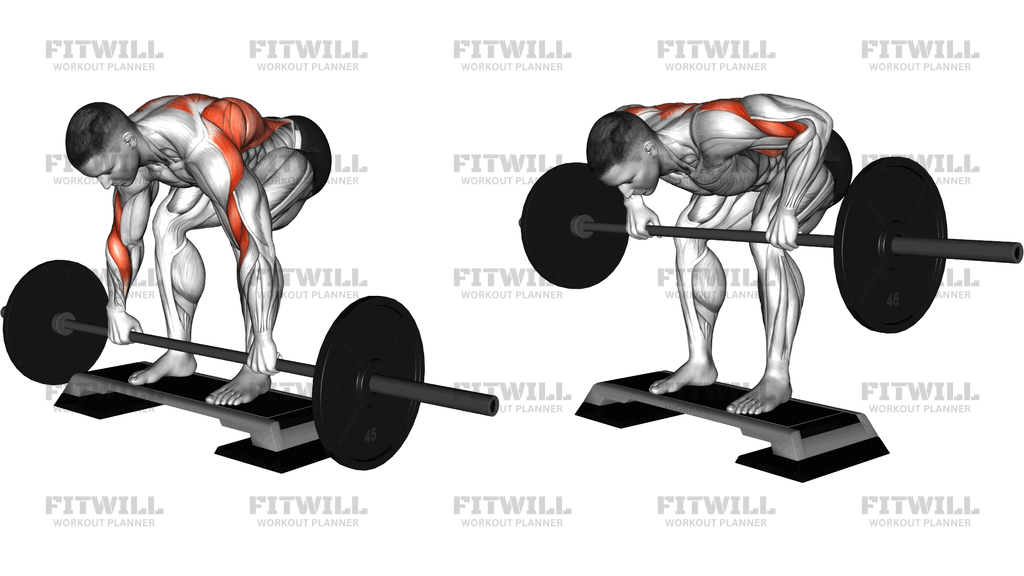
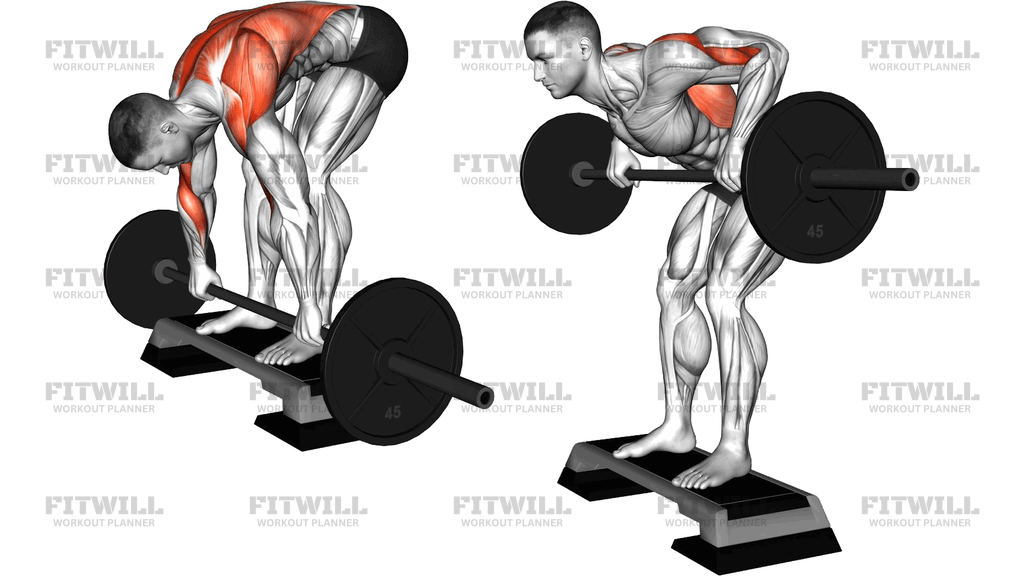
The Barbell Pendlay Row From Deficit is a stricter, longer-range version of the classic Pendlay row. You stand on a step platform or stacked plates so the bar sits lower to the ground, hinge over until your torso is close to parallel with the floor, and pull the bar from a dead stop on every rep. Because the bar starts from the floor each time and travels further, the muscles of the upper back, lats, and rear shoulders are forced to work through a longer range than in a standard row.
This movement suits intermediate lifters who already own a solid hip hinge and can hold a flat back under load. Olympic weightlifters use Pendlay rows to build the explosive pulling strength that carries over to cleans and snatches, and the deficit version exaggerates that effect by adding range at the bottom. Powerlifters and general strength trainees use it to thicken the mid-back and reinforce the ability to keep the spine rigid while heavily loaded in a bent-over position.
The setup is what separates this from a casual bent-over row. Standing on the platform increases the distance the bar must travel, so your hamstrings, glutes, and lower back erectors work isometrically the whole time to hold your torso still. The row itself is driven by the upper back: you pull the bar briskly toward your lower chest and stomach area, then let it settle back to the floor with control before the next rep. There is no standing pause with the bar in hand, which keeps the emphasis on the pull rather than on holding a heavy hang position.
To execute well, keep your shins close to the bar, push your hips back until your chest is nearly facing the floor, and brace hard before the first pull. Initiate each rep with the back and elbows rather than the hands, and think about driving your elbows up and slightly back. Avoid letting the chest rise as the bar approaches your body; if your torso climbs with every rep, the weight is too heavy for a true Pendlay row.
A few practical cautions go a long way. The deficit position places extra demand on the lower back and hamstrings, so start with a lighter load than you would use for a regular Pendlay row and master the standard version first. Use a platform that is low and stable, keep your feet flat and fully supported, and stop the set as soon as your torso position or bar path breaks down. Performed with those limits respected, it is one of the most effective rowing variations for building a dense, strong upper back.
[ Workout Log & Planner ]
Put your next workout in Fitwill
Keep your plan and training log ready when you are.


Instructions
- Place a low, stable step platform on the floor and set a loaded barbell so it runs over or just in front of the platform, with the plates resting on the floor.
- Stand on the platform with your feet about hip-width apart and position the bar directly over the middle of your feet, shins close to the bar.
- Grip the bar slightly wider than shoulder-width with an overhand grip, then hinge at the hips and push them back until your torso is near parallel to the floor and your chest is angled down toward the platform.
- Take a deep breath into your belly, brace your core, and set your lower back in a flat, neutral position before the bar leaves the floor.
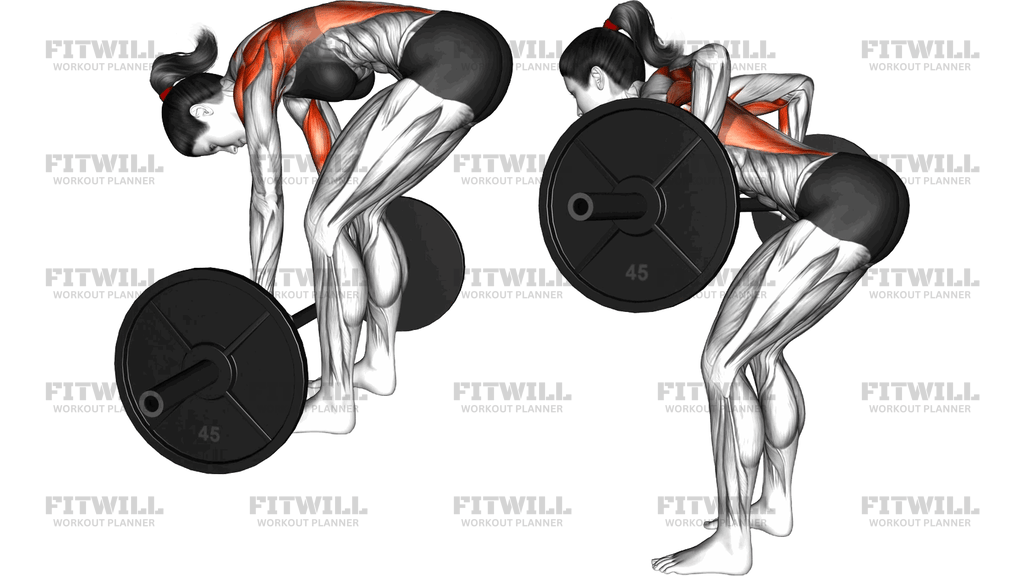
- Pull the bar off the floor in one brisk motion, driving your elbows up and back toward your lower chest and upper stomach.
- Squeeze your shoulder blades together at the top, keeping your torso angle fixed instead of letting your chest rise to meet the bar.
- Lower the bar under control back to the floor and let it settle completely so each rep starts from a dead stop.
- Exhale at the bottom, re-brace, and reset your back position before starting the next rep.
- Keep your knees softly bent and your weight centered over the whole foot throughout the set; step off the platform only after the bar is set down.
Tips & Tricks
- The most common fault is turning this into a standing bent-over row by staying up on the hips; if your torso rises more than a few degrees during the pull, drop the weight until the position holds.
- Bouncing the bar off the floor defeats the purpose of the deficit, since the dead stop is what forces your upper back to generate the pull from a long stretch.
- Use a double-overhand grip or straps rather than a mixed grip; a mixed grip tends to rotate the shoulders and pull your torso out of line.
- Chalk or use straps before your grip fails, because a slipping bar usually shows up as a rounded back before you even notice it in your hands.
- Keep the platform height modest, roughly one to three inches; a taller platform only helps if you can still reach the bar with a flat back and soft knees.
- If you feel the work shifting into your lower back, cue yourself to pull your elbows to the ceiling rather than yanking the bar with your arms and trunk.
- Warm up your hip hinge with a few light conventional deadlifts or standard Pendlay rows first, since cold hamstrings tighten quickly in the deep deficit position.
- Keep reps in the five to eight range for this variation; long grindy sets tend to break the torso angle long before the target muscles are finished.
- Filming from the side for a set or two is worth it, because a rising chest or a bar drifting away from the legs is much easier to see from outside.
Frequently Asked Questions
Which muscles does the Barbell Pendlay Row From Deficit work?
The main movers are the muscles of the upper back, including the mid traps and rhomboids, along with the lats and rear shoulders. Your lower back, glutes, and hamstrings work hard isometrically to hold the bent-over position.
What does the deficit actually add compared to a regular Pendlay row?
Standing on the platform lowers the starting height of the bar, so it travels farther on every rep and your upper back works through a longer range from a deeper stretch. That also increases the demand on your hamstrings and lower back to hold the position.
How high should the deficit platform be?
Keep it low, roughly one to three inches, and only go as high as you can while still reaching the bar with a flat back and soft knees. A taller deficit mostly adds strain to the lower back rather than extra rowing benefit.
Is the Barbell Pendlay Row From Deficit suitable for beginners?
It is better treated as a second-step exercise. Learn the hip hinge and the standard Pendlay row first, then add the deficit once you can hold a near-parallel torso with a flat back under a moderate load.
Why does the bar have to be set fully down on every rep?
The dead stop is the defining feature of the Pendlay row. It removes momentum and stretch reflex, forcing your upper back to initiate each pull, which is what makes the movement so effective for back strength.
Should my chest rise as I pull the bar up?
No, your torso angle should stay fixed near parallel to the floor from start to finish. If your chest climbs with each rep, the weight has exceeded what your upper back can move honestly.
My lower back gets sore after this exercise. What should I check?
First confirm your back stays flat and neutral, and that you are re-bracing before every rep instead of only at the start of the set. If soreness persists, reduce the deficit height or drop back to the standard Pendlay row while your lower back adapts.
What can I substitute if I do not have a step platform?
Stack one or two rubber plates or use a low, solid aerobic step to create the same drop. In a pinch, a standard Pendlay row from the floor trains the same pattern with a shorter range.
Is it acceptable to use lifting straps on this row?
Yes. Grip usually gives out before the upper back on a loaded deficit row, and straps let you train the target muscles without your hands cutting the set short. Keep some direct grip work in your program if you rely on them.
How is this different from a regular bent-over barbell row?
A bent-over row is usually done with the bar hanging and a torso angled around 45 degrees, while the Pendlay row uses a near-parallel torso and a dead stop on the floor every rep. The deficit version simply stretches that already long range even further.