Dumbbell Half Kneeling Single Arm Shoulder Press
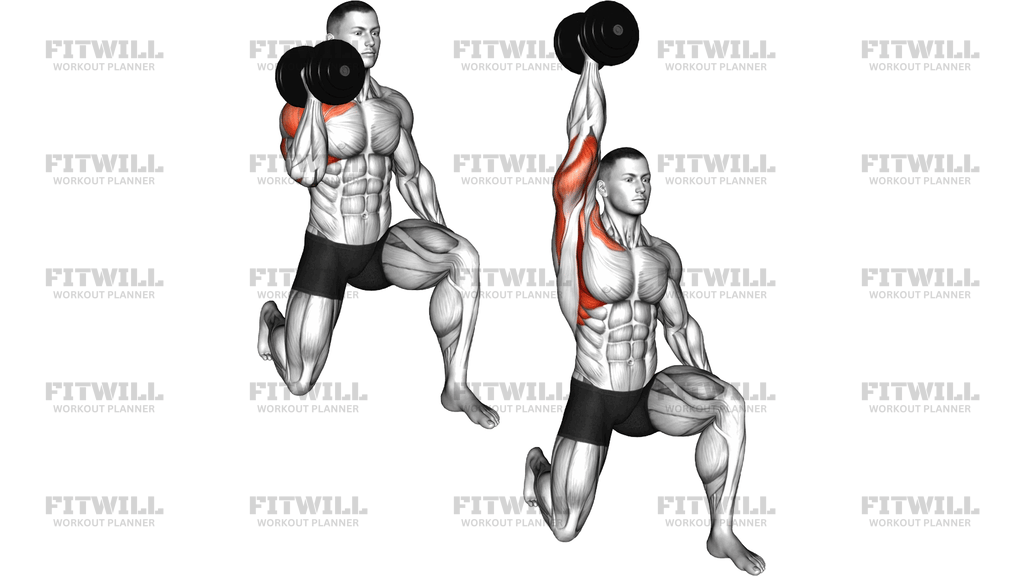
The Dumbbell Half Kneeling Single Arm Shoulder Press is an overhead press performed with one dumbbell while you kneel on one knee with the other foot planted in front of you. The half-kneeling stance removes the help your legs would normally give a standing press, forcing the shoulder and arm to do the actual pressing work while your trunk works to keep your ribs and pelvis stacked. In the starting position the dumbbell rests at shoulder height, and each rep finishes with the arm locked out directly over the shoulder.
This variation is especially useful for lifters who lean back too much during standing barbell or dumbbell presses, because the narrow base makes any backward arch immediately obvious. It is also a good fit for people rehabbing or managing shoulder issues, since pressing one arm at a time lets the shoulder blade move naturally and lets you match the weight to each side. Athletes in rotational sports get extra carryover, as the split stance closely mirrors the hip position used in throwing, swinging, and punching.
The primary muscles at work are the front and side shoulders, with the triceps extending the elbow to finish each lockout. Because you are pressing on one side of the body, the obliques and deep core muscles must resist rotation and side-bending the entire time, and the glute on the down-knee side along with the front hip of the kneeling leg work to hold your pelvis level. The upper traps and serratus assist with upward rotation of the shoulder blade as the arm rises.
Setup details matter more here than in a seated press. Your front shin should be roughly vertical, the back knee placed under or slightly behind the hip, and your torso tall without flaring the ribs. If your stance is too narrow or your torso collapses toward the pressing side, you will leak power and cheat the core demand. Squeezing the glute of the trailing leg gives you a stable base so the press stays a shoulder movement instead of a full-body sway.
To execute well, press the dumbbell up and slightly back so it finishes over the ear and shoulder rather than out in front, then lower it with control back to the shoulder. Exhale as you press, inhale as you lower, and complete all reps on one side before switching. Start light; the unilateral kneeling position exposes weaknesses quickly, and a weight you can press strictly will build more long-term shoulder strength than a heavier one pressed with a twisting torso.
Common use cases include correcting side-to-side strength differences, adding anti-rotation core work without doing separate ab exercises, and building overhead pressing mechanics for people who lose their rib position when standing. Keep the range honest and stop the set as soon as your trunk starts rotating with the press, since that is usually the first sign of fatigue.
Fitwill
Log Workouts, Track Progress & Build Strength.
Achieve more with Fitwill: explore over 9600 exercises with images and videos, access built-in and custom workouts, perfect for both gym and home sessions, and see real results.
Start your journey. Download today!




Instructions
- Kneel on your left knee with your right foot planted flat in front of you, so both knees form roughly 90-degree angles and your front shin stays vertical.
- Pick up a dumbbell in your right hand and raise it to shoulder height with your palm facing forward or slightly angled inward, elbow out to the side just below the wrist.
- Tighten your abs and squeeze the glute of your kneeling leg, then check that your ribs are stacked over your pelvis and your torso is facing forward, not twisted.
- Press the dumbbell straight up and slightly back until your arm is fully extended and the weight sits directly over your shoulder and ear.
- Pause briefly at the top with your biceps near your ear and your shoulder blade supporting the overhead position.
- Lower the dumbbell in a slow, controlled arc back to shoulder height, keeping your elbow tracking under the wrist rather than letting the arm drop.
- Exhale as you press up and inhale as you lower the weight, keeping your breath steady without holding it through the set.
- Complete all reps on one side, then reset your stance and perform the same number of reps with the dumbbell in the opposite hand on the opposite knee.
- Between sets, stand up carefully out of the kneeling position or switch legs before your down-knee becomes sore against the floor.
Tips & Tricks
- If your torso twists toward the non-pressing side as the weight goes up, reduce the load; the twist is the most common cheat in this exercise and it cancels out the anti-rotation benefit of kneeling.
- Do not let the dumbbell drift forward at lockout. Finish each rep with the weight stacked over the shoulder and ear, not out over your face or chest.
- Pad the down knee with a mat if the floor is hard, and place it directly under your hip so the back leg does not splay out to the side.
- Keep your front foot fully flat. Pushing through the front leg to help the press turns this back into a leg-assisted movement and hides how much your shoulder can actually press.
- Grip the dumbbell firmly with your wrist straight. A bent-back wrist at the top of the press is a frequent mistake and shifts stress away from the shoulder.
- Control the lowering phase for about two seconds. Dropping the dumbbell quickly to the shoulder makes the next rep easier and robs you of the time under tension.
- If you feel your lower back working hard, recheck your rib position and squeeze the kneeling-side glute; most back strain in this lift comes from arching to substitute for shoulder strength.
- Start with your weaker or less coordinated arm first, then match the reps with the stronger side so imbalances even out instead of growing.
- Use a neutral grip, palm facing inward, if the standard palm-forward position irritates your shoulder at the bottom of the press.
Frequently Asked Questions
What muscles does the Dumbbell Half Kneeling Single Arm Shoulder Press work?
The front and side shoulders do most of the pressing, with the triceps locking out each rep. The obliques and deep core work to stop rotation, and the glutes and hip stabilizers hold the half-kneeling position steady.
Why kneel on one knee instead of standing for this press?
The half-kneeling base removes leg drive, so the shoulder has to do the work, and the narrow stance makes any torso lean or twist obvious. It also trains hip stability in a split stance that carries over to running and throwing.
Is the Dumbbell Half Kneeling Single Arm Shoulder Press good for beginners?
Yes, and it is often a better first overhead press than a standing version because the light kneeling demand teaches trunk control early. Beginners should start with a modest dumbbell and focus on keeping the torso square to the front.
Which knee should be down when pressing?
A common setup is to have the knee opposite your pressing arm on the floor, which many lifters find gives the most stable trunk position. Try both arrangements with a light weight and use the one where your torso stays tallest and least twisted.
How heavy should the dumbbell be for this exercise?
Choose a weight you can press for all prescribed reps without your torso rotating or your ribs flaring upward. Because one arm works alone without leg help, most people use noticeably less than their standing two-arm press load.
My lower back aches during the press. What should I fix?
Lower back discomfort usually means you are arching to press instead of using the shoulder. Squeeze the glute of your kneeling leg, tuck your ribs down over your pelvis, and drop to a lighter dumbbell until the upright position feels automatic.
Can I do this exercise if standing overhead presses hurt my shoulder?
Many lifters tolerate the half-kneeling press better because the single-arm path lets the shoulder blade rotate freely and the load can be matched to each side. If discomfort continues at shoulder height or above, stop and have it assessed rather than pushing through pain.
What can I use instead of a dumbbell for the Dumbbell Half Kneeling Single Arm Shoulder Press?
A kettlebell in the rack position works well and adds a wrist-control challenge, and a low cable handle can provide constant tension through the whole arc. Keep the same half-kneeling setup and finish with the arm over the shoulder whichever tool you pick.
Should I do all my reps on one arm before switching?
Yes, finish the full set on one side and then match it on the other. Switching every rep breaks your brace and setup, and the fatigue effect that makes the second side honest disappears.
How is this different from a standing single-arm dumbbell press?
Standing lets you lean and use hip and leg movement to help the weight up, while the half-kneel cuts that off and makes the core resist rotation the entire time. The kneeling version typically uses a lighter weight but trains trunk stability alongside the shoulders.