Kettlebell Walking Lunge
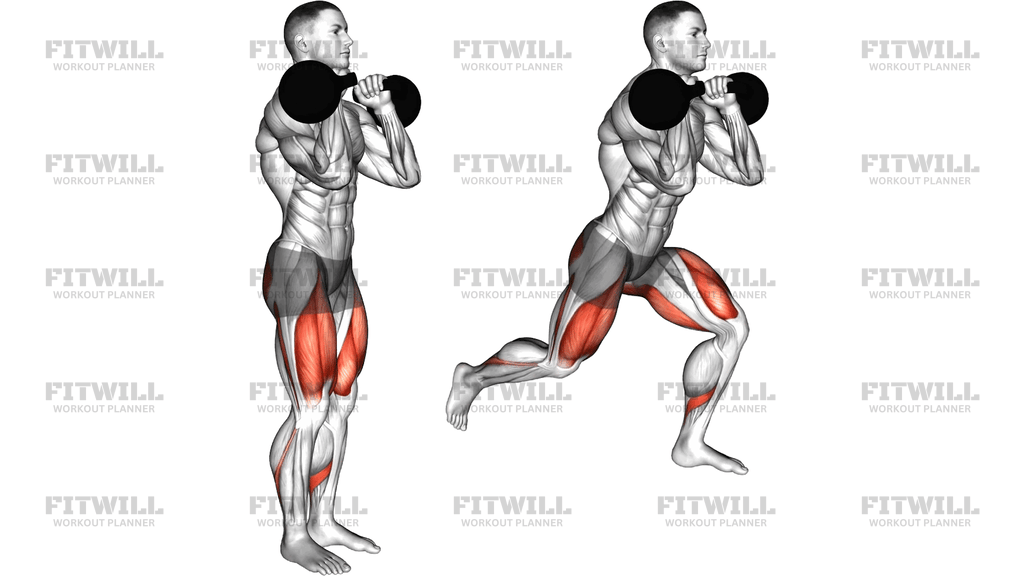
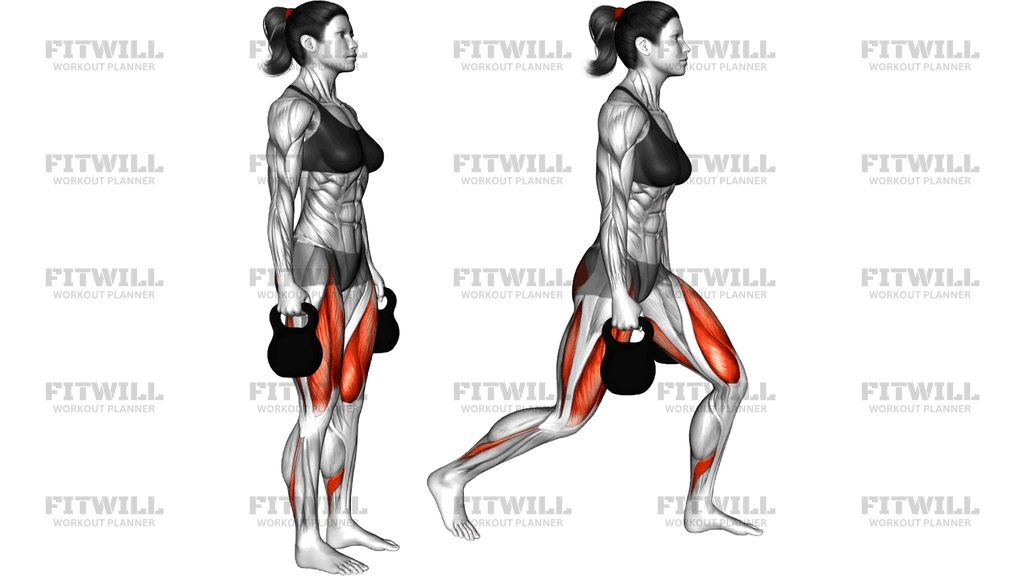
The Kettlebell Walking Lunge is a traveling unilateral leg exercise performed with a kettlebell held in each hand at your sides. Instead of stepping out and pushing back to a fixed spot like a stationary lunge, you step forward into each rep and keep walking, which turns a single movement into a continuous sequence of controlled strides. The loaded, farmer-style grip is what separates it from a bodyweight walking lunge: the kettlebells sit below hip level, pulling straight down, so your legs do the work without your upper body having to support weight overhead or in front of the chest.
This movement suits lifters who already feel steady with bodyweight lunges and want to add load without stressing the lower back or shoulders. Because each leg has to decelerate, absorb, and then drive you forward on its own, it builds the kind of single-leg strength and coordination that carries over to running, hiking uphill, stairs, and sport. It is also efficient in a small space — a hallway, garage, or stretch of gym floor of a few meters is enough.
The main work comes from the quads and glutes of the front leg, with the hamstrings and calves assisting through the stride and the push-off. The trunk works quietly but constantly: with a kettlebell hanging in each hand, any sway or side lean shows up immediately, so your obliques and deep core stabilize you on every step. Your grip and upper traps get steady forearm and shoulder-blade work from simply holding on for the length of a set.
Setup matters more than most people expect. The kettlebells should hang just outside your thighs with arms fully relaxed, shoulders pulled back rather than rounded forward. If the bells are too heavy, the first thing to break is posture — the torso starts tipping toward the lead knee or drifting side to side, and the exercise stops being a leg exercise. Choosing a weight you can hold with a tall chest for a full walking pass is the right starting point.
To execute it well, step forward into a long, natural stride, drop straight down until both knees reach roughly ninety degrees, then drive through the front foot to rise and bring the trailing leg through into the next step. Keep the movement vertical: the torso travels down and up, not forward and back. Each landing should be soft and quiet, with the front shin close to vertical and the heel in contact with the floor.
Common uses are as a primary lower-body exercise in moderate rep ranges, as a finisher after squats or deadlifts, or as a conditioning tool using longer walking distances. The main safety points are simple: clear the walking path before you start, keep loads moderate until your balance under the kettlebells is consistent, and stop the set as soon as your form or foot placement gets sloppy — fatigue shows up in lunges as shortened strides and knee wobble before it shows up anywhere else.
[ Workout Log & Planner ]
Put your next workout in Fitwill
Keep your plan and training log ready when you are.


Instructions
- Stand tall with a kettlebell in each hand, one hanging at each side just outside your thighs, gripping the handles with your arms fully relaxed.
- Set your feet hip-width apart, draw your shoulders back and down, and keep your gaze forward on a fixed point along your walking path.
- Brace your trunk as if bracing for a light push, and confirm the kettlebells hang evenly with your weight distributed over the whole foot.
- Take a controlled step forward with one leg, long enough that both knees can bend to about ninety degrees at the bottom.
- Lower straight down until your front thigh is near parallel to the floor and your back knee hovers just above the ground, keeping your torso upright.
- Check your front foot position: heel flat, knee tracking over the middle of the foot and roughly above the ankle, not collapsing inward.
- Press through the heel and midfoot of the front leg to stand, and as you rise, bring the trailing leg forward into the next step.
- Exhale as you drive up out of each lunge, and inhale during the lowering phase of the next stride.
- Continue walking forward, alternating legs for the desired number of total steps or distance, keeping stride length consistent.
- To finish, step your feet together, stand fully upright, and set the kettlebells down on the floor with a flat back rather than dropping them mid-set.
Tips & Tricks
- If your torso leans toward the front knee at the bottom, your stride is probably too short — step out farther so your front shin stays close to vertical.
- Watch for the front knee caving inward on the descent, a common fault once the kettlebells get heavy; think of spreading the floor slightly with that foot.
- When the trailing knee drops toward the floor, avoid slamming it down; hover it a few centimeters off the ground so the muscles, not the joint, control the depth.
- Keep the kettlebells from swinging forward and back as you walk — a small controlled squeeze of the grip and relaxed, quiet shoulders stop the pendulum effect.
- Alternate which leg starts each set so one side doesn't quietly accumulate more volume over the weeks.
- If you find yourself watching your feet, look up instead; fixing your gaze a few meters ahead noticeably steadies balance under load.
- When the walking path runs out mid-set, turn around carefully by stepping together and rotating small, not by pivoting sharply with kettlebells in hand.
- Cut the set short if your grip fails before your legs — the kettlebells should leave your hands by choice, not because they slipped.
- Start with a lighter pair than you'd use for dumbbell lunges if you're new to kettlebell handles; the shape sits differently against the thigh during the stride.
Frequently Asked Questions
Which muscles does the Kettlebell Walking Lunge target most?
The quads and glutes of the front leg do most of the work, with the hamstrings and calves assisting through the stride and push-off. Your core and grip work throughout to keep the torso tall and the kettlebells steady at your sides.
How is the Kettlebell Walking Lunge different from a stationary lunge?
In the walking version you travel forward with every rep, so each leg repeatedly absorbs a fresh landing and drives you ahead of where it started. The stationary lunge lets you focus purely on the down-and-up pattern, which is slightly easier on balance.
Should I hold one kettlebell or two for the Kettlebell Walking Lunge?
Two kettlebells, one in each hand at your sides, is the standard setup because it keeps the load balanced left to right. Holding a single kettlebell on one side is a valid variation, but it adds a side-bending challenge that changes the exercise considerably.
Can beginners do the Kettlebell Walking Lunge?
Beginners should first be comfortable with bodyweight walking lunges and able to keep their torso upright through a full stride. Once that feels solid, starting with light kettlebells for short sets of six to eight steps per leg works well.
How heavy should the kettlebells be?
Pick a weight you can hold with relaxed arms and a tall chest for the entire set, and let your legs be the limiting factor rather than your grip. If your shoulders round or your torso tips forward as the set goes on, the load is too heavy.
Why does my grip give out before my legs during this exercise?
The kettlebell handle concentrates the load in a narrow grip, so your forearms and fingers fatigue quickly on longer walking sets. Rest intervals, chalk, and slightly heavier-but-shorter sets help your grip catch up, or you can switch to lighter bells held in a comfortable hang.
How deep should I go on each step of the Kettlebell Walking Lunge?
Lower until both knees are bent to roughly ninety degrees, with the front thigh about parallel to the floor and the back knee hovering just above the ground. Going deeper is fine if your hips and knees stay aligned, but depth should never come at the cost of a rounded or leaning torso.
What can I use if I don't have kettlebells?
Dumbbells held at the sides replicate the same farmer-style grip, and a sandbag hugged at the chest or a barbell on the back are other common progressions. With no equipment at all, the bodyweight version is still an effective way to build the pattern.
How many steps should I take per set?
Eight to twelve steps per leg is a typical working range for strength, while longer continuous walks of twenty or more steps per leg shift the exercise toward conditioning. Whatever range you choose, end the set when your stride length starts to shrink.
Is it safe for my knees?
When performed with a controlled descent, a long enough stride, and the front knee tracking over the foot, the lunge is a standard, well-tolerated leg exercise. If you currently have knee pain, have it assessed by a qualified professional before loading the movement, and ease in with shallow bodyweight steps first.