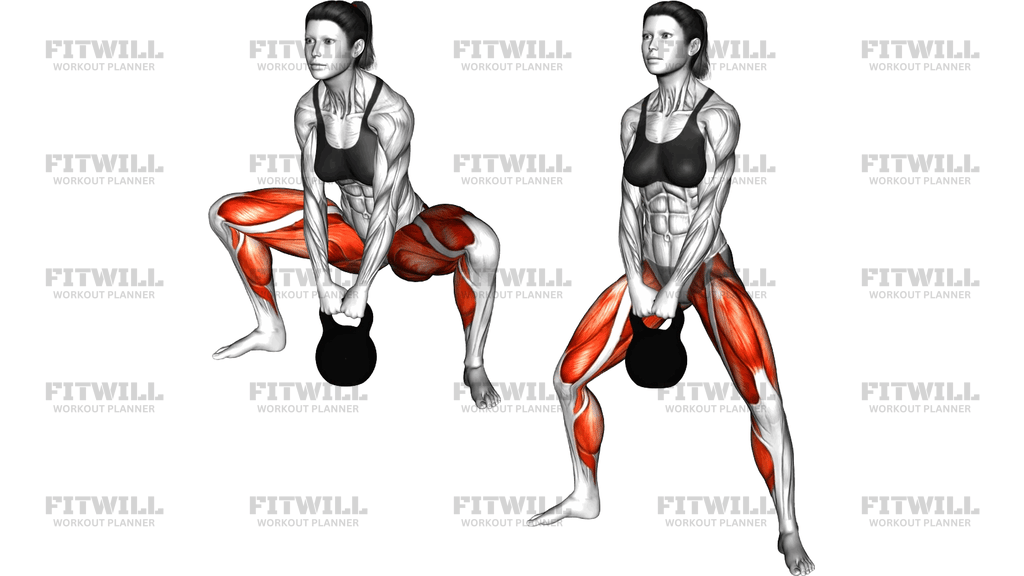
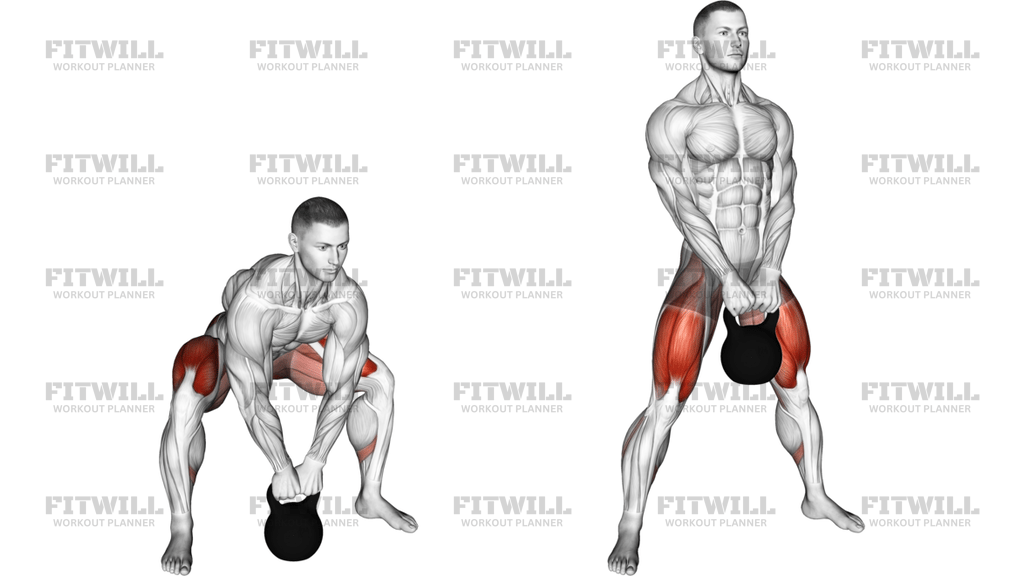
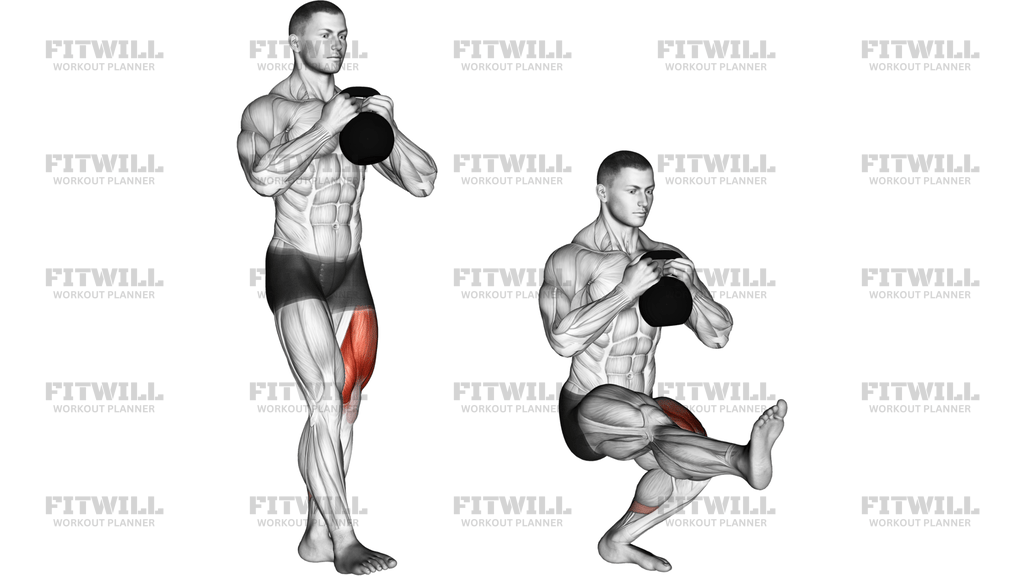
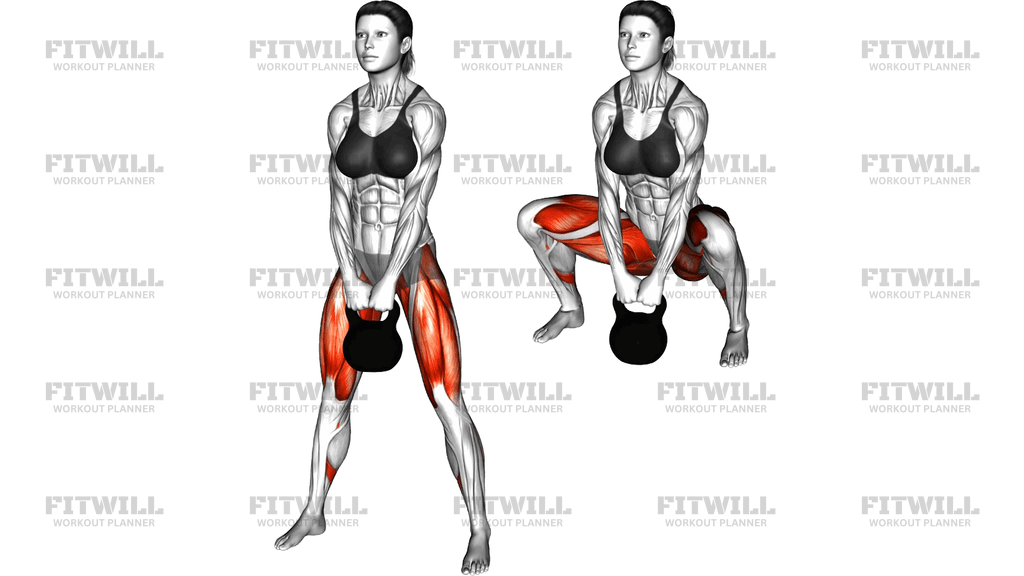
Kettlebell Goblet Single Leg Split Squat
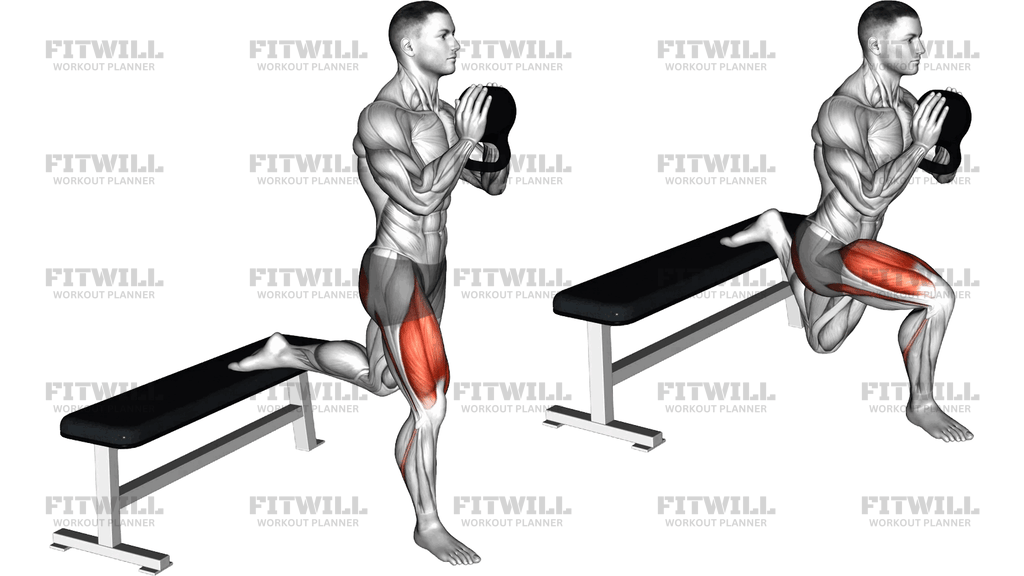
The Kettlebell Goblet Single Leg Split Squat is a rear-foot-elevated split squat — often called a Bulgarian split squat — performed with a kettlebell held at chest height in the goblet position. Your rear foot rests on a flat bench behind you while the front leg handles virtually all of the work as you lower into a deep split stance and drive back up. Because the load sits against your chest rather than hanging at your sides or on your back, the weight stays close to your center of mass, which makes balancing far easier than holding dumbbells and lets you focus on the working leg.
This movement is one of the most effective ways to load the quads unilaterally. Elevating the rear foot shifts more of the demand onto the front leg, and the deeper you squat, the more the quadriceps are emphasized — the highlighted musculature in this pattern is squarely the front thigh. The glutes and hamstrings of the front leg assist strongly out of the bottom, while the glute of the elevated leg gets a long stretch, and your calves, hips, and core work continuously to keep you from wobbling sideways.
Setup matters more here than in most leg exercises because your stance is fixed the moment your rear foot hits the bench. A front foot planted too close to the bench forces the front knee far over the toes and crowds the movement; too far away turns it into a lunge-heavy pattern and limits depth. Take a moment to find a split stance roughly two to three foot-lengths long, then commit to it before you pick up the kettlebell.
Execution is simple in theory: lower straight down until your front thigh is at least parallel to the floor and your rear knee hovers just above the ground, then push the floor away through your whole front foot. The common breakdowns are rushing the descent, letting the torso collapse forward, and letting the front knee cave inward. Slowing down and keeping the chest tall behind the kettlebell fixes most of them.
This exercise earns its place in almost any program. Lifters use it to build leg size without heavy barbell spinal loading, athletes use it to address side-to-side strength differences, and anyone with cranky lower-back history often finds the goblet hold far friendlier than a back squat. It pairs well with squats or deadlifts as a secondary movement, and it works well on its own when equipment is limited to a kettlebell and a bench.
[ Workout Log & Planner ]
Put your next workout in Fitwill
Keep your plan and training log ready when you are.


Instructions
- Place a flat bench behind you and stand facing away from it. Position one foot about two to three foot-lengths in front of you, then reach back and place the top of your other foot on the bench so your shoelaces face down and your rear knee points toward the floor.
- Clean a kettlebell to your chest and hold it by the horns with both hands, elbows tucked close to your ribs. This goblet position keeps the weight anchored against your sternum for the entire set.
- Shift your weight fully onto the front foot, press it flat into the floor, and brace your core as if preparing for a light punch to the stomach.
- Keeping your chest tall and shoulders back, bend your front knee and lower your hips straight down, letting the rear knee travel toward the floor behind you.
- Descend until your front thigh is at least parallel to the floor and your rear knee is just above or lightly touching the ground. Your front knee should track over or slightly inside your toes, not collapse inward.
- Drive through the middle and heel of the front foot to stand back up, pushing the floor away rather than pulling with the rear leg.
- Exhale as you rise, and inhale at the top or on the way down — pick one rhythm and keep it consistent across all reps.
- Complete all reps on one leg, then set the kettlebell down, switch your rear foot to the bench, and repeat on the other side.
- Between sets, step fully away from the bench to reset your stance rather than trying to shuffle your feet while loaded.
Tips & Tricks
- If you lose balance on every rep, your stance is probably too narrow side to side. Widen your front foot slightly outward — an inch or two — so your hips have a stable base under the kettlebell.
- A common mistake is placing the front foot too close to the bench, which slams the front knee over the toes and pinches at the bottom. Step the front foot farther forward and retest your depth.
- The kettlebell will drift away from your chest when you fatigue, turning the goblet hold into a front raise. Re-tuck your elbows and keep the bell touching your sternum throughout the rep.
- Do not let the rear leg do the lifting. The rear foot is a kickstand, not a second engine — if your back leg is pushing hard, lighten the weight and drive only through the front foot.
- Control the lowering phase for two to three seconds. The eccentric is where most of the quad-building stimulus lives, and dropping fast usually means your front knee travels forward and your heel lifts.
- If your rear foot hurts on the bench, pad it or point the toe more so less weight sits on the top of the foot. Discomfort there makes people unconsciously shorten the range.
- Keep your front heel glued to the floor. A rising heel signals the load has shifted too far forward — sit back slightly and let the knee travel forward less aggressively.
- Start with body weight or a very light kettlebell for your first few sessions. This movement exposes hip and ankle mobility limits that a bilateral squat hides, and learning the groove before adding load prevents most form errors.
- If your torso pitches far forward, that is usually tight hip flexors on the rear leg or a weak brace. Elevate the rear foot less steeply — a lower step or even the floor — until your mobility improves.
Frequently Asked Questions
Which muscles does the Kettlebell Goblet Single Leg Split Squat work hardest?
The quadriceps of the front leg are the primary movers, especially at deeper ranges. The front-side glutes and hamstrings assist heavily, the stretched hip flexors of the elevated rear leg get a useful stretch, and the core and calves stabilize throughout.
Is the Kettlebell Goblet Single Leg Split Squat suitable for beginners?
Yes, but learn it unloaded first. Practice the split stance and descent with no weight until you can complete ten controlled reps per side without wobbling, then add a light kettlebell in the goblet position.
Why hold the kettlebell at the chest instead of at the sides?
The goblet position keeps the weight close to your center of mass, which dramatically improves balance on one leg. It also encourages an upright torso and lightens the grip demand compared with holding a heavy dumbbell in each hand.
How high should the bench be for the rear foot?
A standard flat bench of roughly knee to mid-thigh height works for most people. If your hips or rear knee complain, drop to a lower step — the movement still trains the front leg effectively with less elevation.
My front knee hurts during the Kettlebell Goblet Single Leg Split Squat. What should I change?
First check that your front foot is far enough from the bench and your whole foot stays planted, especially the heel. Shorten the depth slightly, slow the descent, and make sure the knee tracks over the toes rather than caving inward. Persistent discomfort should be reviewed by a qualified professional.
How does this differ from a regular split squat or lunge?
Elevating the rear foot shifts more load onto the front leg and allows a deeper range for the front hip and knee, making it harder than a floor-based split squat at the same weight. Unlike a lunge, your feet never travel, so the exercise is easier to load progressively and gentler on balance.
What can I use instead of a kettlebell?
A single dumbbell held vertically at the chest replicates the goblet hold almost exactly. Two dumbbells at the sides also work, though they demand more grip and make balance slightly harder on one leg.
How heavy should I go on this exercise?
Choose a weight you can control for eight to twelve reps per side with a two-second lowering phase and no loss of balance. Because each leg works alone, you will likely start lighter than your bilateral squat numbers suggest.
Should the rear knee touch the floor at the bottom?
Hovering just above the floor is the standard target, and a light, controlled touch is acceptable if you are on a suitable surface. Do not slam or rest on the knee between reps, as that unloads the working leg and breaks tension.