Weighted Plate Jackknife Sit Up
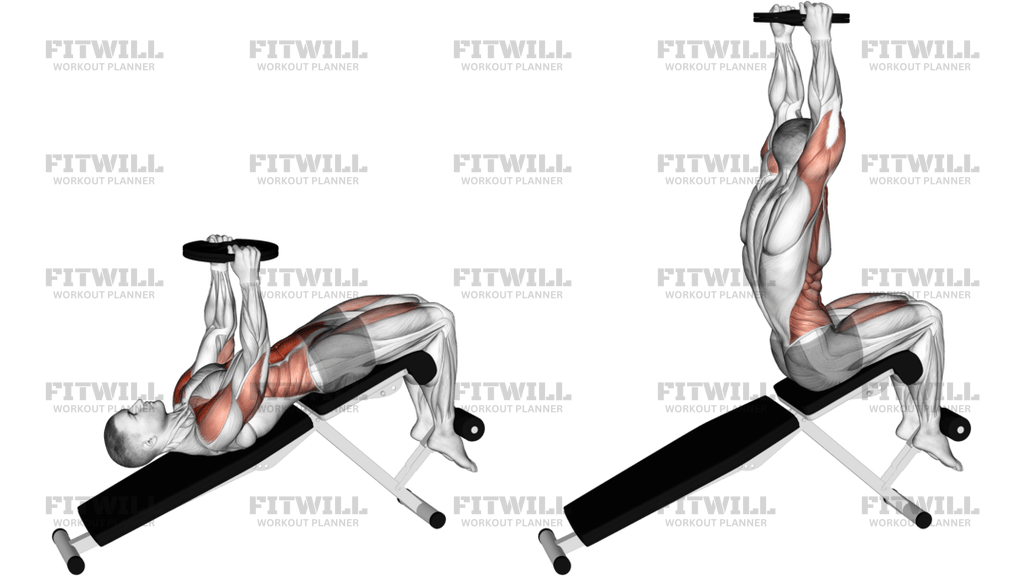
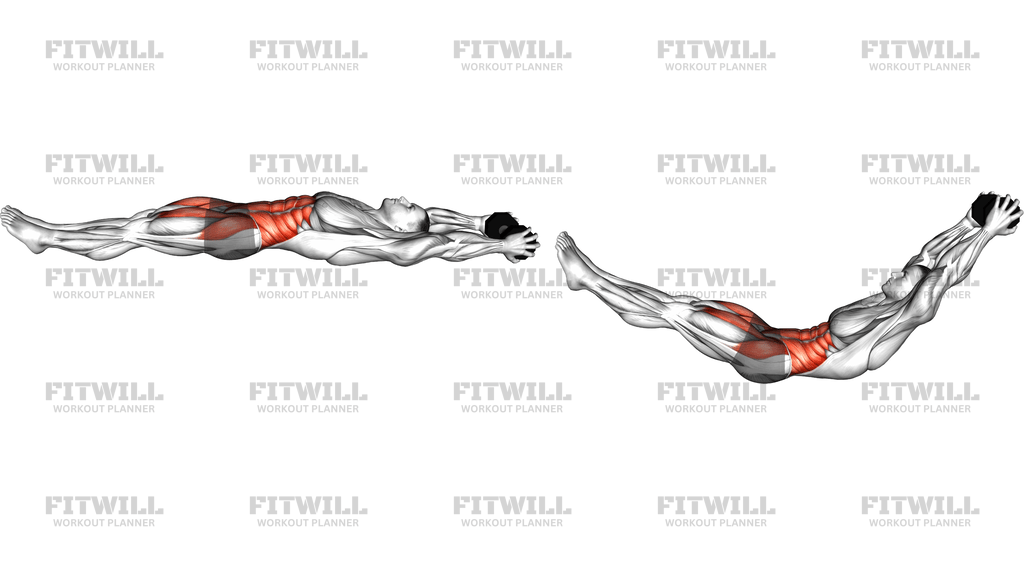
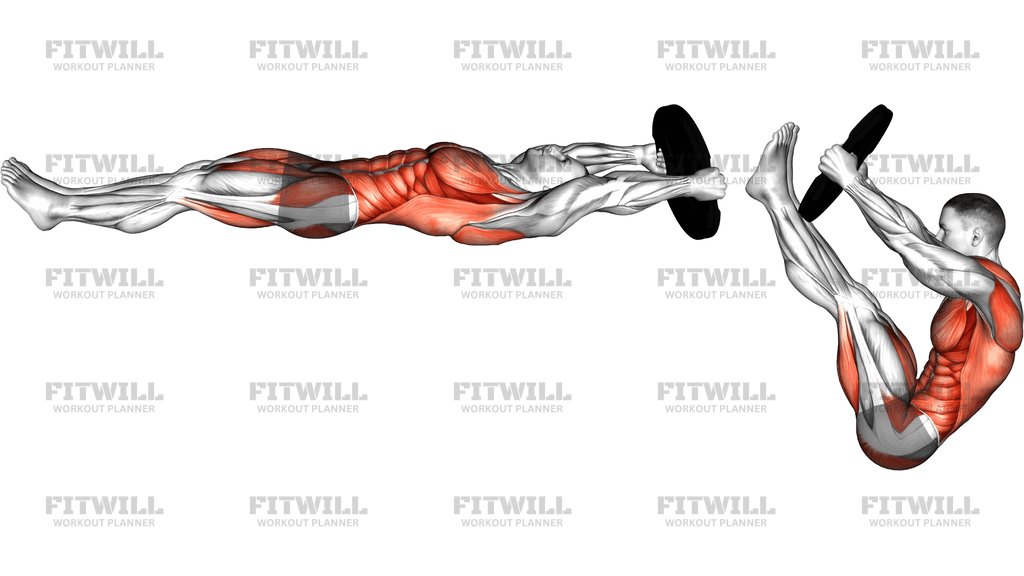
The Weighted Plate Jackknife Sit Up is a floor-based core exercise that combines a leg raise and a trunk curl into one powerful folding movement. You lie flat on your back with a weight plate held in both hands and your arms extended straight overhead. From there, you lift your legs and torso at the same time, meeting at the top so the plate travels toward or past your feet, forming a V shape with your body before lowering back down with control.
This movement earns its place in a training program because it challenges the abs through a much longer range than a standard sit-up. The rectus abdominis works hard to flex the spine, the lower abs and hip flexors drive the leg lift, and holding the plate overhead adds a lever arm that makes every degree harder. Because the arms and legs move together, the exercise also demands coordination and control through the midsection rather than raw hip flexor strength alone.
The setup matters more than most people realize. Lying fully extended with the plate held behind you places the abs under stretch before the rep even starts, which is exactly where the exercise gets its value. If you shorten the starting position by tucking the knees early or letting the plate drift forward, you remove that loaded stretch and turn the movement into an easier, less effective version of itself.
To execute it well, think of folding at the hips and curling the trunk at the same time rather than just yanking your chest toward your knees. Exhale hard as you rise, reach the plate toward your shins or feet at the top, and pause briefly in the V position. The descent should be slow and deliberate; lowering your legs and the plate back to the floor under control is where much of the abdominal work actually happens.
This exercise suits intermediate to advanced lifters who already handle bodyweight jackknifes or lying leg raises comfortably. It fits well as a finishing movement on core days, in abdominal circuits, or as a progression for anyone whose bodyweight ab work has stalled. Start with a light plate, something you could hold overhead for the full set without your grip or shoulders becoming the limiting factor.
A few safety points are worth respecting. Keep your lower back prepared to stay in contact with or lower slowly toward the floor rather than slamming down, and stop the set if you feel your lumbar spine arching aggressively or any pinching at the front of the hips. Quality reps with a modest plate will build more usable core strength than sloppy reps with a heavy one.
[ Workout Log & Planner ]
Put your next workout in Fitwill
Keep your plan and training log ready when you are.


Instructions
- Lie flat on your back on the floor with your legs fully extended and your arms extended straight overhead behind you.
- Grip a weight plate securely with both hands on its sides, keeping your arms straight and the plate resting lightly on or just above the floor behind your head.
- Brace your abdominal muscles and gently press your lower back toward the floor to set a stable starting position.
- Exhale as you raise your straight legs and curl your torso upward at the same time, folding your body at the hips.
- Continue lifting until you reach a V position, bringing the plate in your hands toward your feet or shins at the top.
- Pause briefly in the folded position and squeeze your abdominal muscles hard at the peak of the movement.
- Inhale as you slowly lower your torso and legs back down together, resisting gravity instead of dropping.
- Let the plate return to the starting position behind your head while keeping your arms straight, and lightly touch down without fully relaxing.
- Reset your brace and repeat for the desired number of repetitions, keeping the tempo smooth on every rep.
Tips & Tricks
- If your heels or the plate bang down between reps, you are lowering too fast; slow the descent until both limbs touch down quietly.
- Bent knees are the most common compensation on this movement. They shorten the lever and shift work to the hip flexors, so keep your legs as straight as your flexibility allows.
- If your grip or shoulders fatigue before your abs, the plate is too heavy. Switch to a lighter plate so the abdominal muscles stay the limiting factor.
- Avoid yanking your head and neck forward to reach the top; drive the curl from your ribcage toward your pelvis and keep your neck in line.
- If you feel your lower back arch and lift off the floor during the descent, do not lower your legs all the way down. Stop the descent a few inches higher and rebuild the range gradually over weeks.
- Pausing for a full second in the V position makes a light plate feel much heavier and improves control at the top end of the range.
- Exhaling sharply as you fold helps your abs contract more fully; holding your breath through the whole rep usually leaves the top position incomplete.
- Keep the plate held at its sides rather than pinched flat between your palms, which keeps your wrists neutral and your arms straight overhead.
Frequently Asked Questions
What muscles does the Weighted Plate Jackknife Sit Up work?
The rectus abdominis is the primary mover, with strong involvement from the lower abs and hip flexors as you raise your legs. The obliques and deeper core muscles stabilize your trunk throughout the folding motion.
Is the Weighted Plate Jackknife Sit Up suitable for beginners?
It is best treated as a progression once you can perform bodyweight jackknife sit ups or straight-leg lying leg raises with good control. Beginners can start without the plate or with bent knees to learn the folding pattern first.
How heavy should the weight plate be for this exercise?
Choose a plate light enough that your abs, not your grip or shoulders, are what limit the set, typically starting at 5 to 10 pounds. Progress in small increments only when you can complete all reps with straight arms and legs and a controlled lowering phase.
Why do I feel the Weighted Plate Jackknife Sit Up in my hip flexors more than my abs?
This usually means your knees are bending or you are lifting your legs without curling your trunk, letting the hip flexors do most of the work. Focus on simultaneously pulling your ribcage toward your pelvis and keep your lower back pressed toward the floor as you rise.
Should my arms stay straight during the Weighted Plate Jackknife Sit Up?
Yes, keeping your arms straight overhead preserves the long lever that makes the exercise effective. Bending the elbows to swing the plate forward shortens the lever and turns the movement into a partial, less demanding version.
What can I use instead of a weight plate?
A dumbbell held in both hands, a medicine ball, or a small sandbag can replace the plate. You can also perform the movement with no weight at all and simply progress by slowing the tempo or adding a pause at the top.
Is it bad if my lower back arches as I lower my legs?
Some movement is normal, but a forceful arch that lifts your lower back well off the floor under load can strain the lumbar area. Limit your range of motion to the point where you can keep your back lowering under control, and build the range gradually over time.
How many repetitions of the Weighted Plate Jackknife Sit Up should I do?
Because it is a demanding compound core movement, sets of 8 to 15 controlled reps work well for most lifters. Focus on full range and smooth tempo rather than chasing high numbers with a heavy plate.
How is the Weighted Plate Jackknife Sit Up different from a regular sit-up?
A regular sit-up mainly curls your torso while your legs stay anchored, whereas the jackknife lifts your legs and torso together into a V position. This trains the abs through a longer range and adds significant hip flexor involvement along with the loaded stretch at the bottom.