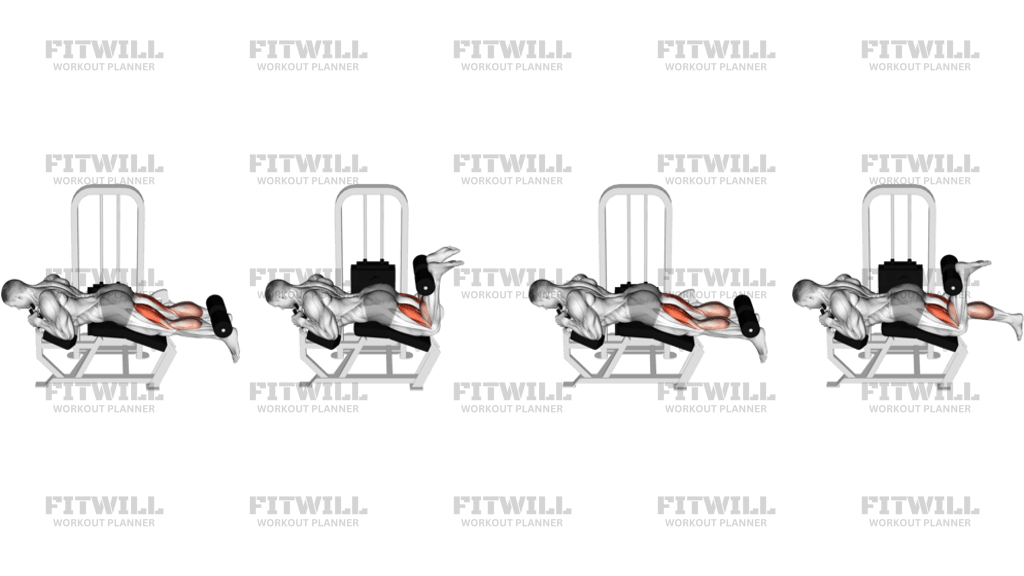
Lever Lying Leg Curl (Plate Loaded)
The Lever Lying Leg Curl (Plate Loaded) is a plate-loaded machine exercise performed face down on a padded bench, with a lever arm carrying padded ankle rollers that you curl up toward your hips by bending the knees. Because you lie prone with your torso supported and your hands gripping fixed handles, the machine isolates knee flexion almost entirely, making it one of the most direct ways to load the hamstrings through their shortening range.
The primary target is the hamstring group at the back of the thigh, with the two-headed biceps femoris doing much of the visible work, supported by the semitendinosus and semimembranosus. The gastrocnemius in the calf crosses the knee joint and assists with flexion, which is why keeping the ankles relaxed changes how the set feels. The glutes and lower back stay largely isometric, holding your pelvis and torso steady against the bench rather than actively moving the weight.
This movement suits lifters who want dedicated hamstring volume without the balance and lower-back demands of Romanian deadlifts or Nordic curls. It is a staple in general leg training, useful for people rebuilding strength after long gaps in training, and popular with field-sport and sprint athletes since strong knee flexors contribute to sprint mechanics and deceleration. Because the resistance travels on a fixed lever path, it is also approachable for beginners who have not yet learned to control free-weight hip hinge patterns.
Setup matters more on this machine than most people expect. The ankle rollers should sit on the lower calf, just above the Achilles, and your knees should line up with the machine's pivot point rather than hanging off the edge of the bench. If your hips lift as you curl, the set loses hamstring tension and shifts work toward the lower back and glutes. Taking a moment to align the pad, chest, and hips before your first rep pays off across every set that follows.
Execution is simple but easy to rush. Curl your heels toward your glutes until the knees are fully flexed, pause briefly to keep tension at the top, then lower the lever back under control instead of letting the plates or lever arm drop. Two to four sets of eight to fifteen reps works well for most goals, with heavier loads suited to the lower end of that range as long as the tempo stays controlled.
A few practical points keep the exercise productive. Grip the handles so your shoulders stay pinned to the bench, exhale on the curl and inhale on the way down, and never bounce the weight out of the stretched position. If the inside or outside of one knee complains, check that your feet are hip-width apart and toes pointing straight down before adding load.
[ Workout Log & Planner ]
Put your next workout in Fitwill
Keep your plan and training log ready when you are.


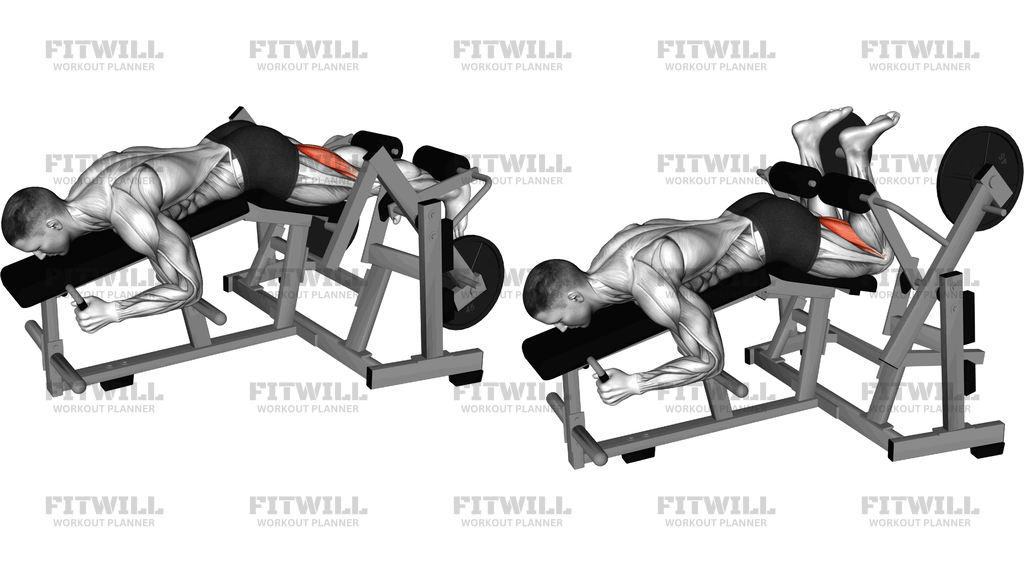
Instructions
- Lie face down on the bench of the Lever Lying Leg Curl (Plate Loaded) machine so your kneecaps hang just past the edge of the pad and your knees line up with the lever's pivot point.
- Position the padded ankle rollers on the back of your lower calves, a few centimeters above your Achilles tendons, and load the weight plates to a manageable starting resistance.
- Grip the fixed handles at the front of the bench firmly and pull your chest and shoulders down onto the pad so your torso stays flat and stable.
- Brace your core lightly and press your hips into the bench; your pubic bone should stay in contact with the pad throughout the set.
- Exhale and curl your heels up toward your glutes by bending your knees, letting the lever arm travel smoothly through its arc without kicking or jerking.
- Curl until your knees are fully flexed or the lever reaches its stop, and hold the top position for a brief pause with your hamstrings squeezed.
- Inhale and lower the lever slowly back to the starting position, resisting the weight on the way down instead of letting it drop.
- Stop just short of full knee extension so tension stays on the hamstrings, then begin the next rep.
- Complete all reps with the same tempo, then release the handles, let the lever settle fully, and step off the machine carefully before changing the load.
Tips & Tricks
- If your hips rise off the bench as you curl, the weight is too heavy or you are curling too explosively — reduce the load and think about driving your hips down into the pad.
- Point your toes straight down (plantarflexed) if you want less calf involvement; pulling the toes toward your shins lengthens the gastrocnemius and makes the calves contribute more.
- Do not let your knees drift off the pivot point during the rep — if your kneecaps slide back onto the bench, shift your whole body position down before the next set.
- A common mistake is bouncing the lever out of the bottom stretch; catch the weight just short of full extension and reverse smoothly to protect the back of the knee.
- Squeeze the top contraction for one to two seconds rather than racing through the range — the hamstrings respond well to a deliberate pause at full flexion on this machine.
- Grip the handles hard and keep your elbows tucked; letting your chest lift or your shoulders shrug usually means the pad position or weight needs adjusting.
- Keep both legs working evenly — if one side is taking over, slow the tempo down and check that the ankle rollers are centered on both calves.
- For a stronger stimulus without adding plates, add a slow five-second lowering phase on your final one or two reps of each set.
Frequently Asked Questions
Which muscles does the Lever Lying Leg Curl (Plate Loaded) work?
The hamstrings are the primary movers, especially the biceps femoris, with the semitendinosus and semimembranosus assisting. The gastrocnemius in the calf helps with knee flexion, while the glutes and lower back work isometrically to hold your position.
Where should the ankle pad sit on a plate-loaded lying leg curl?
The padded rollers should rest on the back of your lower calves, just above the Achilles tendon. Placing the pad directly on the Achilles or too high behind the knee reduces comfort and changes the leverage.
Is the Lever Lying Leg Curl (Plate Loaded) suitable for beginners?
Yes. The fixed lever path and supported prone position make it one of the safest ways to learn hamstring-dominant training, since balance and lower-back control are not major factors. Start light and focus on a smooth, controlled tempo.
Why do my hips lift off the bench during the curl?
Hip rise usually means the load is too heavy, the pad is positioned too far down the calf, or you are kicking the weight up instead of curling it. Lower the weight, check the pad placement, and deliberately press your hips into the bench on every rep.
How does the lying version differ from a seated leg curl?
The lying position puts the hip in a extended position, which places the hamstrings under a long stretch at the knee and many lifters feel it more in the biceps femoris. Seated curls keep the hip flexed, which increases the stretch across the whole muscle and can favor the semitendinosus.
What can I use instead of the Lever Lying Leg Curl (Plate Loaded)?
A cable leg curl with an ankle strap, a stability ball hamstring curl, or Nordic-style curls all train knee flexion. The plate-loaded machine is simply the most supported and easiest to progress in small increments.
Should my toes be pointed or pulled back during this exercise?
Either works, but the choice changes calf involvement. Pointing the toes reduces gastrocnemius contribution and keeps the focus on the hamstrings, while pulling the toes toward your shins recruits more calf in the curl.
How many sets and reps should I do on this machine?
Two to four sets of eight to fifteen controlled reps cover most strength and muscle goals. Because the machine isolates a single joint, moderate loads with strict tempo generally beat heavy sets where the hips start lifting.
Is it safe to go heavy on the lying leg curl?
It is generally safe when your knees stay aligned with the pivot, your hips stay down, and you control the lowering phase. Avoid bouncing out of the fully stretched position and stop the set if you feel pinching at the back of the knee.