Seated Bent Knee Abduction
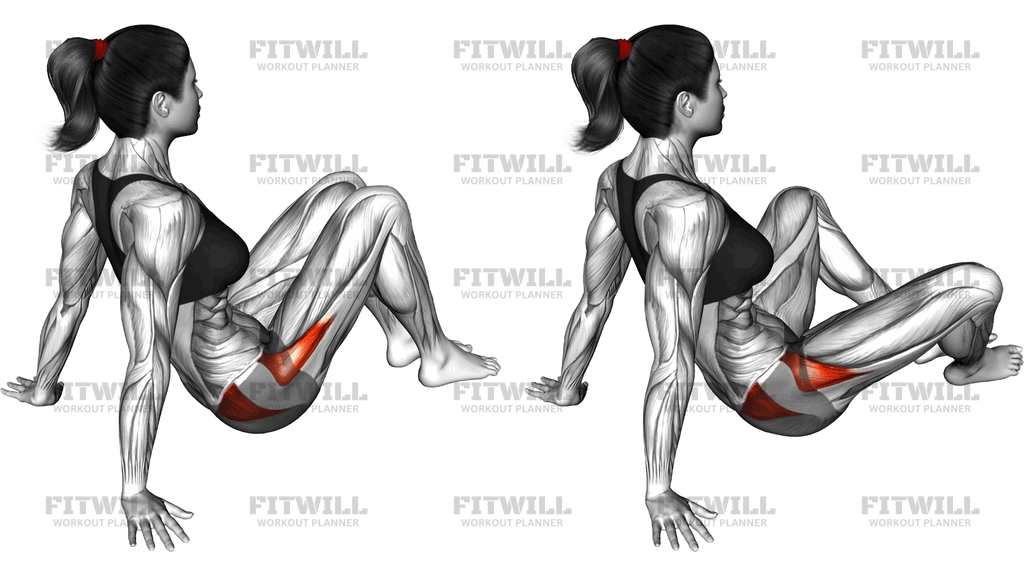
Seated Bent Knee Abduction is a simple floor exercise that trains the outer hips without any equipment. You sit on the floor with your hands planted behind your hips, knees bent in front of you, and then sweep both bent knees down toward the floor on one side before returning through the center and repeating on the other. Because your torso is supported by your arms, the hips are free to move through a wide, controlled range, and the whole thing can be done in a space barely bigger than a yoga mat.
The main work happens in the gluteus medius and the surrounding outer-hip muscles, with the gluteus maximus assisting as the hips rotate. The side the knees move toward gets a strong controlling load, while the opposite hip lengthens and then pulls the legs back to center. That combination of lengthening under control and actively returning is exactly what makes this useful for people whose hips feel stiff from sitting, or who want to switch their glutes on before heavier lower-body work.
Setup matters more than it looks. Sitting tall on your sit bones with your hands a comfortable distance behind your hips keeps your chest open and stops you from slumping into your lower back as the knees travel. Bend the knees to roughly ninety degrees and keep the feet relaxed on the floor so the movement comes from the hips rather than from shoving off with the legs.
To execute it well, keep your shoulders and chest facing forward the entire time while only the hips and knees move. Lower the knees to one side slowly, pause briefly at your comfortable end range, then lift them back through center with the same control before going to the other side. The temptation is to rush and use momentum to flop from side to side; slowing the tempo down is what turns this from a casual stretch into genuine abduction strength work.
This exercise fits naturally into warm-ups, glute activation circuits, cool-downs, and home routines where no bands or machines are available. It also works well as a low-impact option for anyone returning to training who wants to rebuild hip control before progressing to standing abduction, banded work, or hip thrusts.
Keep the range honest: the knees only need to travel as far as you can control without twisting your upper back or feeling pinching in the front of the hip. If your wrists complain about supporting your torso, bend your elbows slightly or rest your hands on a raised surface. Stop short of any sharp pain in the outer hip or lower back and build range gradually over sessions.
[ Workout Log & Planner ]
Put your next workout in Fitwill
Keep your plan and training log ready when you are.


Instructions
- Sit on the floor or a mat with your knees bent in front of you at roughly ninety degrees, feet flat on the floor about hip-width apart.
- Place your palms flat on the floor behind your hips with your fingers pointing outward or back, arms straight, and lean your torso back slightly so your weight rests on your hands and sit bones.
- Sit up tall, gently brace your abdominal muscles, and pull your shoulders down away from your ears so your chest stays open.
- Keeping both knees bent and your chest facing forward, slowly rotate both knees down toward the floor on your right side, letting the hips pivot naturally.
- Stop when you feel the outer hip of the leading side working or a firm stretch on the opposite side, and pause there for a second.
- Lift the knees back up through the center under control, then lower them down toward the left side to complete one alternating rep.
- Breathe out as the knees lower to one side and breathe in as you bring them back through center.
- Keep your hands planted and your shoulders level the whole time; do not let your torso collapse or rotate toward the moving side.
- Continue alternating sides for your target number of reps, then bring the knees back to center, sit upright, and shake out the hips before the next set.
Tips & Tricks
- If you feel the movement in your lower back rather than your hips, your range is too large. Shorten the sweep until the motion clearly comes from the hip joints.
- Do not let your feet slide or push off the floor. If the legs are driving the movement, the glutes stop doing the work; keep the feet light and passive.
- A common mistake is letting the chest rotate toward the side the knees are dropping to. Face forward and treat the upper body as locked in place.
- Keep the knees bent at a consistent angle throughout. Straightening the legs mid-rep turns it into a different, looser movement and reduces the outer-hip work.
- If your wrists ache from supporting your torso, turn your hands slightly outward, soften your elbows, or place your hands on a low bench or yoga blocks instead of the floor.
- Add difficulty by slowing the lowering phase to a two- or three-second count or by pausing two seconds at the end range of each side.
- Sit far enough forward on your sit bones that you are not rocking back onto your tailbone; a rounded, slumped base is the most common setup error here.
- Alternate sides continuously for a balanced warm-up effect, or do all reps on one side first if you are trying to fatigues a specific hip deliberately.
- Use a mat or soft surface. The movement is comfortable on a rug or mat but unpleasant on a hard floor, which can make you alter your posture to protect your sit bones.
Frequently Asked Questions
Which muscles does Seated Bent Knee Abduction work?
It primarily targets the gluteus medius on the outer hip, with the gluteus maximus assisting as the hips rotate and the knees sweep toward the floor. The deep hip stabilizers also work to keep the motion controlled.
Should my knees touch the floor during Seated Bent Knee Abduction?
No, touching the floor is not required. Lower the knees only as far as you can control without your upper back twisting or your lower back rounding, and let your range grow gradually over time.
Why do I lean back on my hands for this exercise?
Supporting your torso on your hands removes the balance demand and lets the hips move through a wider range than you could manage standing. It also makes the exercise accessible for beginners or anyone with limited hip mobility.
Can beginners do Seated Bent Knee Abduction?
Yes, it is one of the most beginner-friendly hip exercises because it uses only body weight and a supported position. Start with a small, slow range and focus on feeling the outer hips rather than chasing floor contact.
Why do I feel Seated Bent Knee Abduction in my lower back instead of my hips?
This usually means you are rotating through your spine instead of your hip joints, or sweeping the knees further than your hips allow. Sit taller, shorten the range, and keep your chest facing forward throughout the rep.
Do my feet stay on the floor the whole time?
Keep them resting lightly on the floor as a reference point, but they should not push or slide. If your feet are driving the movement, your glutes are no longer doing the work.
How is Seated Bent Knee Abduction different from a seated abduction machine?
The machine lifts the knees straight out to the sides against resistance, while this version sweeps the bent knees down and across toward the floor using body weight. It emphasizes hip rotation and control rather than pure lateral force.
What can I use instead of Seated Bent Knee Abduction?
Clamshells, banded seated abductions, or standing cable hip abductions all train the same outer-hip muscles. This version is simply the most convenient when you have no equipment and want to work from the floor.
Can I do Seated Bent Knee Abduction every day?
Yes, its low load makes it suitable as a daily warm-up or mobility drill. If you train it as a strength set with slow tempo and pauses, give the hips a rest day between harder sessions like any other muscle work.
My wrists hurt when I support myself behind my hips. What should I do?
Turn your fingers slightly outward, keep a small bend in your elbows to shift some load into the arms, or place your hands on a low step or blocks. If wrist discomfort continues, choose a side-lying option like clamshells instead.