Resistance Band Seated Bent Knee Abduction Feet
Resistance Band Seated Bent Knee Abduction Feet is a floor-based hip exercise where you sit upright, support yourself with your hands behind you, and press your bent knees apart against a looped resistance band wrapped around your thighs just above the knees. The key difference from the standard seated abduction variation is that your feet stay lifted slightly off the floor for the whole set, which removes the chance of bracing through the heels and forces the hip muscles to do all of the work. The highlighted area in the movement is the side and back of the hip, specifically the gluteus medius and upper gluteus maximus.
This exercise fits well into glute-focused sessions, warm-ups before squats or deadlifts, and rehab-style programming for hip stability. Because you are seated with a neutral, rounded-back-leaning torso supported by your arms, there is very little spinal loading, making it a good choice for people who want targeted hip work without standing or heavy equipment. It is also useful for runners and lifters who need to strengthen hip abduction in a shortened, bent-knee position that standing band walks do not cover.
The setup matters more than it looks. Leaning back with your hands planted behind you lets you keep your chest open and your pelvis in a stable position, and lifting the feet means your hip abductors cannot borrow help from a planted stance. The band should sit above the knees with light tension at the starting width, so your knees are already working slightly before you begin each rep.
To execute it well, start with the knees together, feet hovering just off the floor, and open the knees outward against the band by rotating from the hips rather than swinging the lower legs. Pause briefly at the widest point, then close with control instead of letting the band snap the knees back together. Keep the movement smooth and the torso quiet; if your shoulders are shrugging or your hips are rocking with each rep, the band is too strong.
Common use cases include glute activation circuits, home workouts where the only equipment is a loop band, and finishing sets after heavier hip exercises. Because the range is small and the resistance is light, it works best for higher reps and quality contractions rather than maximal effort. Expect the outer hip to burn well before the set feels long.
For safety and form, keep the band clear of the back of the knees, avoid forcing the knees wider than comfortable, and stop if you feel pinching at the front of the hip. If your lower back takes over or your feet drop to the floor, reduce the band tension or let the feet rest lightly down while keeping the same knee action.
[ Workout Log & Planner ]
Put your next workout in Fitwill
Keep your plan and training log ready when you are.


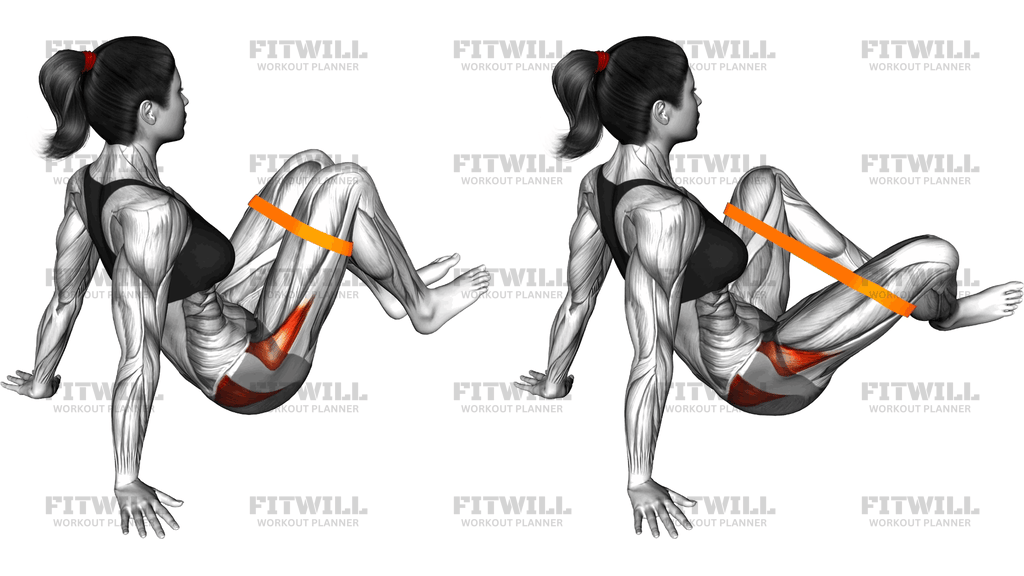
Instructions
- Sit on an exercise mat with a loop resistance band wrapped around both thighs just above your knees.
- Lean back and place your palms flat on the floor behind your hips, fingers pointing away from you, with your elbows soft.
- Bend your knees to about 90 degrees and lift both feet a few inches off the floor so they hover for the entire set.
- Draw your shoulder blades down, brace your abdominals, and let the band pull your knees gently toward each other to set the starting position.
- Press both knees outward and apart against the band, rotating from the hip joints while keeping the feet lifted and close together in space.
- Pause for one to two seconds at the widest point where the band tension is highest, feeling the work along the outer hip.
- Slowly bring the knees back together with control, resisting the band rather than letting it snap them closed.
- Exhale as you press the knees apart and inhale as you return them to the starting width.
- Complete your reps, then lower the feet to the floor before sliding the band off your legs.
Tips & Tricks
- If your feet keep dropping to the floor mid-set, the band is likely too heavy; switch to a lighter loop so the hips, not momentum, control the knees.
- Keep your weight balanced across both hands; sinking into one shoulder makes the pelvis tilt and steals work from the outer hip on that side.
- Think about spreading the knees like a hinge opening rather than kicking the feet outward, so the rotation happens at the hip instead of the ankle.
- A short pause at the widest point is worth more than extra speed, since the band's resistance peaks exactly where most people rush.
- If the band rolls or slides up your thighs, choose a flat loop band with more grip or reposition it mid-thigh where it sits flatter.
- Keep your neck relaxed and gaze forward; craning to watch your knees often rounds the upper back and shortens the range.
- Feel pinching at the front of the hip? Reduce how far the knees open and keep the press within a comfortable, crease-free arc.
- For a harder version without changing bands, slow the closing phase to a three-count so the outer hips work eccentrically against the band.
Frequently Asked Questions
Which muscles does Resistance Band Seated Bent Knee Abduction Feet work?
The primary muscles are the gluteus medius and upper gluteus maximus on the outer hip, with the deep hip rotators assisting. Your core and arms work isometrically to hold the seated, leaned-back position.
Why are the feet lifted off the floor in this exercise?
Keeping the feet hovering removes the floor as a bracing point, so the hip abductors have to control the knees entirely on their own. It also makes it harder to cheat by pushing through the heels.
Where exactly should the resistance band sit?
Place the loop just above your knees, around the lower thighs. Above the knee gives the best leverage for abduction and keeps the band from sliding down during the press.
Is Resistance Band Seated Bent Knee Abduction Feet good for beginners?
Yes, it is a low-load, floor-based exercise that is easy to control. Beginners should start with a light band, smaller range, and let the feet rest lightly on the floor until the hip position feels stable.
How many reps should I do?
Because resistance is light, aim for 12 to 20 controlled reps per set, stopping when the outer hip fatigues or your feet start dropping. Two to three sets is typical for activation or finishing work.
What is the most common mistake in this movement?
Letting the band snap the knees back together instead of resisting the return, which cuts the time under tension in half. Another frequent error is rocking the torso side to side to help the knees open.
Can I do this exercise without a mat?
You can do it on carpet or a firm towel, but a mat protects your hands and sits bones during the leaned-back position. Avoid hard bare floors, which make the hand support uncomfortable.
What can I substitute if I do not have a loop band?
You can perform the same seated bent-knee opening without equipment as an activation drill, though the resistance will be much lower. A mini band or a tied flat band around the thighs works the same way.
Should I feel this in my lower back?
No, the work should stay in the outer hips. If your lower back tires, check that your abdominals are braced and your weight is even on both hands, and shorten the range of the knee press.
Is it safe if my knees click or feel stiff during the press?
Occasional painless clicking is usually harmless, but if there is discomfort, reduce the band tension and how far the knees open. Persistent pain warrants pausing the exercise and getting assessed by a professional.