Resistance Band Kneeling Leg Kickback On Bench
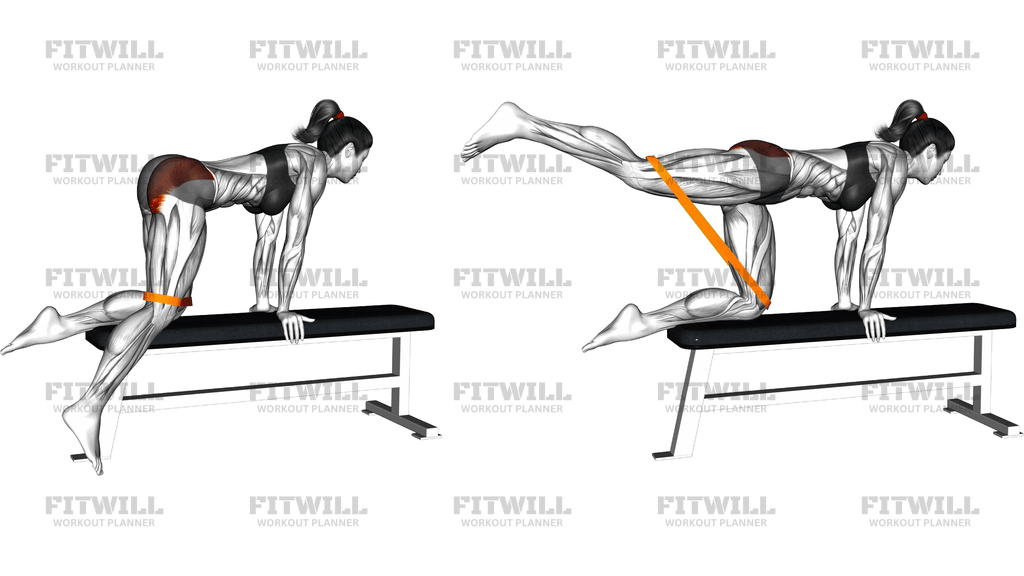
Resistance Band Kneeling Leg Kickback On Bench is a glute isolation movement performed on a flat bench with a loop resistance band providing tension. You kneel on the bench with one knee planted and both hands gripping the edge for support, while the other leg hangs behind you with the band looped around it and anchored against your support leg. From there, you drive the working leg up and back against the band's pull, then lower it under control. Because the band gets tighter as you extend, the hardest part of the rep lands right where the glutes are close to full contraction.
The bench setup is what separates this version from floor-based kickbacks. Elevating your torso and kneeling on the bench puts your hips in a slightly flexed position and gives the leg a clear arc to travel through, which many people find more comfortable on the lower back than kneeling on the floor. The band anchored to the opposite leg also means you don't need a rack, door anchor, or cable station — just a bench and one loop band, which makes this a practical option for home training or busy gym floors.
The primary target is the gluteus maximus, which extends the hip as you kick the leg up and back. The gluteus medius and other hip stabilizers work to keep the leg from swinging outward or rotating, and the hamstrings assist on the drive. Your core and the muscles along the spine work isometrically the entire time to keep your torso from twisting or arching as the leg moves.
This exercise suits lifters who want focused glute work without heavy loading, people rehabbing back into hip extension after lower back irritation, and anyone whose squats and hinges leave their glutes under-stimulated. It's also a common accessory in glute-focused programs, often placed after compound lifts when the muscles are prefatigued and lighter resistance is enough to create a strong working effect.
To get the most from it, treat it as a precision movement rather than a power movement. The band makes it tempting to swing the leg for momentum, but the value comes from a deliberate squeeze at the top and a slow return. Keep the ribs down, avoid rotating the hips open as the leg lifts, and let the height of the kick be dictated by how far you can extend the hip without your lower back taking over. Sets in the 10 to 20 rep range per side work well, and the burn at the top of each rep is a better progress signal than chasing more resistance too quickly.
[ Workout Log & Planner ]
Put your next workout in Fitwill
Keep your plan and training log ready when you are.


Instructions
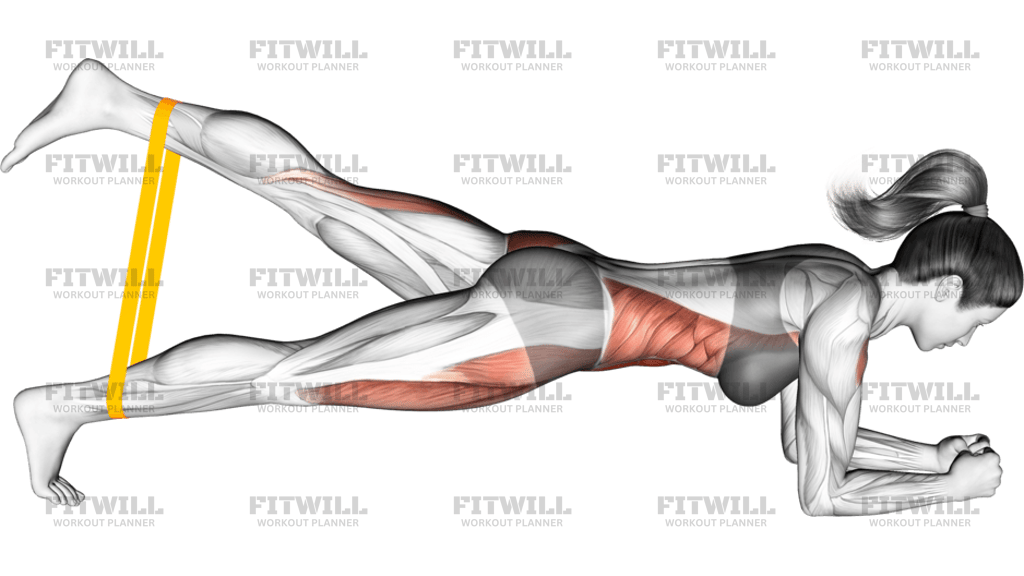
- Place a flat bench in an open area and loop a resistance band around both legs — position it around the working leg near the ankle or calf and around the lower thigh or knee of the leg you'll kneel on, so the band stretches between them.
- Kneel onto the bench with your support knee, setting it roughly in the middle of the pad, and place both hands flat on the bench edge with your arms straight and shoulders stacked over your wrists.
- Let the working leg hang off the back of the bench with the knee slightly soft, feeling light tension in the band before you start the rep.
- Brace your core and tuck your ribs so your back stays neutral and your hips stay square to the bench.
- Exhale and drive the working leg up and back against the band, extending at the hip and squeezing the glute at the top without arching your lower back.
- Pause briefly at the top with the leg roughly level with or slightly above your hip, feeling the glute under tension.
- Inhale and lower the leg slowly back to the hanging start position, keeping tension in the band rather than letting it slack completely.
- Complete all reps on one side, then reposition the band and kneel on the opposite knee to train the other leg.
- Rest briefly between sides and reset your brace each time so your torso position doesn't drift as fatigue builds.
Tips & Tricks
- If the band slips down your leg during the set, move it to a wider point like the calf of the working leg and the mid-thigh of the support leg — a narrower loop tends to roll.
- Watch for hip rotation: as the leg lifts, the same-side hip often opens up to cheat the range. Point your hips down toward the bench and think of kicking straight back, not out to the side.
- A common mistake is kicking so high that the lower back arches and takes over. Cut the height slightly and you'll usually feel the glute working harder, not easier.
- Keep some bend in the working knee throughout. Fully straightening the leg shifts tension toward the hamstrings and makes the band harder to control.
- Press your hands firmly into the bench and keep your shoulders over your wrists. Collapsing into the shoulders turns a glute drill into an upper-body endurance test.
- Use a lighter band than you think you need at first. Because the band is stretched between two legs, tension builds fast and form breaks down quickly with a heavy loop.
- Slow the lowering phase to a two or three count. Most of the muscle-building value on banded work comes from resisting the band on the way down, not the kick itself.
- Place a folded towel under your support knee if the bench pad feels too firm during longer sets.
- If you feel it in the front of the hip instead of the glute, reduce the kick height — overextending the hip can irritate the hip flexor on the return.
Frequently Asked Questions
What muscles does the Resistance Band Kneeling Leg Kickback On Bench work?
The gluteus maximus does most of the work as it extends the hip against the band. The hamstrings assist, the gluteus medius stabilizes the leg's path, and your core and lower back muscles hold your torso steady throughout.
Why kneel on a bench instead of doing this kickback on the floor?
The bench raises your torso and frees the working leg to travel through a longer arc behind you, which many lifters find easier on the lower back. It also keeps your hands at a comfortable height and makes the band setup between both legs easier to maintain.
How is the band positioned in the Resistance Band Kneeling Leg Kickback On Bench?
A loop band is stretched between the working leg, placed around the ankle or calf, and the support leg, placed around the lower thigh or knee area. As you kick back, the band lengthens and the resistance increases toward the top of the rep.
Is this exercise suitable for beginners?
Yes, as long as you start with a light band and focus on controlled reps. Beginners often struggle most with keeping the hips square, so it helps to master the movement bodyweight-only before adding band tension.
How high should I kick my leg during the Resistance Band Kneeling Leg Kickback On Bench?
Kick only as high as you can extend the hip while keeping your back neutral and hips square — usually to about hip height or slightly above. If your lower back arches or your torso twists to gain height, you've gone too far.
What's the most common mistake with this movement?
Swinging the leg for momentum, usually paired with an arched lower back and a rotating hip. Slow the tempo, shorten the range slightly, and focus on squeezing the glute at the top instead of maximizing kick height.
What can I substitute if I don't have a bench?
You can perform the same band-resisted kickback kneeling on the floor or on a sturdy mat with hands on the ground. The range will be slightly shorter, but the glute emphasis stays the same.
How many reps and sets should I do?
Ten to twenty reps per side for two to four sets is a typical working range. Since the resistance is limited by band strength, higher reps with a strong squeeze at the top tend to work better than low-rep grinding sets.
Is the Resistance Band Kneeling Leg Kickback On Bench safe for the lower back?
It's generally a low-load, back-friendly way to train hip extension when performed with a neutral spine and controlled tempo. Keep your core braced, avoid overextending at the top, and reduce range if you feel any strain in your lower back.