Kettlebell Elevated Heel Goblet Squat
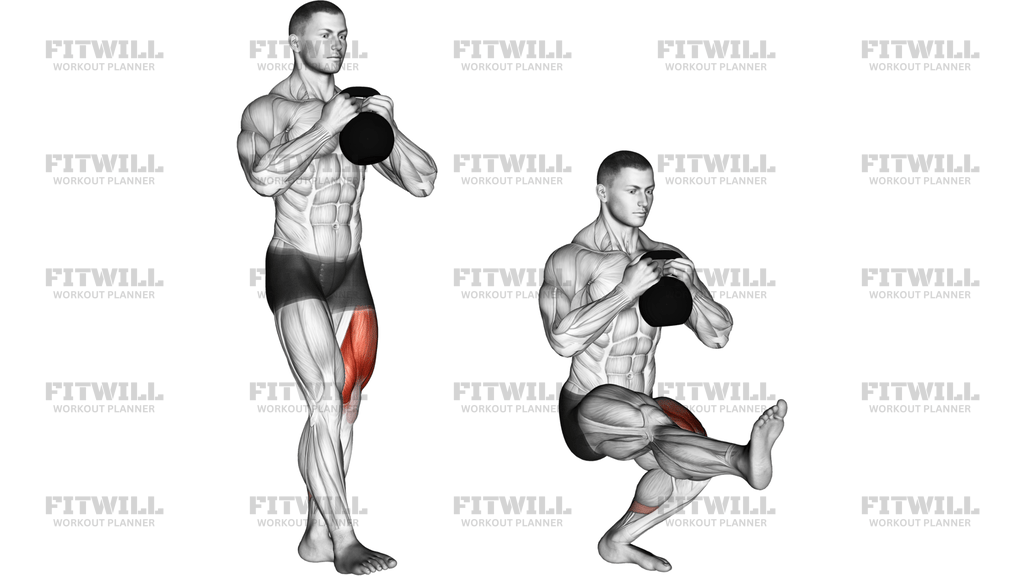
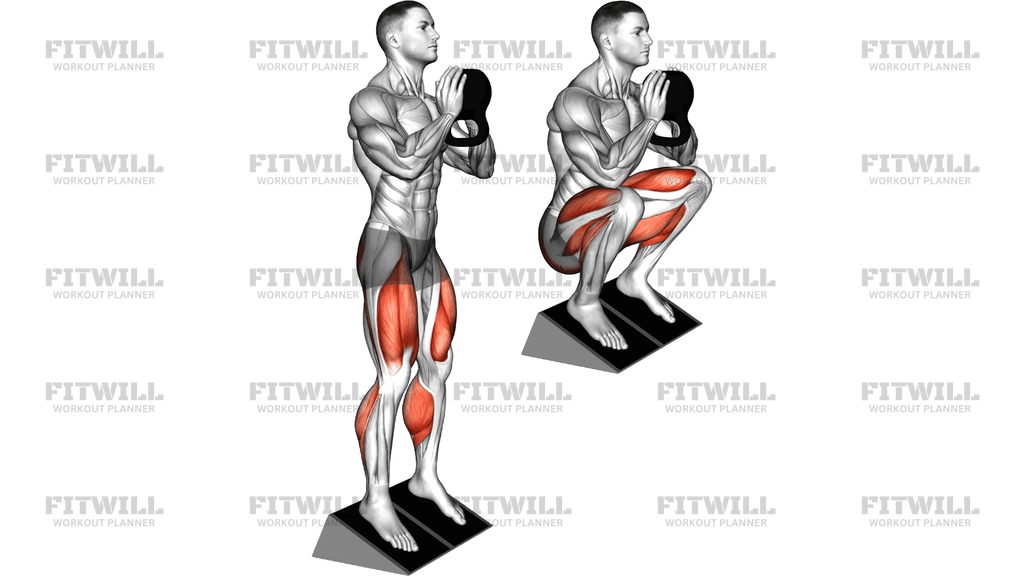
The Kettlebell Elevated Heel Goblet Squat is a front-loaded squat performed with your heels raised on a slant board or wedge platform while you hold a kettlebell against your chest in the goblet position. Elevating the heels shifts your weight slightly forward and allows deeper knee travel over the toes, which changes the emphasis toward the quadriceps and makes it much easier to reach a deep, upright squat without dumping the weight forward or rounding your lower back.
This variation is especially useful for people whose ankles lack the dorsiflexion to squat deeply with flat feet. If your heels lift or your torso collapses when you try a regular deep squat, raising the heels on a wedge instantly gives you that extra range. It is also a favorite among lifters who want to bias the quads specifically, since the more vertical shin angle and upright torso keep constant tension on the front of the thigh through the bottom half of the rep.
The goblet grip does more than just hold the weight. Cradling the kettlebell by the horns at chest height loads your front rack and forces you to brace your core to keep your torso tall, which doubles as a teaching tool for squat mechanics. The counterbalance of the weight at your chest lets most people sit deeper and more comfortably than they can with a barbell or bodyweight alone.
To execute it well, stand with the balls of your feet on the wedge and heels on the lower edge, feet about shoulder-width apart with toes turned out slightly. Hinge the kettlebell up to your chest, tuck your elbows, and squat by bending the knees and hips together, letting your knees track over your toes. Descend until your thighs are at least parallel or as deep as your hips allow with a flat back, then drive through your mid-foot to stand.
Use this movement as a main quad-focused lift with moderate weight, or as an accessory after heavier squatting. It also works well as a warm-up groover before leg day because the groove it teaches carries over to back squats and front squats. Start light, own the bottom position, and only add load once you can keep your chest up and knees tracking cleanly for all reps.
[ Workout Log & Planner ]
Put your next workout in Fitwill
Keep your plan and training log ready when you are.


Instructions
- Place a slant board or wedge platform on the floor so your heels will rest on the lower, thicker edge and the balls of your feet will sit higher up the incline.
- Set a kettlebell on the floor in front of you, then stand on the wedge with feet about shoulder-width apart and toes turned out 10 to 20 degrees.
- Grip the kettlebell by the horns with both hands and lift it to your chest, resting it against your sternum with elbows tucked down close to your ribs.
- Take a breath into your belly, brace your core, and pull your shoulders back so your chest stays proud behind the bell.
- Push your hips back slightly and bend your knees, letting them travel forward over your toes as you lower toward the floor.
- Descend until your thighs are at least parallel to the floor or as deep as you can go while keeping your chest up and heels glued to the wedge.
- Pause briefly in the bottom position, keeping the kettlebell close so it does not pull you forward.
- Drive through your mid-foot and exhale as you stand, extending your hips and knees together until you are fully upright.
- Finish each rep with your legs straight and glutes engaged, then reset your brace before starting the next rep.
Tips & Tricks
- If the kettlebell drifts away from your chest as you fatigue, your torso is folding forward. Drop to a lighter bell and recommit to keeping it touching your sternum for every rep.
- Make sure your heels stay in full contact with the wedge at the bottom. If they lift, you are probably rushing the descent or running out of ankle range before you actually need to stop.
- Do not bounce out of the bottom. A short pause there turns the stretch into controlled tension and keeps your knees from absorbing the rep for you.
- Push your knees slightly outward as you descend instead of letting them cave inward, especially with the toes-turned-out stance the wedge setup encourages.
- Breathe in at the top and hold the brace through the descent, then exhale on the way up. Losing air at the bottom is the most common reason the chest drops.
- The elevated heels shift load toward your knees and quads, so expect the front of your thighs to work harder than in a flat-footed squat. Choose weight accordingly rather than copying your regular goblet squat load.
- If your low back rounds when you chase extra depth, stop at the depth where your spine stays neutral. Depth that costs you your back position is not worth it.
- Keep your elbows working down toward your ribs rather than flaring wide, which keeps the bell stable and stops your shoulders from tiring before your legs.
- Stand fully upright between reps instead of starting the next rep half-way down, so every rep begins from the same braced position.
Frequently Asked Questions
What muscles does the Kettlebell Elevated Heel Goblet Squat work?
The quadriceps are the primary movers because the elevated heels and upright torso increase knee bend and knee-dominant loading. Your glutes, adductors, and calves assist, and your core works hard to hold the kettlebell steady at your chest.
Why are the heels elevated in this squat variation?
Raising the heels on a slant board improves ankle range so your knees can travel further forward without your heels lifting or your torso pitching forward. This lets you squat deeper and more upright, which biases the quads.
Is the Kettlebell Elevated Heel Goblet Squat good for beginners?
Yes, it is one of the most beginner-friendly deep squat variations. The goblet position acts as a counterbalance and the heel elevation removes the ankle mobility barrier, so most people can reach a full-depth squat with good form on day one.
What can I use if I do not have a slant board?
A pair of weight plates, a thick book, or a small sturdy wedge under each heel works in a pinch. Just make sure the surface is stable and will not slide while you are loaded.
How heavy should the kettlebell be?
Pick a weight you can hold at your chest for all reps without your upper back or arms failing before your legs do. For most people this is lighter than their flat-footed goblet squat weight, because the deeper bottom position demands more control.
How deep should I squat in the Kettlebell Elevated Heel Goblet Squat?
Aim for thighs at least parallel, and go deeper if you can keep your chest up, heels down, and lower back neutral. Depth is only productive when your spine and knee positions stay clean.
Why do my heels lift off the wedge at the bottom?
This usually means you are descending too fast and dropping into the hole rather than lowering under control. Slow the eccentric, shift your weight slightly back toward the middle of your foot on the wedge, and stay within the depth you can own.
Is this exercise safe for my knees?
The deeper knee flexion loads the quads more, so use a load you can control and avoid bouncing at the bottom. If you have a current knee issue, get clearance from a professional first and start with a shallow range.
How does this differ from a regular Goblet Squat?
With flat feet, limited ankle mobility often caps your depth and tips your torso forward. Elevating the heels removes that limit, keeps your torso more vertical, and shifts more of the work onto the quads compared to the standard version.
Can I use dumbbells instead of a kettlebell?
You can hold a dumbbell vertically against your chest in a similar goblet position, but the kettlebell's horns sit more naturally against the sternum and are easier to keep stable at the bottom of a deep squat.