Weighted Plate Front Rotation Raise
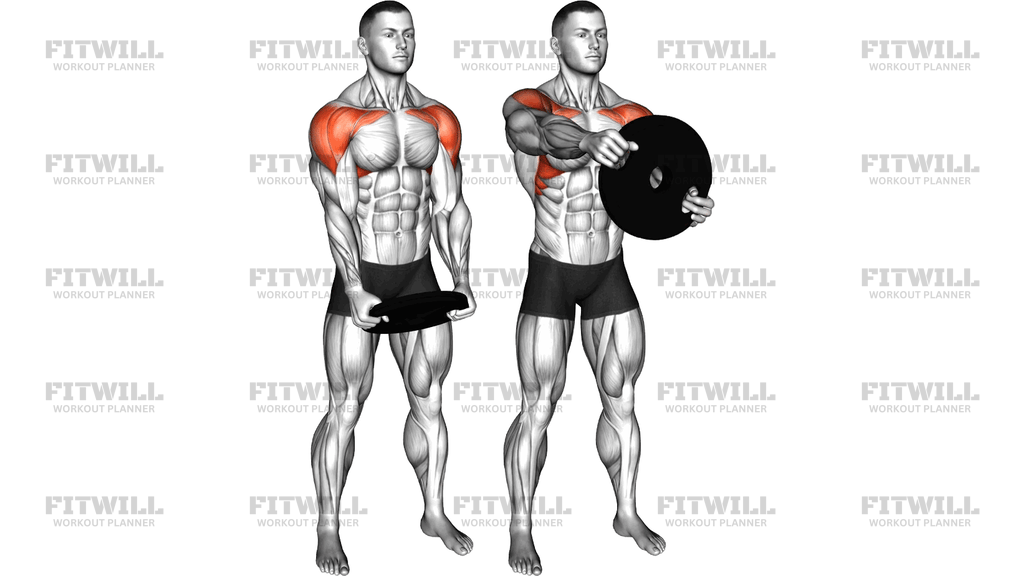
The Weighted Plate Front Rotation Raise is a standing front raise performed with a single weight plate held by its edges. You start with the plate held low in front of your hips, arms hanging straight down, then raise it forward and up to shoulder height while rotating the plate so it turns from a horizontal position to a vertical, edge-up position as your arms reach the top. The added rotation is what separates this from a standard plate front raise and forces the shoulders to control the plate through two planes of motion at once.
The main work is done by the front delts, which lift the arms forward, with the upper chest assisting during the drive up. Because you are gripping the rim of a flat plate and turning it as you raise, the side delts, upper traps, and forearm muscles stay busy stabilizing and controlling the tilt. Your core also works quietly the whole time to stop the weight from pulling your torso backward or sideways.
This movement suits lifters who want a simple shoulder raise variation without dumbbells or cables. A plate is easy to hold, easy to scale — just swap in a heavier or lighter plate — and the offset rim grip makes the weight slightly awkward in a useful way, demanding more stabilization than a balanced dumbbell. It fits well as a secondary shoulder exercise after pressing work, or as a finisher for higher reps.
Setup matters more than it looks. Stand tall with feet about hip-width apart, hold the plate at one edge with both hands, and keep a soft bend in the elbows that stays fixed throughout. If you arch your lower back or swing the plate, the front delts stop doing the lifting and the momentum takes over, which is the most common way people cheat this exercise.
To execute it well, raise the plate along a straight path in front of your body until your arms are roughly parallel to the floor, rotating the plate to vertical as you climb. Pause briefly at the top, then lower under control, letting the plate rotate back toward horizontal as it descends. The tempo down should be at least as slow as the tempo up.
Practical safety points are straightforward: choose a plate you can raise without shrugging or leaning back, keep your wrists straight rather than letting them bend back under the load, and stop the set if your grip starts slipping on the smooth plate surface. Because the shoulders are involved in stabilization here, controlled reps beat heavy, jerky ones every time.
[ Workout Log & Planner ]
Put your next workout in Fitwill
Keep your plan and training log ready when you are.


Instructions
- Stand upright with your feet about hip-width apart and a weight plate held flat by its edges in both hands, arms extended straight down in front of your thighs.
- Set a soft, fixed bend in your elbows and grip the rim of the plate firmly with your fingers wrapped around the edge.
- Brace your core, pull your ribs down, and keep your chest tall so your torso does not lean back as you lift.
- Raise the plate forward and upward in a smooth arc in front of your body, keeping your elbows at the same bend the whole way.
- As the plate climbs, rotate your wrists so the plate turns from flat to vertical, finishing with the plate standing on its edge at the top.
- Stop when your arms are roughly parallel to the floor at shoulder height; do not lift the plate above your head.
- Pause for a moment at the top, then slowly lower the plate back down along the same path, rotating it back toward horizontal as it descends.
- Exhale as you raise the plate, inhale as you lower it.
- Complete your reps without resting the plate against your thighs between repetitions, or set it down fully and reset your grip if you need a break.
Tips & Tricks
- The most common cheat on this exercise is leaning the torso backward as the plate rises — brace your abs before the first rep and think about lifting the plate with your shoulders, not your hips.
- Do the rotation deliberately: if the plate stays flat the whole way up, you have turned it into a plain front raise and lost the extra rotator control the movement is built for.
- Keep your wrists straight and stacked over your forearms; letting them bend backward under a heavy plate strains the forearm flexors and shifts tension away from the delts.
- Shoulder-height is the target, not eye level or overhead — raising higher just shifts work to the upper traps and encourages shrugging.
- If your grip fails before your shoulders do, chalk your hands or use a lighter plate; a slipping rim grip mid-rep is the main safety risk with this setup.
- Smooth plates are slick, especially with sweaty hands — dry your palms between sets or the edge grip will get sketchy on the rotation.
- Use a slower lowering phase than lifting phase; the descent is where the front delts get most of their stimulus on this movement.
- Keep both hands evenly placed on the rim; one hand drifted toward the center makes the plate tilt and one shoulder does more work than the other.
- Start with a small plate (5–10 lb) until the rotation feels coordinated — the turning motion is harder to control than the lift itself.
Frequently Asked Questions
What muscles does the Weighted Plate Front Rotation Raise work?
The front delts do most of the lifting, with the upper chest assisting on the way up. The rotation and rim grip also challenge the side delts, upper traps, forearms, and core as stabilizers.
Why rotate the plate during a front raise instead of keeping it flat?
The rotation adds a second plane of control, forcing your shoulders and wrists to stabilize the plate as it turns. That makes the exercise harder at the same weight and builds coordination that a flat front raise does not.
Is the Weighted Plate Front Rotation Raise good for beginners?
Yes, as long as you start with a light plate. The movement pattern is simple, but the rotation takes a few sets to feel natural, so learn it with a small plate before going heavier.
How high should I raise the plate?
Raise until your arms are about parallel to the floor at shoulder height, with the plate vertical. Going much higher mainly recruits the traps and increases shrugging without extra delt benefit.
What is the most common mistake with this exercise?
Using momentum — swinging the plate, arching the lower back, or shrugging the shoulders. Fix it by slowing the tempo, bracing your core, and reducing the plate weight until every rep is controlled.
Can I substitute a dumbbell or kettlebell for the plate?
You can perform a similar front raise with a dumbbell or kettlebell held by both hands, but the flat plate's rim grip and horizontal-to-vertical rotation are hard to replicate, so a plate remains the best match for this movement.
How heavy should the plate be for the Weighted Plate Front Rotation Raise?
Pick a plate you can raise to shoulder height for 10–15 reps without leaning back or losing the rotation. Most people need far less weight here than they expect because the leverage is unfavorable.
Should my elbows bend during the raise?
Keep a small, fixed bend in the elbows for comfort, but do not bend them more as the plate rises. Turning the raise into a front raise plus curl shifts work to the biceps and shortens the lever.
Where should I put this exercise in my workout?
Use it after your main pressing or overhead work as a secondary shoulder movement, or as a higher-rep finisher. Two to four sets of 10–15 controlled reps is a solid range.
Is it safe for people with shoulder issues?
If raising your arms to shoulder height or rotating your wrists under load causes pain, skip this exercise and consult a qualified professional. The rim-grip rotation demands more wrist and shoulder control than a standard front raise.