Cable Standing Hip Flexion (Version 3)
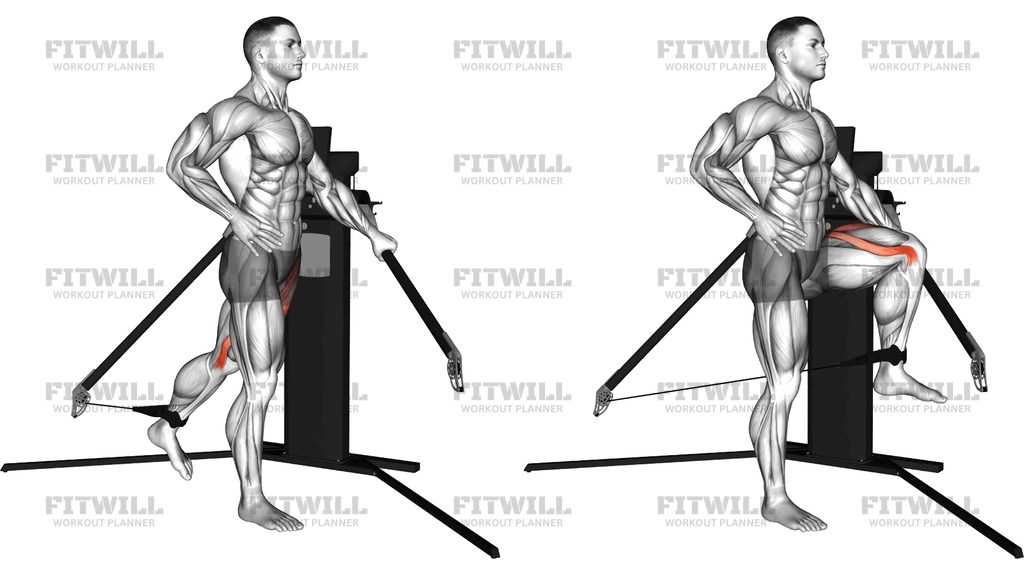
Cable Standing Hip Flexion (Version 3) is a single-leg isolation exercise performed with an ankle strap attached to a low cable pulley behind you. You stand tall facing away from the machine, hold the machine's handle or frame for balance, and drive the strapped knee up toward your chest against the cable's resistance. The weighted arm of the machine keeps tension pulling your leg backward, so every rep forces your hip flexors to work through the full lifting arc rather than just at the top.
The main muscles at work are the hip flexors, especially the iliopsoas and the rectus femoris, which runs down the front of the thigh and crosses both the hip and knee. Your lower abs help control the pelvis as the leg lifts, and the standing leg works quietly the whole time to keep you balanced over a stable foot. Because you are upright and loaded from behind, the movement also challenges posture and trunk control more than seated hip flexion variations.
This exercise is useful for runners, sprinters, martial artists, and anyone whose sport involves driving the knee forward, since it trains the exact hip action used in those movements. It is also a practical choice for people rebuilding hip flexor strength after time off, or for lifters whose training is heavy on hip extension (squats, hinges, glute work) but light on the opposite action. Balanced hip strength supports smoother stride mechanics and can reduce the feeling of tight, underworked hips at the front of the pelvis.
Setup matters more than it looks. The pulley should be at its lowest position behind you, the strap snug around the ankle of the working leg, and your stance far enough forward that the cable pulls your leg back and slightly behind your body before each rep. If you stand too close to the machine, tension is lost at the bottom; if you lean your torso forward, you turn the exercise into an abdominal crunch instead of a hip movement. Keep your chest tall, ribs stacked over the pelvis, and a light grip on the support.
Execution is simple but easy to rush. Lift the knee up until the thigh is roughly parallel to the floor or slightly higher, pause briefly, then lower the leg back under control so the cable's pull stretches the hip flexor at the bottom of each rep. The return is where most people get sloppy, letting the leg get yanked back by the stack. Controlling that lowering phase is a big part of the value of the exercise. Keep the weight moderate, complete all reps on one leg before switching, and breathe out as the knee rises.
Use it as an accessory movement, typically two to four sets of ten to fifteen controlled reps per side, rather than a heavy strength lift. If your hips cramp early or you feel it more in your lower back than the front of your hip, the weight is likely too high or your pelvis is tipping forward as you lift.
[ Workout Log & Planner ]
Put your next workout in Fitwill
Keep your plan and training log ready when you are.


Instructions
- Set the cable pulley to its lowest position and attach an ankle strap around the ankle of your working leg, with the strap sitting snugly just above the ankle bone.
- Stand facing away from the cable machine, far enough forward that the cable pulls your strapped leg slightly behind your body with the stack lifted.
- Grip the machine's handle or frame with the hand on the same side as your working leg, or hold lightly with one hand, and place your free hand on your hip.
- Stand tall on your non-working leg with a soft knee, brace your abs lightly, and keep your ribs stacked over your pelvis so your lower back does not arch.
- Exhale and drive the strapped knee up and forward until your thigh is about parallel to the floor or just above it, letting the knee bend so the lower leg hangs relaxed.
- Pause for a second at the top without leaning your torso back to help the leg higher.
- Lower the leg slowly back behind your body until the cable's pull is fully resisted, feeling a stretch across the front of the hip.
- Inhale at the bottom, then begin the next rep without letting the stack slam down.
- Complete all reps on one side, then switch the strap to the other ankle and repeat.
- Once finished, unclip the strap before adjusting or removing weight from the machine.
Tips & Tricks
- A common mistake is swinging the torso backward to raise the knee higher; if your chest leans back as you lift, the weight is too heavy for your hip flexors to lift honestly.
- Keep the cable running behind you, not to the side. If you drift sideways, the strap can slide on your ankle and the resistance stops matching the direction of hip flexion.
- The lower abs should feel braced, not strained. If you feel pinching or arching at the front of your lower back, tilt your pelvis slightly back before each rep and reduce the range a little.
- Do not lock the knee of the strapped leg straight; letting the lower leg hang with the knee bent shortens the quad and lets the hip do the lifting.
- Cramping in the front of the thigh usually means the strap is too low or the weight is too high; move the strap slightly up the ankle and drop a plate or two.
- Control the lowering phase for two to three seconds. The eccentric portion is where the cable setup earns its keep, so do not let the stack pull your leg back on its own.
- Use a light grip on the handle. Leaning your weight into your hand removes the balance demand on the standing leg, which is half the benefit of doing this standing.
- Warm the hips up with a few bodyweight high knees or leg swings before adding cable tension, especially early in the morning when hip flexors tend to feel tight.
- Keep both hips squared forward. Letting the working hip rotate out turns the movement into a diagonal lift and reduces the work on the primary hip flexors.
Frequently Asked Questions
What muscles does Cable Standing Hip Flexion (Version 3) work?
It primarily targets the hip flexors, mainly the iliopsoas and rectus femoris at the front of the hip and thigh. The lower abs assist with pelvic control, and the standing leg's glutes and stabilizers work to keep you balanced.
Why does the cable attach behind me in this exercise?
With the low pulley behind you, the cable pulls the strapped leg backward, which places the hip flexors in a stretched position at the start and loads the entire lifting arc. This creates constant tension that bodyweight knee raises cannot provide.
Is Cable Standing Hip Flexion (Version 3) suitable for beginners?
Yes, as long as the weight starts light and the emphasis stays on controlled reps. Beginners should hold the machine's handle for support and focus on keeping the torso upright rather than chasing knee height.
How high should I raise my knee during Cable Standing Hip Flexion (Version 3)?
Aim for the thigh to reach roughly parallel to the floor or slightly higher, without leaning your trunk back to gain extra range. If you cannot reach that height with control, lower the weight.
Why do I feel this in my lower back instead of my hips?
That usually means your pelvis is tipping forward and your lumbar spine is extending to help the leg up. Brace your abs, think about tucking the pelvis slightly under, and reduce the range or load.
What can I use instead of an ankle strap for this exercise?
Some cables allow you to loop the handle or a small attachment around the ankle, but a proper ankle strap is more secure and comfortable. A resistance band anchored low behind you works well as a home alternative.
How many reps and sets should I do of Cable Standing Hip Flexion (Version 3)?
Two to four sets of ten to fifteen controlled reps per leg is a solid working range. Because the hip flexors are a small muscle group, favor moderate weight and clean tempo over heavy loads.
Should I do both legs back to back or alternate?
Completing all reps on one leg before switching is generally easier to track and keeps the working hip under consistent tension. Rest a short moment between sides so balance does not degrade on the second set.
Can this exercise help with running and sprinting performance?
It trains the knee-drive action used in sprinting and running, which can support stronger stride mechanics. It works best alongside hip extension work like glute and hamstring training rather than in isolation.
Is it safe to do Cable Standing Hip Flexion (Version 3) every day?
Daily light reps are possible, but most people do well treating it as a normal accessory lift two to three times per week. If the front of your hip feels sore or pinchy rather than worked, back off and allow recovery.