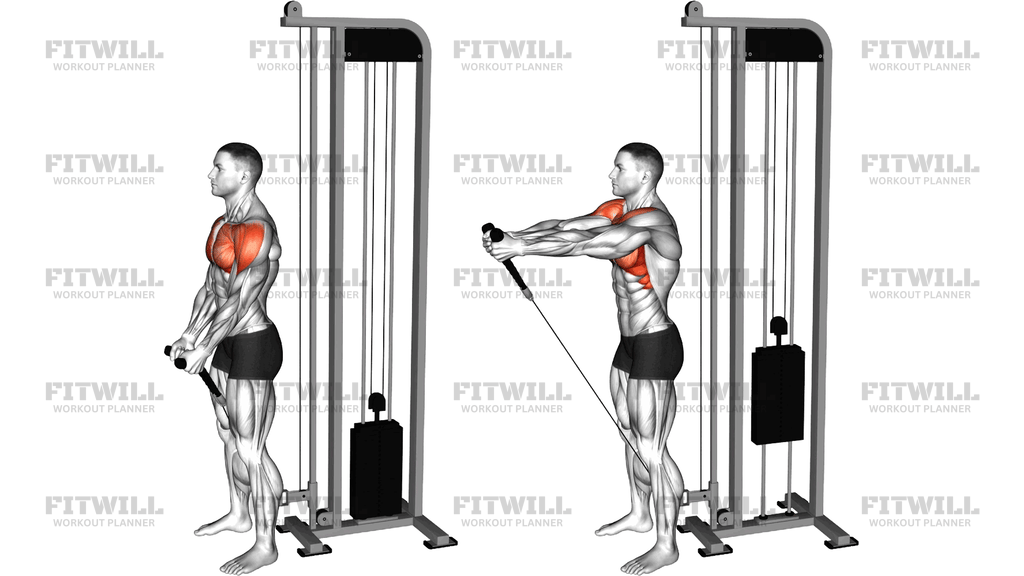
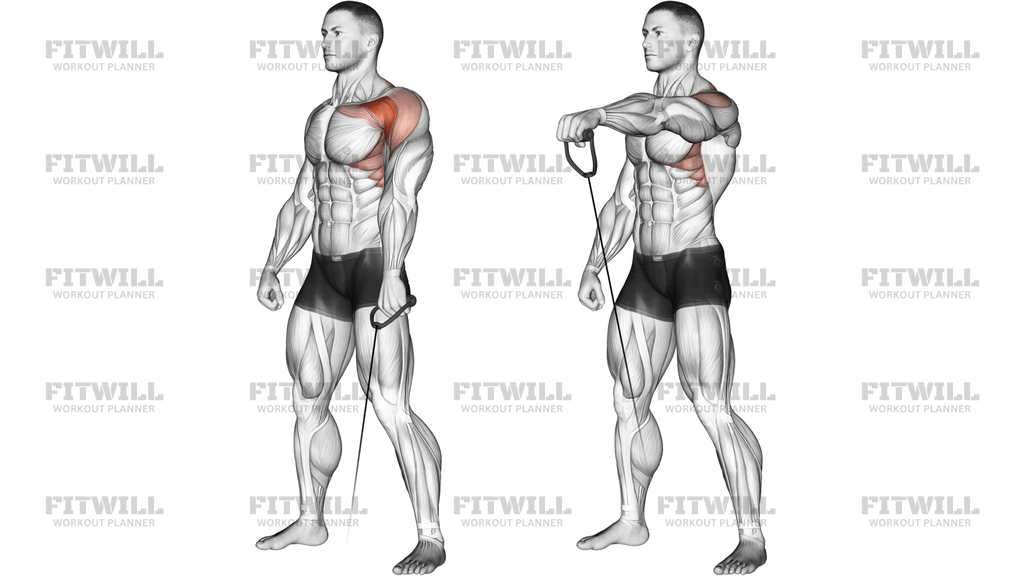
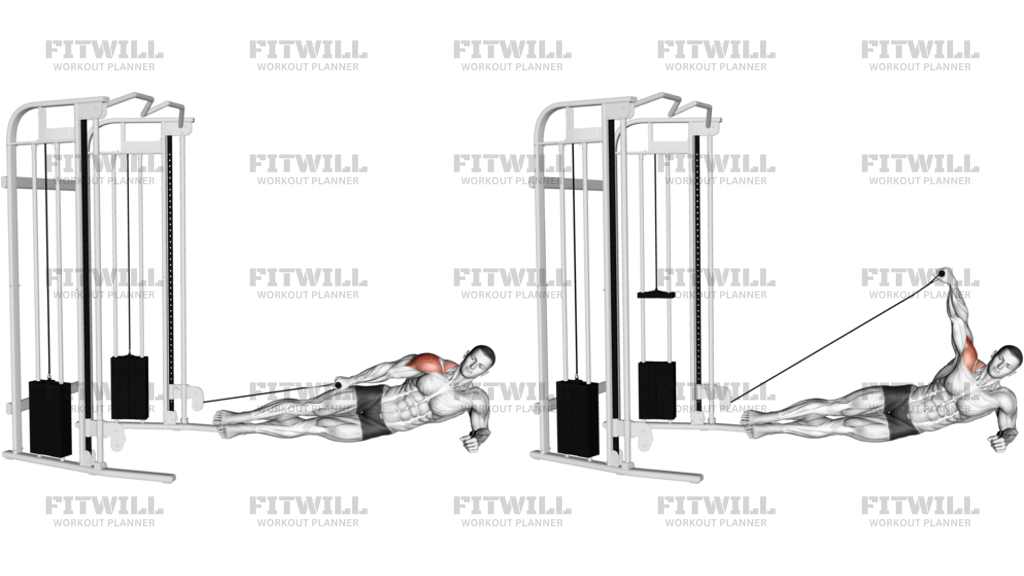
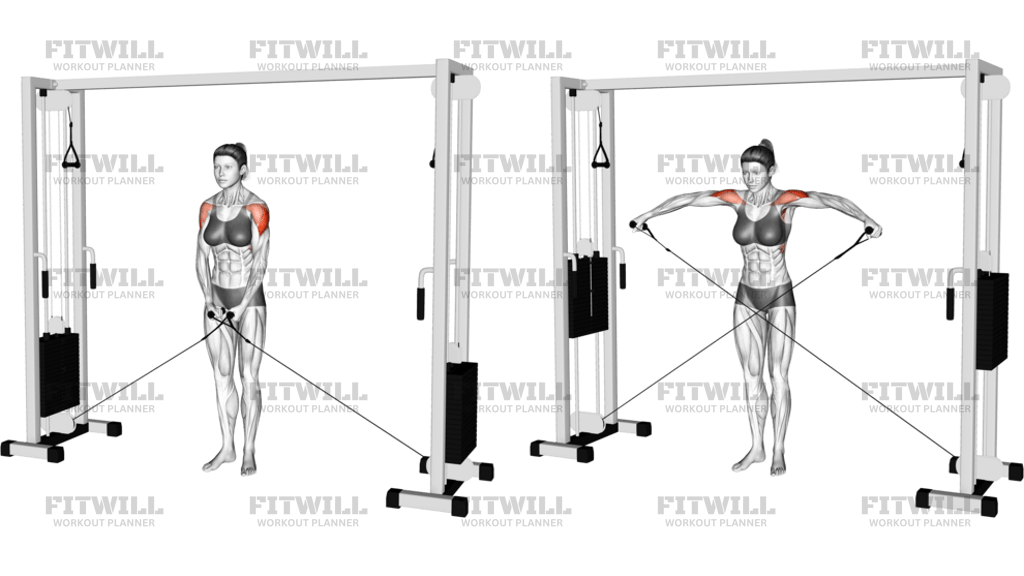
Cable Standing Biceps Curl To Arnold Press
The Cable Standing Biceps Curl To Arnold Press is a two-phase compound movement that takes you from a supinated curl at your sides all the way to an overhead press with the rotating hand path that gives the Arnold press its name. You attach single handles to a low pulley, stand facing away from the machine, and curl the handles up with your palms turned forward. Without pausing, you rotate your palms to face your body at shoulder height, then press upward while turning your palms to face forward overhead. The cable runs behind you the entire time, which changes the feel compared to free weights because tension stays constant through every angle of the arc.
This lift suits lifters who want to train the biceps and shoulders in one continuous sequence rather than as separate sets. Because the cable pulls from behind and slightly below, the front delts and upper chest assist through the press while the biceps do the bulk of the work from thigh level to shoulder height. The rotation at the top also brings the side delts and stabilizers around the shoulder into play more than a standard overhead press would.
Setup matters more here than in most arm exercises. The pulley must sit at the bottom, the cables need to run behind your arms and past your hips, and your stance has to be far enough from the machine that the handles do not drag or slack at the start. If you stand too close, the first inches of the curl lose tension; too far, and the cable pulls you backward at the top of the press. Take time to find the distance where tension is present in both the hanging position and the lockout.
To execute well, keep your ribs stacked over your pelvis and your elbows pinned to your sides during the curl. As the handles reach shoulder height, let your elbows travel forward and out slightly so your palms can rotate inward, then drive up and turn your hands so they face away from you at lockout. Reverse the rotation on the way down, lower the handles back to your thighs under control, and keep tension in the cables between reps.
Common use cases include upper-body days where arm isolation and pressing overlap, time-efficient sessions, and breaking through plateaus on standard curls or presses by exposing the shoulders and biceps to a different resistance angle. It is also a reasonable choice for lifters who find dumbbell overhead pressing uncomfortable, since the cable path can be adjusted slightly forward to suit the joint.
The main safety points are simple: choose a weight you can press without leaning back, keep your lower back from arching as the handles pass overhead, and never sacrifice the rotation speed for extra reps. The shoulder is in a vulnerable spot mid-rotation under load, so smooth, deliberate turns of the wrist protect the joint and actually improve the training effect.
[ Workout Log & Planner ]
Put your next workout in Fitwill
Keep your plan and training log ready when you are.


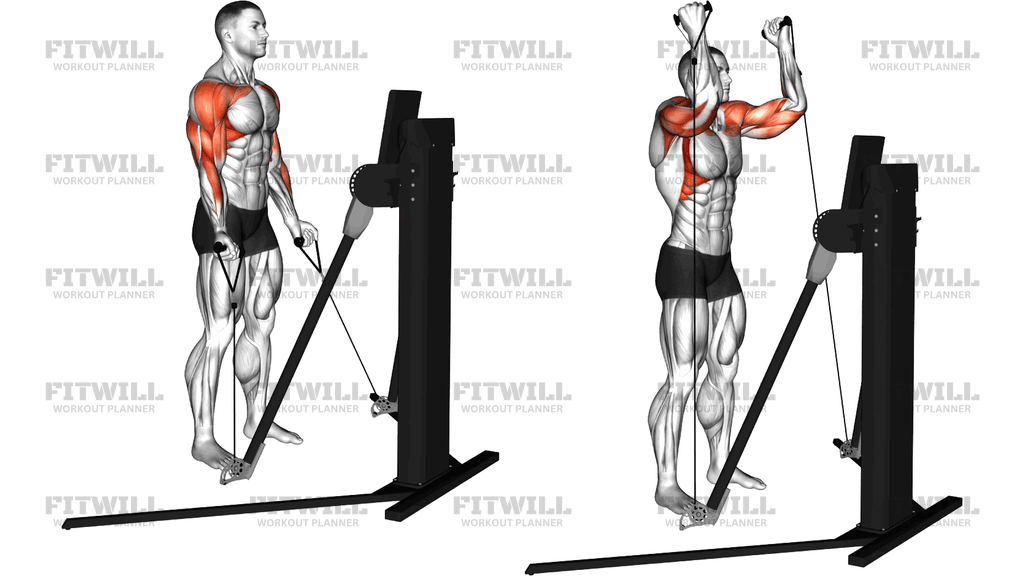
Instructions
- Clip two single handles to the low pulley of a cable machine and select your weight before gripping.
- Stand facing away from the machine with feet about hip-width apart, one foot slightly forward for balance, holding a handle in each hand with palms facing forward and arms hanging at your sides.
- Step forward until the cables run behind your arms and light tension is already present with your arms fully extended down.
- Brace your core, pull your shoulder blades down gently, and keep your ribs stacked over your hips so your lower back stays neutral.
- Curl both handles up toward your shoulders, keeping your elbows pinned to your sides and your palms facing up throughout the lift.
- At shoulder height, rotate your palms inward to face your body and let your elbows move slightly forward and out, stacking them under the handles.
- Press both handles straight up, rotating your palms so they face away from you as your arms reach overhead lockout, with biceps beside your ears.
- Reverse the rotation as you lower, bringing your palms back to face your shoulders, then return the handles to the start by bending your elbows and lowering them to your sides.
- Exhale as you curl and press, inhale as you lower and rotate back down.
- Complete the set, then release the handles one at a time and let the weight stack settle before walking away.
Tips & Tricks
- The most common mistake is standing too close to the machine, which removes tension at the bottom of the curl; step forward until you feel the cable pulling before the first rep begins.
- Do not swing the handles up with your hips. If your torso rocks forward during the curl, the weight is too heavy or your stance is too narrow.
- Watch your elbow height at the transition point. Letting the elbows drift far behind your torso during the rotation turns the press into a behind-the-neck pattern and stresses the shoulder.
- Keep the rotation of the wrists smooth and continuous during the press. Jerking the palms from facing-in to facing-out mid-press is where most shoulder discomfort starts.
- If your lower back arches at overhead lockout, squeeze your glutes and exhale fully at the top rather than just reducing weight.
- Check that both cables are the same length and the pulley is centered; an uneven setup makes one arm travel a shorter path than the other.
- Because the cable resists from behind, the challenge at the top is forward drift, not backward lean. Keep your head neutral and avoid pushing your chin toward the handles.
- For a harder curl phase, pause for one second at shoulder height before rotating. This removes momentum from the press and forces the biceps to hold the load isometrically.
- Warm up the shoulder rotation with light weight or band external rotations first, since the Arnold-style path demands more mobility than a fixed-grip press.
Frequently Asked Questions
What muscles does the Cable Standing Biceps Curl To Arnold Press work?
The biceps handle the curling phase, the front delts and upper chest drive the press, and the side delts and triceps assist at the top. Your core works throughout to keep you upright while the cables pull from behind.
Why rotate the palms during the press instead of pressing with palms facing forward the whole time?
The rotation lets your elbows travel a more natural arc and shifts emphasis across the deltoid as the arm moves overhead. It also lets the biceps contribute through a longer portion of the lift than a fixed-grip press would.
Can beginners do the Cable Standing Biceps Curl To Arnold Press?
Yes, as long as they start with light weight and master the curl and the press separately before combining them. Beginners should also practice the wrist rotation slowly, since that transition is the hardest part to coordinate.
How far should I stand from the low pulley?
Far enough that the cables already have slight tension with your arms hanging at your sides, but close enough that the press does not pull you off balance. Roughly one large step from the machine works for most people.
What is the most common mistake with this exercise?
Using body English to swing the handles through the curl, then rushing the rotation on the press. Both mistakes usually mean the load is too heavy; drop the weight and move with control through the transition.
Can I do this exercise one arm at a time?
Yes. Single-arm reps let you focus on the rotation path and are easier on balance, though the cables will pull slightly toward the machine, so brace your opposite side harder to stay square.
What can I substitute if my gym has no low pulley with single handles?
A barbell or dumbbell curl followed by a seated or standing Arnold press with dumbbells covers the same two phases. You lose the constant cable tension from behind, but the movement pattern and muscles remain similar.
Is the overhead lockout position safe for the shoulders?
For most lifters with healthy shoulders and adequate overhead mobility, yes. If you feel pinching during the rotation, reduce the range slightly at the top, slow the wrist turn, or check that your elbows are not drifting behind your head.
How should I breathe during the Cable Standing Biceps Curl To Arnold Press?
Exhale as you curl and press upward, then inhale during the controlled return. Avoid holding your breath at overhead lockout, since bracing too hard there tends to arch the lower back.
Should the cables touch my arms or body during the movement?
They will run close behind your arms and past your hips, but they should not drag or scrape. If the cable catches on your elbow during the curl, rotate your arms slightly outward or take a half step forward.