Band Narrow Grip High Row
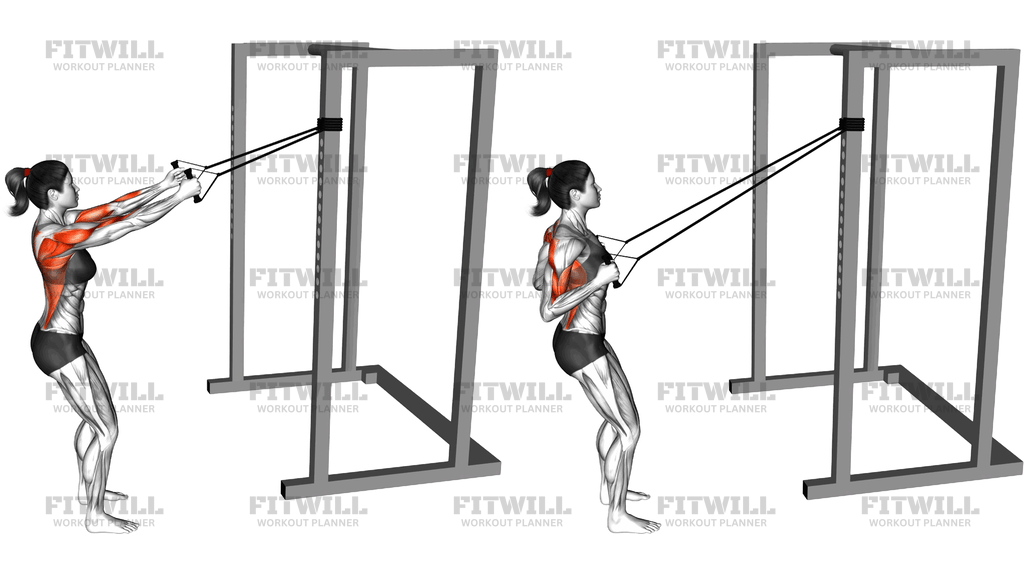
Band Narrow Grip High Row is a standing horizontal pull performed with a resistance band anchored at roughly chest height or above, using a narrow, close-hands attachment such as a V-bar handle. You face the anchor point, take the handle in both hands, and draw it back toward your lower chest while keeping your elbows tucked close to your ribs. Because the band is set high and the grip is narrow, the movement emphasizes the mid-back and the muscles that pull the shoulder blades together, rather than the wide-elbow row that biases the rear delts and upper traps.
This exercise works the rhomboids and middle trapezius as the primary movers, with the lats, rear shoulders, and biceps assisting through the pull. The standing stance also asks your core and legs to keep you stable as the band tries to pull you forward, which makes it a surprisingly complete upper-body pull for a piece of equipment that fits in a bag. The narrow grip lets your arms travel close to your torso, a path that many lifters find comfortable on the shoulder joints.
Setup matters more here than with a cable row because the band's resistance increases as it stretches. Anchor the band at a secure, sturdy point at or slightly above chest height, check that the attachment cannot slip, and step back only far enough to create tension with your arms nearly extended. Stand tall with soft knees, a braced trunk, and a slight forward lean from the ankles, not a rounded lower back.
To perform the row, pull the handle toward your lower chest, driving your elbows back and squeezing your shoulder blades together at the end of the movement. Pause briefly, then let the handle travel forward under control until your arms are extended and you feel a gentle stretch across your upper back. Exhale as you pull, inhale as you return.
This is a practical choice for home training, warm-up ramp-up sets before heavier rows or pulls, and higher-rep back volume when you don't have access to a cable machine. It also suits anyone managing equipment-limited training who still wants direct mid-back work. Keep the load honest: with bands, the tension is heaviest exactly where your muscles are shortest, so a band that feels easy at full stretch can still be demanding at the chest.
The most common faults are shrugging the shoulders toward the ears, leaning back excessively to cheat the pull, and letting the band snap the arms forward on the return. Move through a range you can own, keep the torso quiet, and let the shoulder blades do the finishing work rather than the biceps alone.
[ Workout Log & Planner ]
Put your next workout in Fitwill
Keep your plan and training log ready when you are.


Instructions
- Anchor a resistance band securely at or slightly above chest height on a rack or other stable attachment point, and clip a narrow V-bar handle to the free end.
- Face the anchor, grip the handle with both hands close together, and step back until your arms are nearly extended and the band is under light tension.
- Set your feet about hip-width apart with a slight bend in the knees, and hinge a few degrees forward from the ankles while keeping your spine tall.
- Brace your core and let your arms extend fully toward the anchor so your shoulder blades protract forward into the start position.
- Pull the handle toward your lower chest, keeping your elbows tight to your sides rather than flaring them wide.
- Squeeze your shoulder blades together at the end of the pull and hold for a beat without shrugging your shoulders up.
- Slowly extend your arms back toward the anchor, resisting the band's pull until your elbows are straight and your upper back stretches slightly forward.
- Breathe out as you row the handle in, and breathe in as your arms return to the starting position.
- Complete all reps on one band tension, then step forward to release tension before letting go of the handle.
Tips & Tricks
- If your shoulders creep up toward your ears as you pull, drop to a lighter band — the shrug usually means the weight exceeds what your mid-back can handle with a narrow grip.
- Keep the pull target at your lower chest, not your neck or chin; pulling too high shifts work to the upper traps and away from the rhomboids.
- Resist the temptation to lean back as the set gets hard. If your torso swings more than a few degrees, the band is too heavy or you're past the point of good reps.
- Because band tension rises sharply near lockout, the hardest part is at your chest. Shorten the range slightly rather than bouncing the handle off your torso.
- Control the return for two to three seconds. Letting the band snap your arms forward is the most common way to stress the shoulder joint in this setup.
- Check the anchor before every set. A band slipping off a rack upright mid-rep is a real hazard, so use a designated anchor or a loop that fully encircles the post.
- If your biceps fatigue before your back feels worked, slow the tempo and think about driving your elbows backward instead of pulling with your hands.
- A staggered stance can help if you feel unstable standing square; it gives you a base to brace against without changing the row path.
Frequently Asked Questions
Which muscles does the Band Narrow Grip High Row work?
The primary muscles are the rhomboids and middle trapezius of the upper back, which pull the shoulder blades together. The lats, rear shoulders, and biceps assist, and your core stabilizes the standing position.
Why use a narrow grip instead of a wide grip for a high row?
With a narrow grip your elbows stay close to your sides, which lets the arms travel along the torso and places the emphasis on mid-back retraction rather than the rear delts. It's also a comfortable path for many people's shoulders.
How high should I anchor the band?
Set it at or slightly above chest height so the band pulls slightly downward toward your hands as you row. Too low turns it into more of a lat pulldown angle; too high makes the start position awkward.
Is this a good exercise for beginners?
Yes. The band provides smooth resistance, the standing setup is simple, and the narrow path is joint-friendly. Start with a light band and focus on squeezing the shoulder blades rather than pulling hard with the arms.
How do I choose the right band tension?
Pick a band that lets you extend your arms fully at the start and still pull the handle all the way to your lower chest. Because band tension is highest at the end of the pull, the last few inches to your chest are the true test.
Why do I keep shrugging my shoulders during the row?
Shrugging usually means the band is too heavy or you're initiating the pull with your upper traps. Lighten the tension and consciously keep your shoulders down and back while your elbows drive the movement.
What can I use instead of a Band Narrow Grip High Row?
A seated cable row with a narrow or V-bar handle is the closest machine equivalent. A bent-over dumbbell row with the elbow tucked to your side trains a similar mid-back pattern without an anchor point.
How far should I stand from the anchor point?
Stand far enough that the band is under light tension with your arms nearly extended, but not so far that the band is already taut before you start. Excess pre-tension makes the start cramped and reduces your range.
Is it safe to anchor the band on a squat rack?
It's fine if the band is looped fully around an upright or attached through a secure anchor point that cannot slide down the posts. Check the attachment before every set and never anchor to an unstable or smooth object.