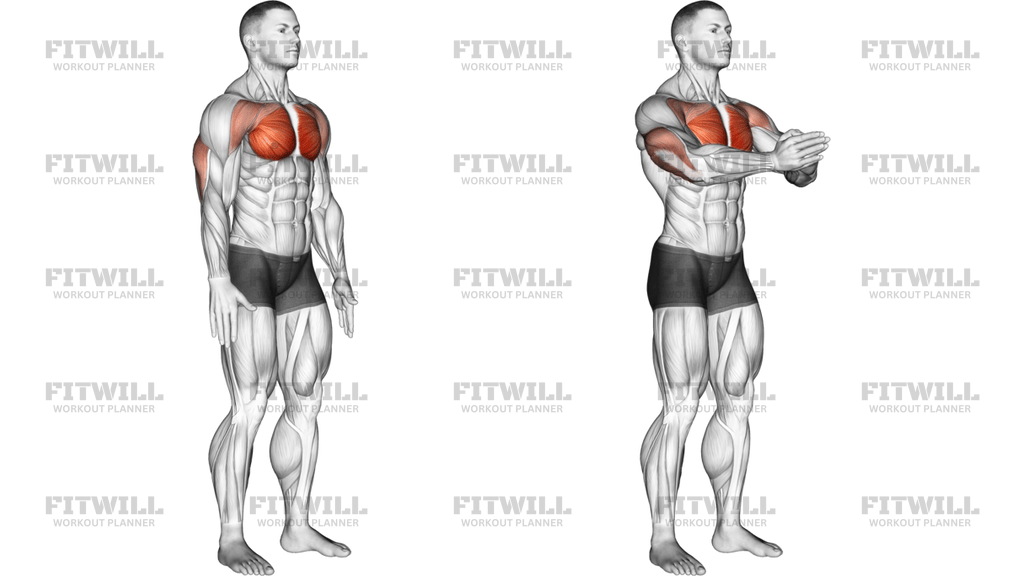
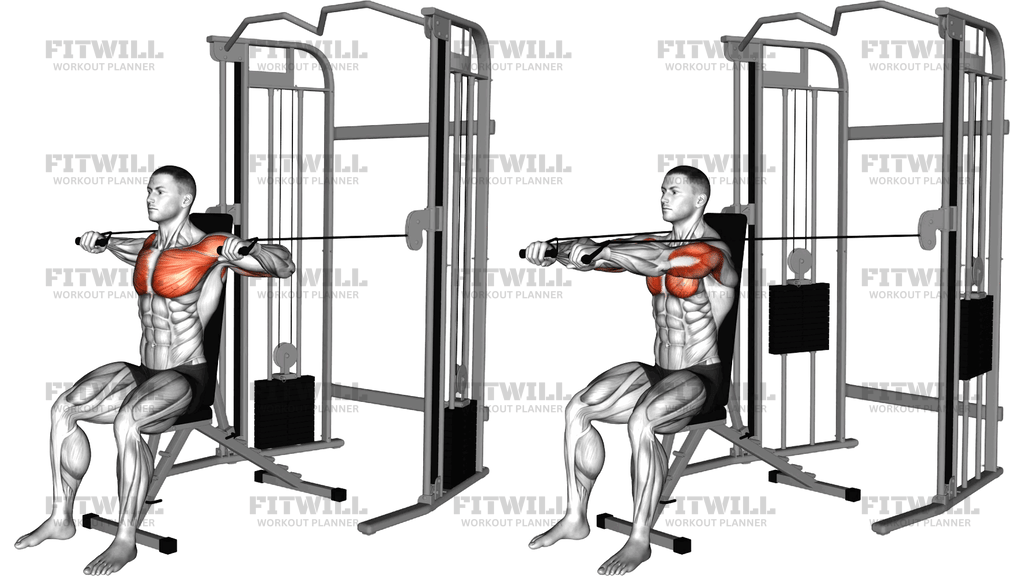
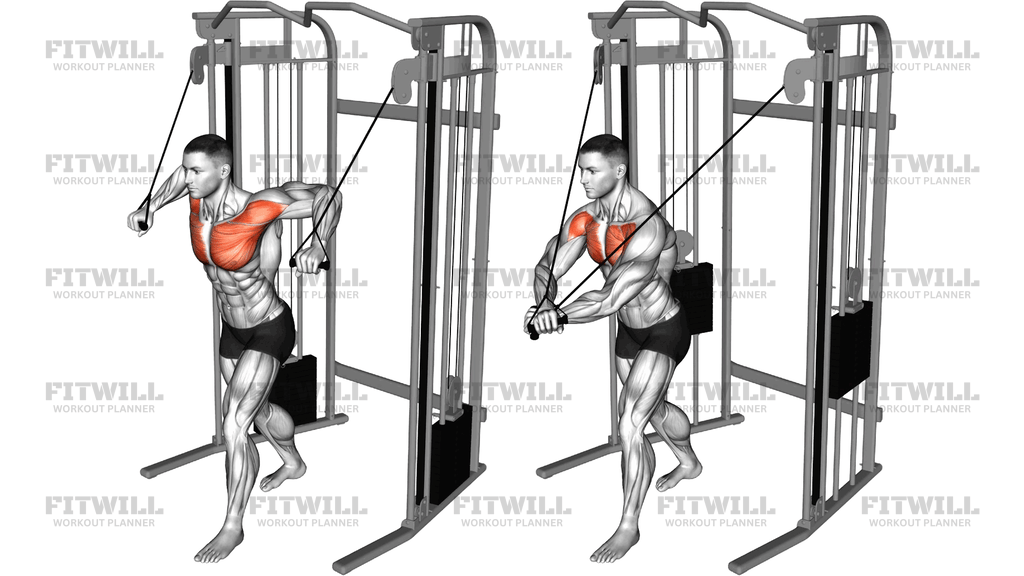
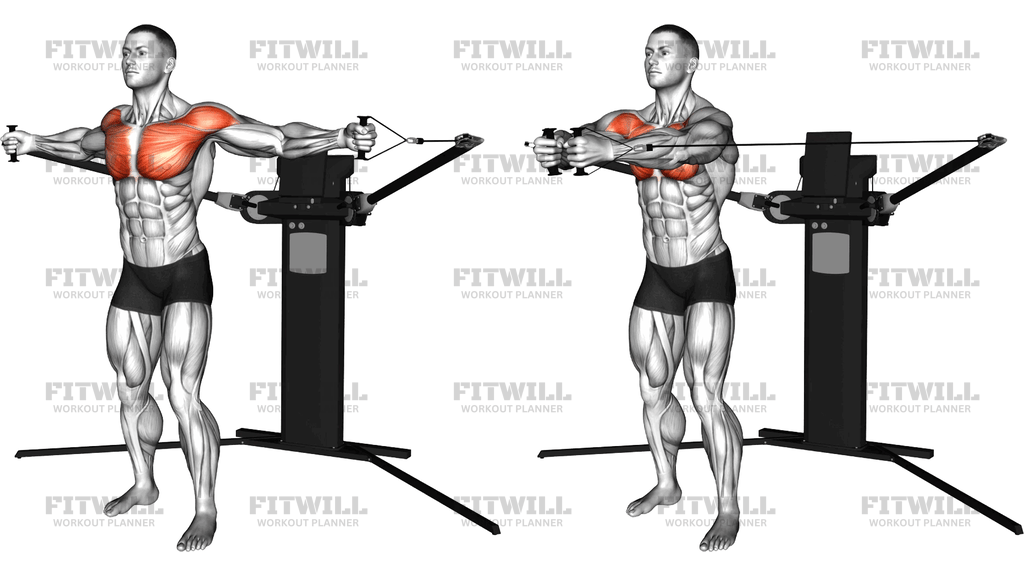
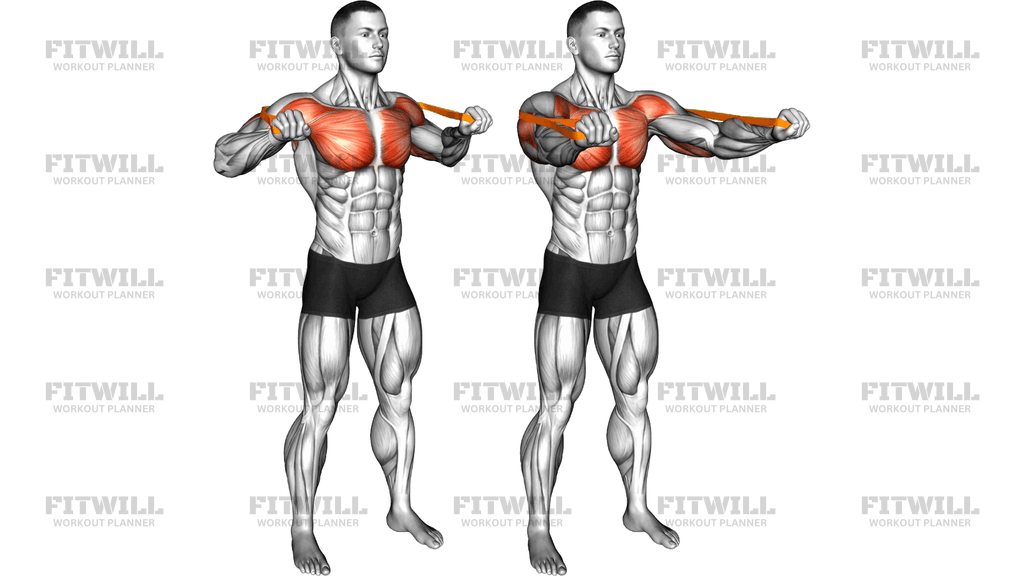
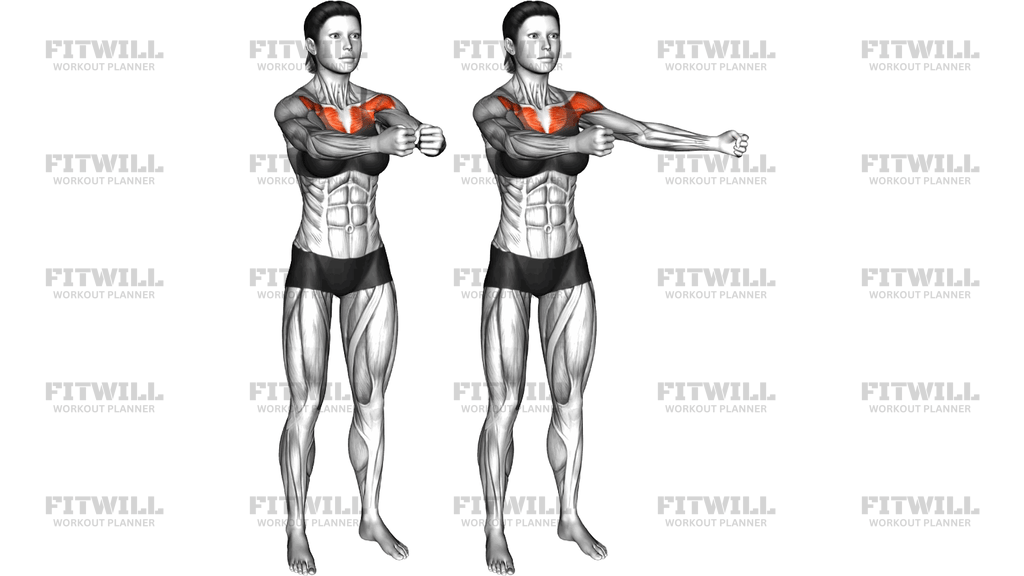
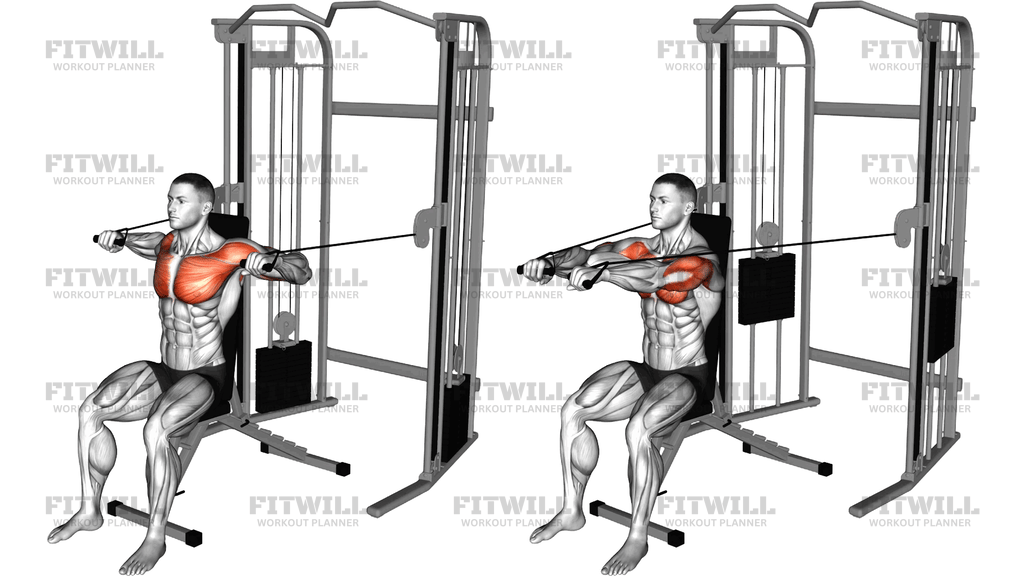
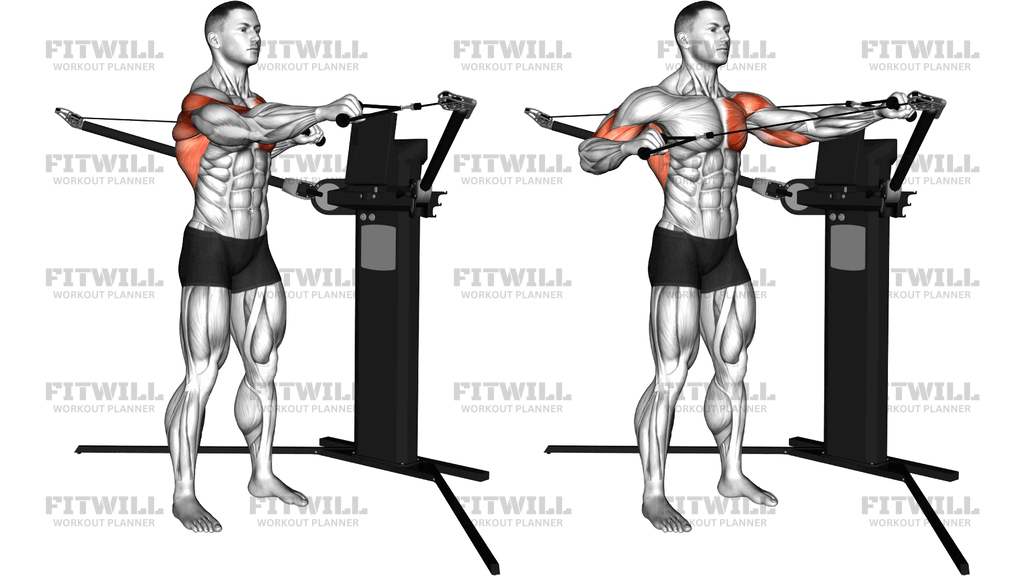
Cable Standing Alternating Diagonal Chest Press
The Cable Standing Alternating Diagonal Chest Press is a standing cable exercise where you press one handle at a time forward and across the midline of your body along a diagonal path, then return it while the other arm works. The cables run from a dual pulley machine positioned behind you, so each press pulls your hand from an out-to-the-side starting position toward the opposite side of your chest. That crossing, angled line of pull is what separates this from a standard cable press: it lengthens the pec under tension and then drives it through a horizontal adduction pattern that a straight press does not fully cover.
The primary muscles worked are the pectorals, with the front delts assisting on every press and the triceps extending the elbow to finish each rep. Because you are standing and pressing across the body one arm at a time, your core has to resist rotation on every repetition. The obliques and deep trunk muscles work isometrically to keep your hips and shoulders square while one side of your body is being pulled backward by the cable. This makes the movement useful for people who want chest work that also trains anti-rotation control, rather than isolating the press in a purely sagittal plane.
Setup matters more here than in most pressing variations. The pulley height determines the angle of the diagonal, so set both pulleys at the same height, roughly waist to lower-chest level, so each press travels from low-outside to high-across or follows a consistent downward diagonal depending on your setup. Stand far enough forward that the cables already have tension at the start position, with a staggered stance and a slight forward lean from the ankles. If you stand too close, tension disappears at the top of each rep; too far back, and the stretch at the start becomes hard to control.
Execution is about one arm doing the work while the rest of the body stays quiet. Press the working handle forward and across your midline until the hand crosses toward the opposite shoulder, squeeze the chest briefly, then control the cable back to the start without letting your torso twist toward it. Alternate arms rep by rep or complete all reps on one side before switching. Keep the non-working hand holding its handle at your side throughout so both cables stay loaded and nothing swings.
This exercise fits well as an accessory on chest days, especially after heavier barbell or dumbbell pressing when you want a longer-range, constant-tension finisher. It is also a smart option for people with cranky shoulders, because the cable's resistance vector and the diagonal path let many lifters find a pain-free pressing arc. Rotation-averse lifters, martial artists, and anyone doing rotational sport training appreciate the cross-body pattern, since pressing across the midline under anti-rotation demand closely mirrors real-world pushing mechanics.
[ Workout Log & Planner ]
Put your next workout in Fitwill
Keep your plan and training log ready when you are.


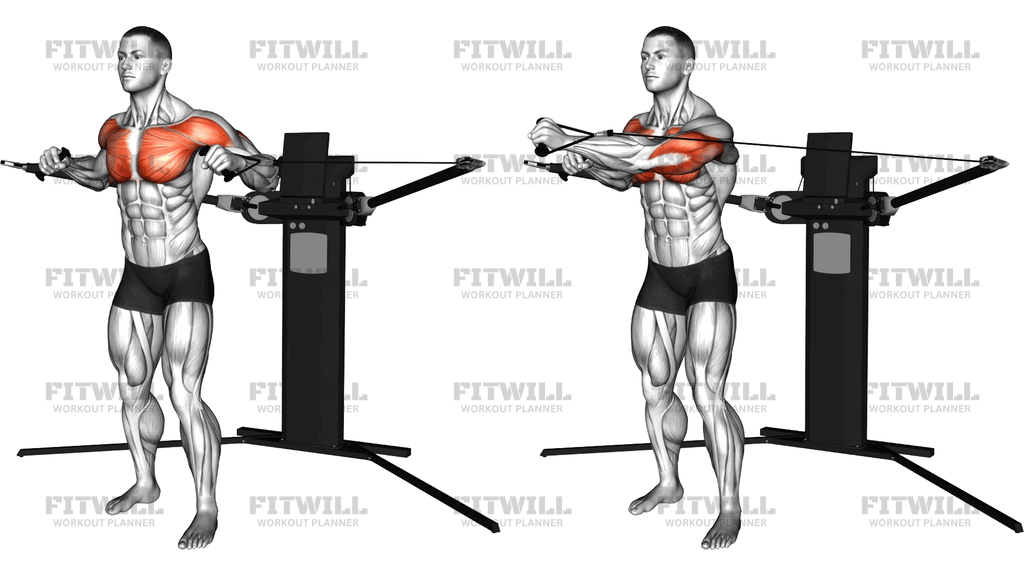
Instructions
- Set both pulleys of the cable machine to the same height, around waist to lower-chest level, and attach a single handle to each cable.
- Grip a handle in each hand and step forward so you are standing facing away from the machine with the cables running behind your shoulders and light tension already on both arms.
- Take a staggered stance with one foot forward, brace your core, and let your arms open out to the sides with a soft bend in the elbows.
- Exhale and press your right handle forward and diagonally across your midline, guiding your hand up and over toward your left shoulder area.
- Keep your torso square and your hips still as the arm crosses; the press should come from the chest and shoulder, not from twisting your spine.
- Extend fully at the end of the press so the handle crosses the midline and your pec visibly shortens, and pause there for a beat.
- Inhale and slowly control the handle back along the same diagonal path until your arm returns to the open starting position.
- Immediately press the left handle across toward your right side while the right hand stays at its start position holding tension.
- Continue alternating sides for the target number of reps, then walk the handles back to the stack carefully and release one at a time.
Tips & Tricks
- Do not let your shoulders rotate toward the pressing arm; if your chest turns to follow the handle, drop the weight so your trunk can stay square.
- If tension vanishes when your hand crosses the midline, take one more step forward from the machine before your first rep.
- Keep the elbow of the working arm roughly at chest height throughout the press; letting it drop turns the movement into a downward swing and unloads the pec.
- The non-working arm is not resting, it is anchoring; keep holding its handle with a slight bend so the cable does not yank you backward between reps.
- Press along a deliberate diagonal, not straight ahead; imagine drawing a line from your hip-side starting point to the opposite shoulder.
- Use a slower return than the press, around two to three seconds, since the lengthening phase is where this exercise differs most from a regular cable press.
- Grip the handles firmly but do not squeeze so hard that your forearms fatigue before your chest does.
- If the staggered stance feels unstable, widen your feet slightly rather than leaning further forward, which tends to arch the lower back.
- Set the weight lighter than you would for a two-arm cable press; single-arm cross-body work exposes how much you normally use trunk rotation to cheat.
Frequently Asked Questions
What muscles does the Cable Standing Alternating Diagonal Chest Press work?
The pectorals are the prime movers, with the front delts and triceps assisting each press. Your obliques and deep core muscles also work hard to stop your torso from rotating as each arm crosses the midline.
Why press diagonally across the body instead of straight forward?
The diagonal path follows the natural fiber direction of the chest as it moves the arm across the midline, which trains horizontal adduction more completely than a straight press. It also adds an anti-rotation demand you do not get from a standard two-arm press.
What pulley height should I set for the Cable Standing Alternating Diagonal Chest Press?
Set both pulleys at the same height, roughly waist to lower-chest level, so the diagonal path is consistent on both sides. Once set, do not change one side independently or your arms will work different angles.
Is this exercise suitable for beginners?
Yes, but start with a light weight and focus on keeping the torso square while one arm presses. Beginners often rotate their shoulders to help the handle across, so mastering that stability first matters more than load.
Should I alternate arms every rep or do all reps on one side?
Both work. Alternating every rep keeps both cables loaded and mimics continuous rhythmic pressing, while finishing all reps on one side first makes it easier to notice and correct side-to-side differences.
Why does the cable pull me backward when my hand returns to the start?
That usually means you are standing too close to the machine, so the cable has slack at the end of the return, or you are exhaling and relaxing at the top. Step forward a few inches and keep tension on the non-working hand throughout the set.
Can I do the Cable Standing Alternating Diagonal Chest Press if barbells bother my shoulders?
Many lifters with shoulder discomfort tolerate cable pressing better because the resistance vector is adjustable and there is no fixed bar path. Keep the weight modest, avoid forcing a deep stretch at the start, and stop any range that causes sharp pain.
How does the staggered stance affect the exercise?
The staggered stance widens your base and makes it easier to resist the backward pull of the cable, so your trunk stays square and the chest does the pressing. A narrow parallel stance makes the anti-rotation demand harder but can compromise balance at heavier loads.
What can I use if my gym only has one adjustable cable?
You can perform the same diagonal press one arm at a time with a single handle attachment, setting the pulley to the same height and simply resting the non-working hand at your side. You lose the constant double-cable tension but keep the diagonal cross-body pattern.