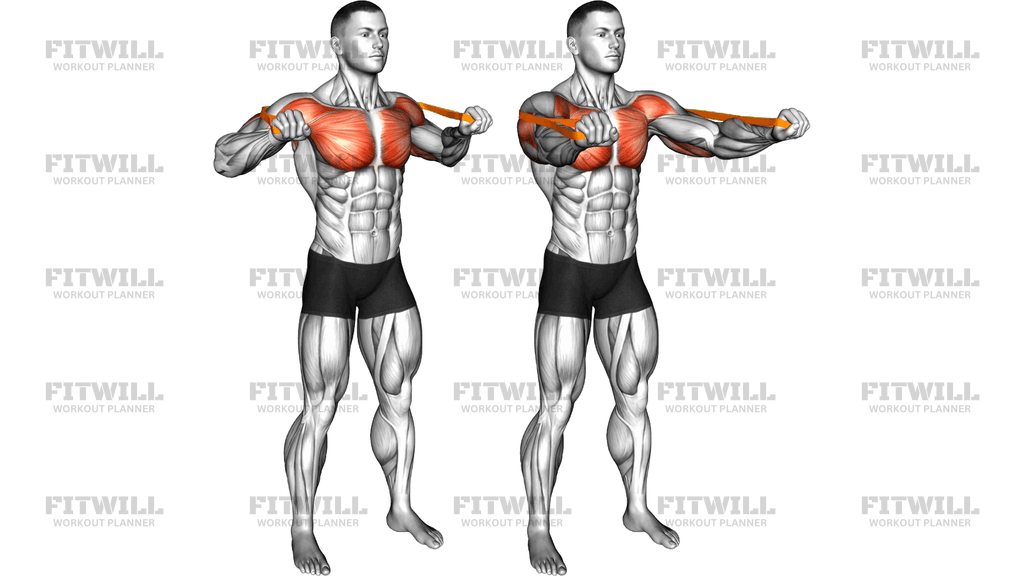
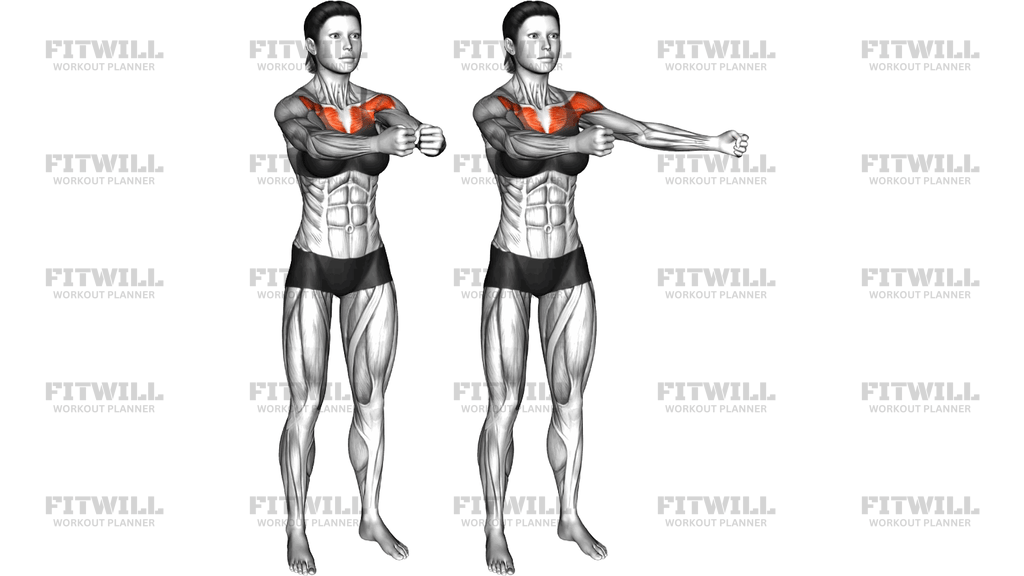
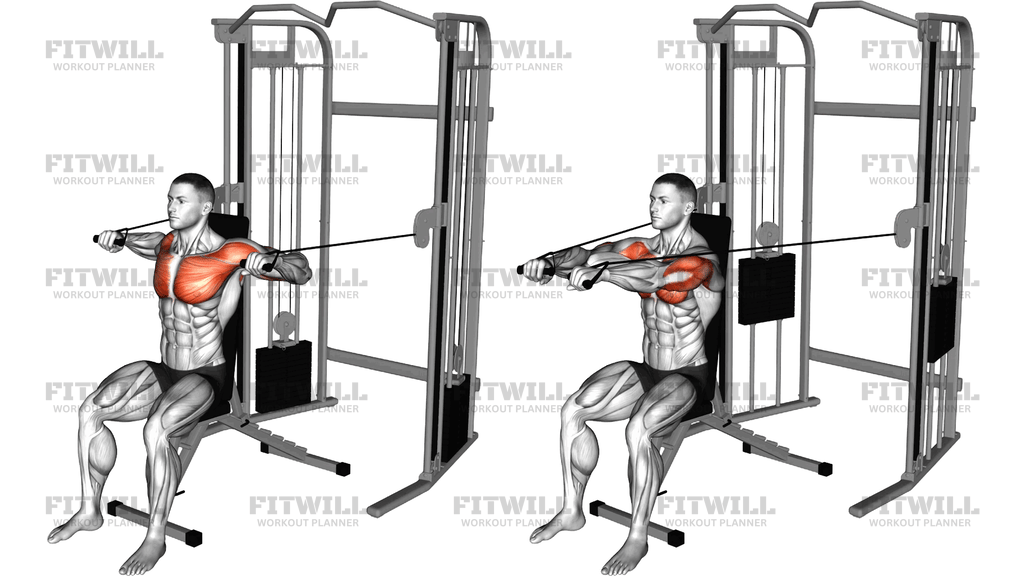
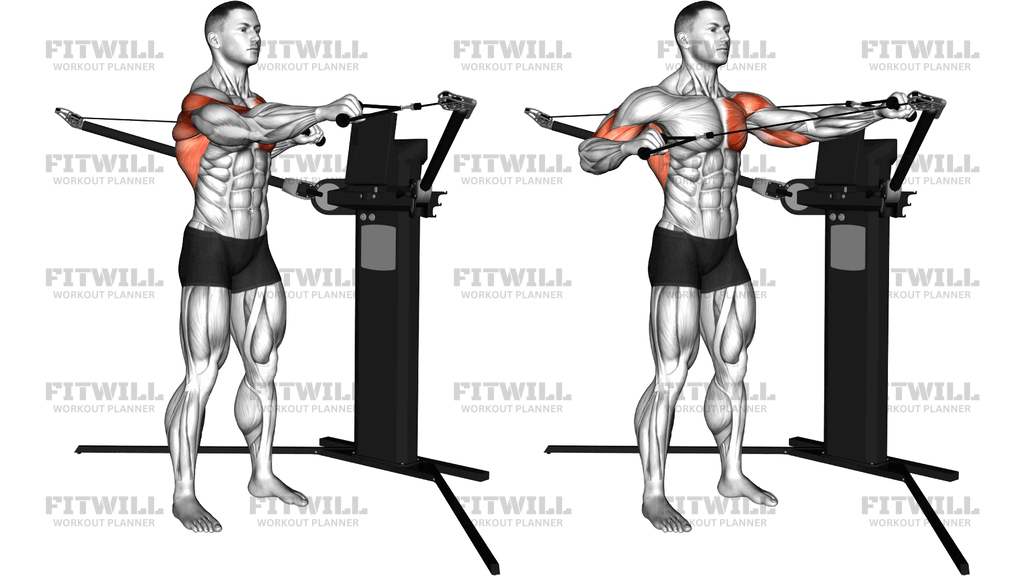
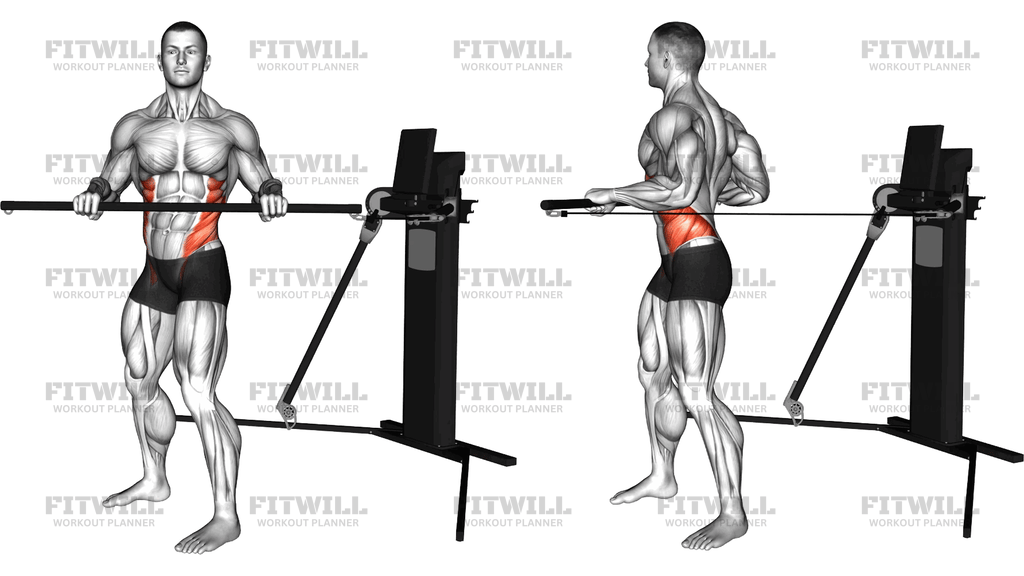
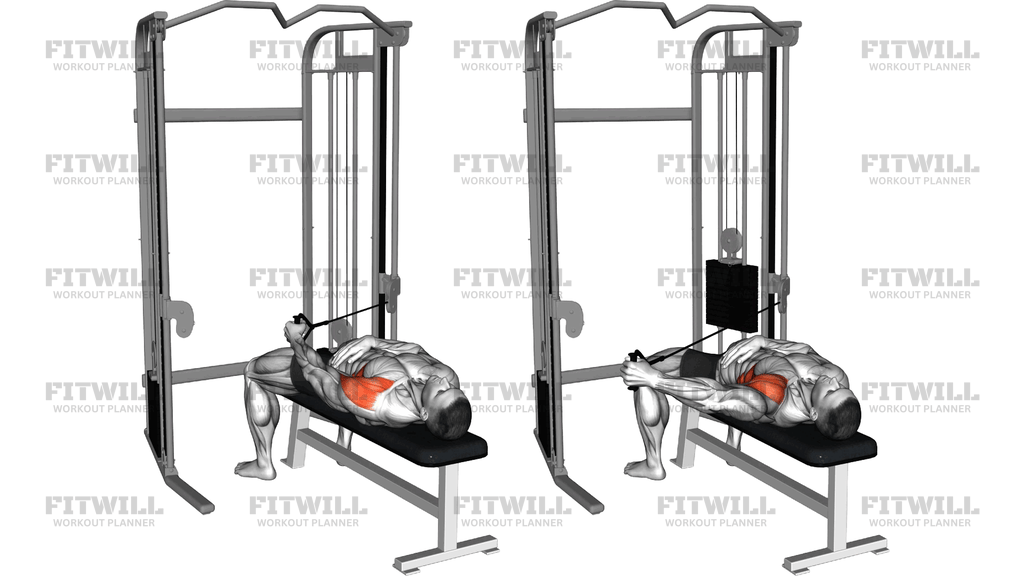
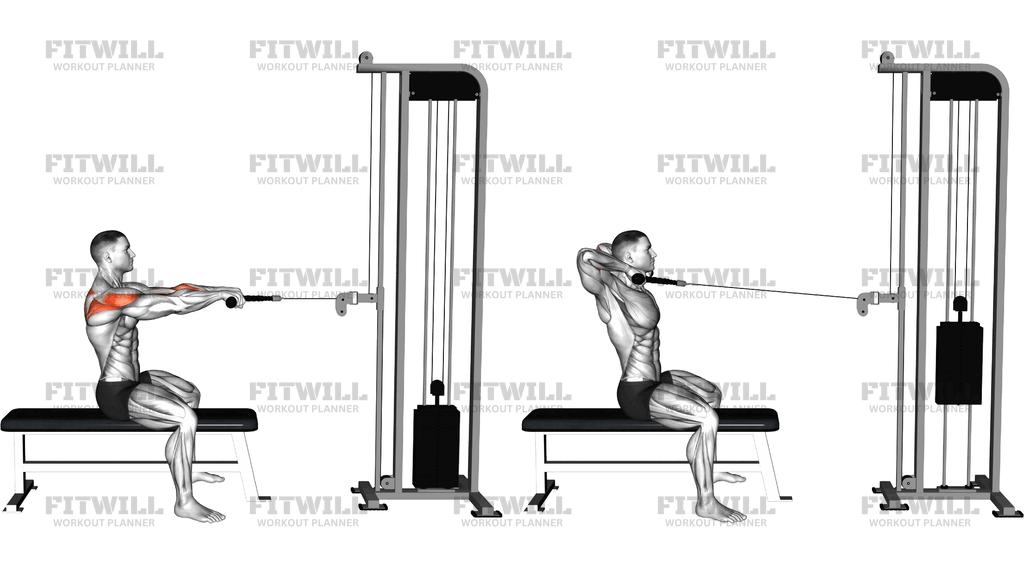
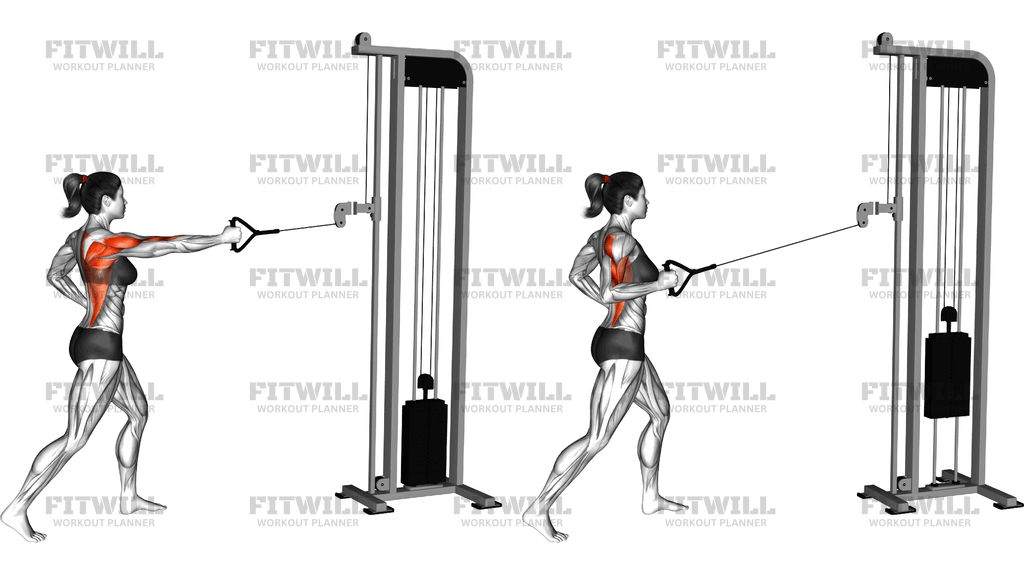
Cable Standing Fly (Version 3)
The Cable Standing Fly is a chest isolation exercise performed on a dual-pulley cable machine with the pulleys set at roughly shoulder height. You stand centered between the two cables, take a handle in each hand, and sweep your arms forward and together in a wide hugging arc until your hands meet in front of your chest. Unlike presses, the elbows stay slightly bent and mostly fixed, so the pectorals do the work of horizontal adduction without much help from the triceps.
This movement suits anyone who wants direct, constant-tension work for the chest. Because the cables pull from behind you at the start of each rep, the pecs are loaded in a stretched position that dumbbells can only approximate, and the resistance stays smooth through the entire arc. Bodybuilders use it as a finishing movement after presses, while general lifters use it to build the mind-muscle connection and control that make heavier pressing work more productive.
The setup matters more here than in most chest exercises. Pulley height determines which fibers you emphasize: shoulder-height pulleys, as in this version, hit the mid-chest and the clavicular fibers of the upper chest, while the cables running slightly behind your torso keep tension on the pecs rather than letting the shoulders take over. Standing with one foot slightly forward and a slight forward lean of the torso gives you a stable base and keeps the cables from dragging you backward at the stretched position.
Execution is a controlled sweep, not a press. Keep a soft, fixed bend in the elbows, lead with the elbows rather than the hands, and bring the handles together in front of your chest with a brief squeeze before letting the arms travel back out along the same path. The stretch phase should be slow and quiet; if you feel the load yanking your shoulders forward, the weight is too heavy.
Common use cases include post-press chest burnout, higher-rep hypertrophy blocks, and rehab-adjacent chest work where the smooth cable resistance is friendlier to the shoulder joint than free weights. Safety-wise, the main risks are overstretching at the rear position and losing balance with a weight that exceeds your control, so progress the load gradually and keep the range just short of the point where your shoulders get pulled forward.
[ Workout Log & Planner ]
Put your next workout in Fitwill
Keep your plan and training log ready when you are.


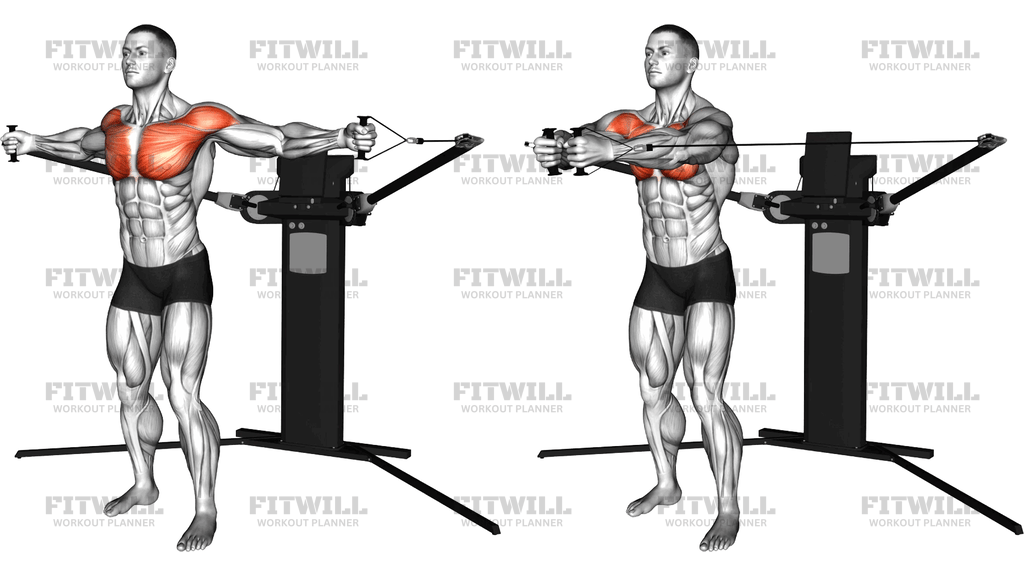
Instructions
- Set both pulleys of the cable crossover machine at shoulder height and attach a single handle to each side.
- Stand centered between the two cables with feet about hip-width apart, one foot slightly ahead of the other, and grip each handle with a neutral palm facing inward.
- Step forward slightly so the cables pull from just behind you, lean your torso a few degrees forward from the hips, and brace your core to keep your ribs from flaring.
- Start with your arms out to the sides, elbows slightly bent and locked into that angle, shoulders pulled gently back and down.
- Exhale and sweep both arms forward in a wide hugging arc, leading with the elbows, until your hands meet in front of your chest at sternum level.
- Squeeze your chest hard for a beat with the hands together, letting one hand cross slightly over the other if that feels natural.
- Inhale and slowly open your arms back out along the same arc until you feel a comfortable stretch across the chest, keeping the elbows bent and the shoulders from rolling forward.
- Complete the rep, then reset your stance and brace before the next repetition rather than letting the cables pull you around.
Tips & Tricks
- If your shoulders drift forward at the stretched position, the pulleys may be set too high or the weight too heavy; drop the load and think about keeping your chest proud through the back of the arc.
- Do not straighten your arms into a press mid-set; once the elbow bend changes, the triceps join in and the pecs lose their isolation.
- Lead with the elbows, not the hands. Pushing with the hands turns the fly into a half press and shifts stress to the front delts.
- Avoid letting the cables snap your arms back on the return; the eccentric is where a lot of the chest stimulus lives, so take two to three seconds to open up.
- Keep your torso lean fixed. Rocking your body weight into the handles is a common cheat on this exact setup because the cables pull you backward at the stretch.
- A slight upward angle of the hands toward the end of the arc, finishing around upper-chest height, can bias the clavicular fibers if that is your target area.
- Use lighter weight and higher reps here, typically 10 to 15, since the pecs are in a disadvantaged position at full stretch and heavy loads tend to break your form quickly.
- If you feel it pinching at the front of the shoulder, reduce the range so your hands stop just short of behind your torso line rather than chasing a deeper stretch.
Frequently Asked Questions
What muscles does the Cable Standing Fly work?
The primary mover is the pectoralis major across the mid and upper chest, with the front delts assisting in horizontal adduction. The core and legs stabilize your stance throughout the set.
How is the Cable Standing Fly different from a dumbbell fly?
Cables maintain tension through the entire arc, including the stretched position where dumbbells lose resistance because gravity pulls straight down. The cable path also lets you fine-tune the line of pull with pulley height.
Where should I set the pulleys for this version?
Set both pulleys at about shoulder height. This emphasizes the mid-chest with contributions from the upper chest fibers; lowering the pulleys shifts emphasis downward, and raising them biases the upper chest.
Is the Cable Standing Fly good for beginners?
Yes, provided you start light. The cable resistance is smooth and predictable, which makes it easier to learn chest control than a heavy dumbbell fly, but the stretched position still requires modest loads at first.
Why do my shoulders take over during the Cable Standing Fly?
This usually means you are pressing with your hands instead of leading with the elbows, or the weight is heavy enough that your front delts compensate. Cut the weight, keep the elbow bend fixed, and think of your hands as hooks.
Should my arms be straight or bent during the movement?
Keep a soft, fixed bend of roughly 15 to 20 degrees in the elbows from start to finish. Straight arms strain the elbow joints and elbow joint capsules, while bending more turns it into a press.
How far back should I let my arms go on the stretch?
Open up until you feel a solid stretch across the chest but your shoulders are still packed back and down. If your shoulders roll forward or you feel pinching at the front of the shoulder, you have gone past your usable range.
What can I substitute if my gym has no cable crossover machine?
Dumbbell flies on a flat bench, resistance band chest flies, or machine chest flys all train the same horizontal adduction pattern with a similar isolation effect.
How many sets and reps should I use for the Cable Standing Fly?
It works best as an accessory or finisher after presses, typically 3 to 4 sets of 10 to 15 reps with a slow eccentric. Because the pecs are loaded at a mechanical disadvantage, prioritize control over load.