Cable Standing Side Bend (Version 3)
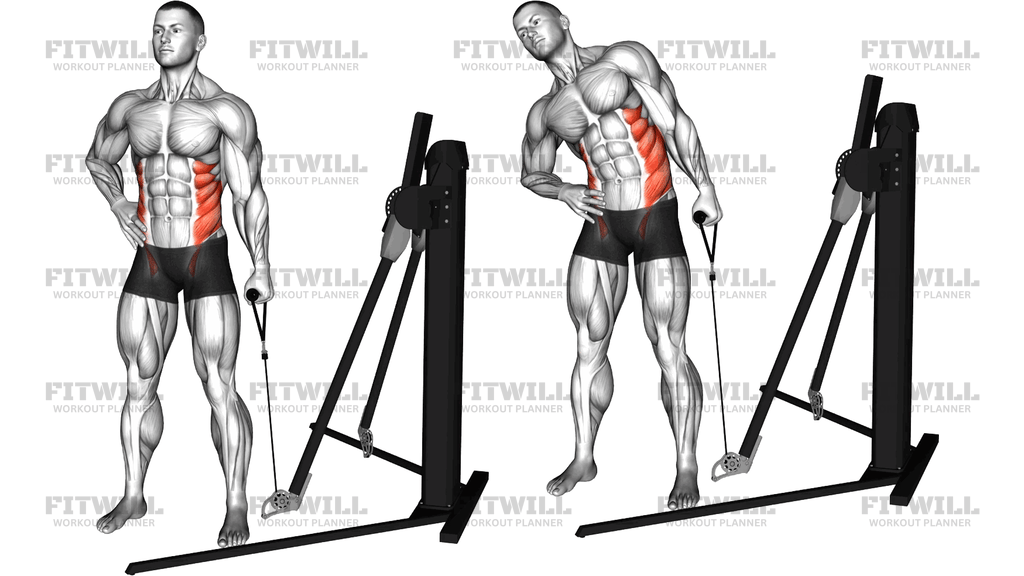
The Cable Standing Side Bend (Version 3) is a single-arm anti-gravity core exercise performed with a handle attached to the low pulley of a cable machine. You stand side-on to the machine, hold the handle in the hand closest to the pulley, and bend sideways away from the cable to lift the weight stack, then lower it back down under control. Because the resistance comes from a low point and pulls down toward the machine, the obliques on the opposite side of your body do the pulling as you flex your trunk sideways.
This movement trains the obliques directly through their main function, which is lateral flexion of the spine. The abs and the quadratus lumborum in the lower back assist, while the legs, hips, and deep core work to keep your torso from twisting as the cable tries to drag you sideways. Compared with dumbbell side bends, the cable version keeps constant tension on the working side through the entire range, including at the top, where a dumbbell tends to unload the muscle.
The setup matters a lot with this exercise. Stand far enough from the machine that the cable runs clear of your body and your legs, and keep the handle in the hand on the same side as the pulley. If you stand too close, the cable drags against your thigh and the resistance angle changes; if you grip with the wrong hand, you turn the exercise into an unweighted lean instead of a loaded side bend.
Execution is deliberately simple but easy to cheat. Keep your hips square and your shoulders level, exhale as you bend away from the machine, and let the lift come from your waist rather than from shrugging the handle or swinging your hips. Pause briefly at the top, then bend back toward the machine slowly so the weight stack lowers without slamming. Finish all reps on one side before switching hands and repeating on the other.
This exercise suits lifters who want targeted oblique work, people rehabilitating their way back to loaded trunk strength under supervision, and anyone whose usual core work is heavy on crunches and planks but light on side-to-side movement. It also transfers well to sport, since throwing, swinging, and changing direction all rely on controlled lateral strength through the trunk. Keep the load moderate; this is a small muscle group moving a single joint action, and the temptation to pile on weight usually shows up as hip sway and neck strain rather than better oblique development.
[ Workout Log & Planner ]
Put your next workout in Fitwill
Keep your plan and training log ready when you are.


Instructions
- Set the pulley of the cable machine to its lowest position and attach a single handle.
- Stand side-on to the machine with the pulley on your left, feet about shoulder-width apart, and grab the handle with your left hand using a neutral grip so the cable hangs just outside your left thigh.
- Place your right hand on your hip or let it hang relaxed at your side, and stand tall with your shoulders level and hips facing forward.
- Step out from the machine until your arm hangs straight down and the weight stack is lifted slightly off rest, keeping a soft bend in both knees.
- Brace your core and keep your head neutral, looking straight ahead rather than down at the handle.
- Exhale and bend sideways to your right, away from the machine, letting your left arm rise with the cable while your hips stay square and your torso does not twist.
- Bend as far as your waist comfortably allows, roughly 20 to 30 degrees, and squeeze the obliques on the right side of your waist for a moment at the top.
- Inhale and lower yourself slowly back toward the machine by bending at the waist, letting the weight stack come down without crashing against the rest of the plates.
- Complete all reps on this side, then switch hands and turn around so the pulley is on your right and repeat on the other side.
Tips & Tricks
- The most common mistake is bending forward or twisting instead of staying in a single plane; face a fixed point ahead of you and check that both hips stay pointing the same direction throughout the rep.
- Do not let the weight stack slam down at the bottom. If it crashes, the load is too heavy or you are rushing the return, and both rob the obliques of the eccentric part of the rep.
- Keep the movement in your waist, not your neck. If your head tilts hard toward the ceiling as you bend, shorten the range slightly and keep your eyes level.
- A slight bend in the knees is fine, but do not push your hips sideways to fake extra range. If your belt line shifts toward the machine, the cable angle changes and the obliques stop doing the work.
- Choose a load you can hold at the top for a one-second squeeze. The cable keeps tension even when you are upright, so heavy weights turn this into a grip and trap exercise.
- Because one side usually bends further than the other, start with your weaker side and match the reps and range on the stronger side rather than working to your best side's range.
- Keep the working arm as a passive attachment. If you pull the handle up with your shoulder and elbow, you shrink the arc and take load off the waist.
- If the cable scrapes your thigh at the bottom, take one small step further from the machine so the line of pull sits just outside your leg.
Frequently Asked Questions
Which muscles does the Cable Standing Side Bend (Version 3) work?
The obliques on the side you bend toward are the primary movers, with the abs and the quadratus lumborum in the lower back assisting. Your hips and deep core also work statically to stop you twisting under the pull of the cable.
Should I hold the handle in the hand nearest the pulley or the far hand?
Hold it in the hand on the same side as the pulley. That way the cable pulls down on that arm and the obliques on the opposite side of your waist lift the weight as you bend away from the machine.
Is the Cable Standing Side Bend (Version 3) good for beginners?
Yes, the pattern itself is simple and the cable provides smooth, adjustable resistance. Beginners should start light, use a short range of about 15 to 20 degrees, and focus on keeping the hips square before adding load.
How is this different from dumbbell side bends?
With a dumbbell, tension drops off as you get more upright because gravity only pulls straight down. The low pulley keeps constant tension through the whole arc, including the top of the rep, and it removes the temptation to load one side heavily while the other hand simply hangs on.
How far should I bend sideways during the Cable Standing Side Bend (Version 3)?
Bend only as far as you can move through the waist without your hips drifting sideways or your torso twisting forward. For most people that is roughly 20 to 30 degrees; extra range usually comes from the hips, not the obliques.
Why does my lower back ache after this exercise?
The quadratus lumborum and spinal erectors assist in lateral flexion, so some lower-back fatigue is normal. Sharp or lingering discomfort usually means the load is too heavy, the range is excessive, or you are collapsing forward instead of staying in the side-bend plane.
Can I do this exercise if I have no cable machine?
You can perform the same side-bend pattern holding a single dumbbell or kettlebell in one hand, though tension at the top of the rep will be lower. Resistance bands anchored low are another option and give a similar pull toward the anchor point.
How many sets and reps should I use?
Two to four sets of 10 to 15 controlled reps per side works well for most lifters. Because the range is short and the muscle is small, prioritize slow returns and a brief squeeze at the top over heavy weight.
Should both sides get the same number of reps?
Yes, always match the reps and range on both sides. Start with your weaker or stiffer side, and only bend as far on the stronger side as the weaker side could manage cleanly.