Cable Lying Pallof Press
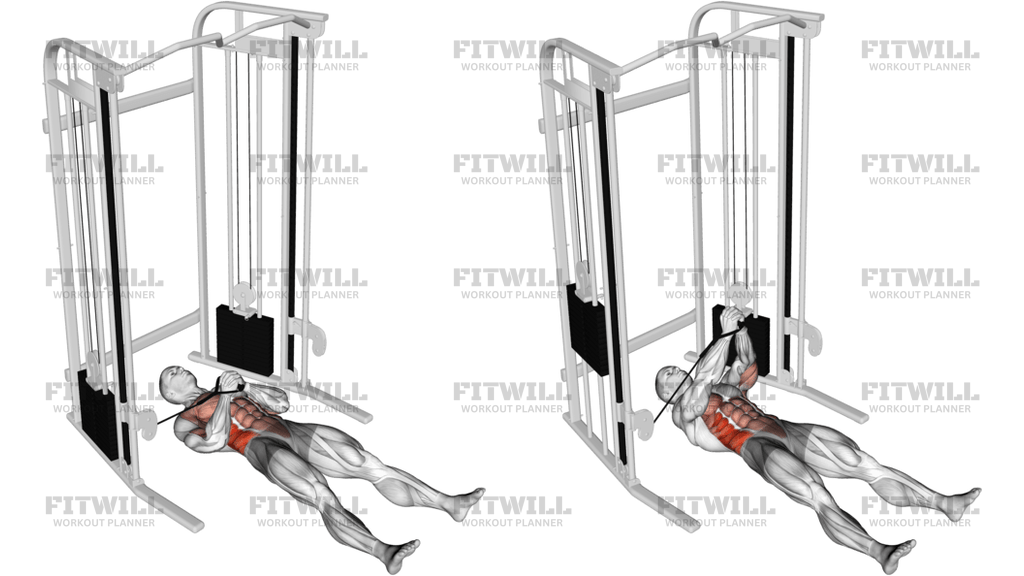
Cable Lying Pallof Press is a floor-based anti-rotation core exercise that uses a cable machine and handle attachment to challenge the obliques without relying on momentum. Lying on your back removes a lot of standing balance noise, so you can feel what happens when the cable tries to twist your torso and learn how to keep your ribs and pelvis quiet.
This variation is especially useful when you want the control benefits of a Pallof press but with more feedback from the floor. The main work lands on the obliques and deep abdominal wall, while the rectus abdominis, transverse abdominis, and spinal stabilizers help keep your trunk from rotating or arching. It is a smart option for core sessions, warmups, and accessory work when you want crisp tension rather than heavy loading.
The setup matters because the cable should pull you off line without forcing your shoulders, neck, or lower back into a bad position. Lie flat beside the machine, hold the handle over your chest, and organize your body so both shoulders stay level and your ribs do not flare. If the pulley height or body angle is off, the exercise turns into a press with body sway instead of a true anti-rotation drill.
Each repetition should feel like a controlled press away from the chest, a short pause against the cable’s pull, and a slow return with the same torso position you started with. Keep the movement smooth and deliberate, and let the floor tell you when your lower back starts to arch or one side of your ribcage begins to lift. That feedback is the main advantage of the lying version.
Use Cable Lying Pallof Press when you want core stability work that is honest, repeatable, and easy to scale with load. Start light enough that you can keep the handle path clean and your breathing steady, then increase resistance only when you can finish every rep without twisting, shrugging, or pressing through your shoulders. It is a practical drill for beginners learning anti-rotation control and for experienced lifters who want a strict core accessory without overtaxing the rest of the body.
[ Workout Log & Planner ]
Put your next workout in Fitwill
Keep your plan and training log ready when you are.


Instructions
- Set the cable pulley so the handle lines up with the middle of your chest when you lie down beside the machine.
- Lie flat on your back on the floor with the cable coming in from one side, legs long or slightly bent, and your shoulders square to the ceiling.
- Hold the handle with both hands over your sternum, stack your wrists over your elbows, and draw the cable tight before you start the first rep.
- Press your lower back gently into the floor and keep your ribs down so your torso stays long instead of arching.
- Press the handle away from your chest until your arms are almost straight and the cable tries to pull your trunk off center.
- Keep both shoulders level as you press, and stop the rep before one side of your ribcage opens or your hips roll.
- Pause briefly with the handle away from your chest, then bring it back to the start under control without losing torso position.
- Exhale as you press out and inhale as you return, keeping the cable under tension the whole time.
- Set the handle down only after the last rep, then reset your body before the next set.
Tips & Tricks
- Choose a pulley height that lets the handle start at chest level; if it pulls from too high or too low, your shoulders will compensate.
- Keep the handle centered over your sternum instead of drifting toward your face or hips as you press.
- If your lower back starts to arch, shorten the press and keep more of your ribs heavy on the floor.
- A slower return usually reveals whether you are actually resisting rotation or just pushing the handle back.
- Do not let your elbows flare wide; keep them close enough that the press feels like a core drill, not a chest press.
- Use a load that makes the cable challenge your torso before it challenges your arms.
- Keep your jaw and neck relaxed so the tension stays in your trunk instead of creeping into your shoulders.
- If one shoulder lifts first, reduce the weight and press in a smaller, cleaner line.
- A brief pause at full extension makes it much harder to cheat with momentum.
Frequently Asked Questions
What muscle does Cable Lying Pallof Press target most?
The obliques are the main target, with the deeper abdominal wall and spinal stabilizers helping you resist the cable’s pull.
Can beginners perform this exercise?
Yes. The lying position gives beginners a lot of feedback, so start with a light stack and learn to keep the ribs and hips square before adding load.
Where should the cable handle start on Cable Lying Pallof Press?
It should start over the middle of your chest, with your wrists stacked over your elbows and enough tension that the cable is already trying to pull you sideways.
Should my lower back stay flat during Cable Lying Pallof Press?
Yes. A small natural arch is fine, but if the press makes your low back lift or your ribs flare, the load is too heavy or the range is too long.
What is the difference between this and a standing Pallof press?
The lying version removes balance demands and gives you floor feedback, so it is easier to isolate anti-rotation control without cheating through the legs.
Why do I feel Cable Lying Pallof Press in my shoulders?
Some shoulder work is normal, but the effort should stay centered in the trunk. If your shoulders burn first, lighten the stack and keep the handle closer to your chest path.
How many reps work best for Cable Lying Pallof Press?
Use moderate sets with slow, clean reps. The goal is control and anti-rotation tension, so stop the set when you can no longer keep the torso quiet.
Can I do Cable Lying Pallof Press with one arm?
Yes, but the single-arm version is harder to control. Use it only after you can keep both shoulders level and the handle path clean with two hands.