Kettlebell Seated Two Arm Military Press
The Kettlebell Seated Two Arm Military Press is a strict overhead press performed with a kettlebell in each hand while sitting on a bench. Unlike the standing version, the seated position removes any help from the legs and hips, so your shoulders and arms have to do all of the work. You start with the kettlebells racked at shoulder height, wrists stacked over elbows, and press both bells straight up until your arms are fully extended overhead.
This movement is a solid choice for anyone who wants to build pressing strength without lower body momentum. Because the kettlebell sits slightly behind and outside your hand rather than directly over your wrist like a dumbbell, the press challenges your stabilizers a little differently and demands honest technique. The seat also makes it easier to notice when you lean back or arch through the lower back, which is one of the most common faults in overhead pressing.
The primary muscles worked are the front and side deltoids, with strong contributions from the triceps as you lock the bells out overhead. The upper traps and serratus anterior help you finish the press and control the weight on the way down, while your core stays braced the entire time to keep your torso upright on the bench. Grip and forearm strength matter too, since you are holding two kettlebell handles throughout the set.
Setup matters more here than in most presses. Sit tall on a flat bench with your feet planted wide and firmly on the floor, and clean the kettlebells into the rack position at your shoulders before the first rep. If your feet are floating or your torso is slouched, the press becomes sloppy and the shoulder joint takes on stress it does not need. A tall spine, ribs down, and elbows tucked slightly in front of the torso give you the strongest starting position.
To execute the press well, drive both bells up together in a straight line, letting your head move back slightly so the weights pass close to your face rather than out in front of you. Press to full lockout with the bells directly over your shoulders, then lower them under control back to the rack position. The descent should be deliberate; dropping the kettlebells back down wastes half of the exercise and makes the next rep harder to start cleanly.
This exercise fits well as a primary pressing movement on an upper body or shoulder-focused day, typically for sets of 5 to 10 reps with a weight you can press strictly. It is also a useful progression for lifters who wobble or hyperextend when pressing standing, since the bench gives feedback without offering assistance.
[ Workout Log & Planner ]
Put your next workout in Fitwill
Keep your plan and training log ready when you are.


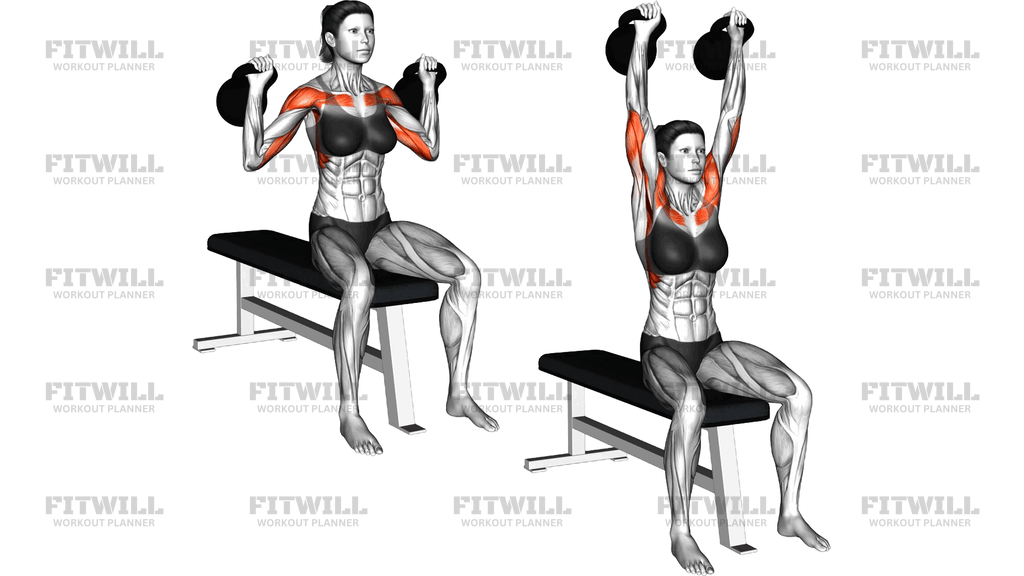
Instructions
- Sit on a flat bench with your feet planted wide and flat on the floor, toes turned slightly out, and your torso sitting tall.
- Clean a kettlebell into each hand so both bells rest on the outside of your forearms at shoulder height, elbows bent and tucked slightly in front of your ribcage.
- Brace your core and pull your ribs down so your lower back stays neutral against the upright torso position.
- Grip the kettlebell handles firmly with your knuckles facing up and your wrists straight and stacked over your elbows.
- Press both kettlebells straight overhead at the same time, letting your head shift back slightly so the bells travel close to your face.
- Keep the bells from drifting forward; at the top your arms should be fully extended with the kettlebells stacked directly over your shoulders.
- Pause briefly at lockout, then lower both bells under control back to the rack position at your shoulders.
- Exhale as you press the weight up and inhale as you lower it back down.
- Reset your brace and your rack position before each repetition rather than rushing through the set.
- When finished, either lower the kettlebells to your lap first or stand up before setting them on the floor; never drop them from the seated position.
Tips & Tricks
- If the bells want to fall forward at the top, your wrists are breaking back; press slightly back over your shoulders so the kettlebells finish stacked over your shoulder joints, not in front of them.
- Leaning back on the bench turns this into an incline press and takes work away from the deltoids; keep your torso vertical and imagine sliding your shoulder blades down your back as you press.
- A bell slipping off the forearm usually means a loose grip or a floppy wrist; squeeze the handle hard and keep your knuckles facing up throughout the press.
- Keep your elbows under the bells in the rack position rather than flaring straight out to the sides; flared elbows make the bottom of every rep harder to start.
- Breathe out forcefully at the top of each press instead of holding your breath through the whole set, especially on heavier weights.
- If one arm presses before the other, slow the tempo down so both bells move and arrive together; this imbalance often shows up first with kettlebells because each side is loaded separately.
- Choose a kettlebell size you can clean into position with control, since getting two heavy bells to your shoulders while seated is part of the challenge.
- Avoid shrugging your shoulders up toward your ears mid-press; this happens when the weight is too heavy and shifts stress into the neck.
- Place the bench in an open area so the bells have clearance on both sides, and keep your feet wide enough that you feel planted from the first rep to the last.
Frequently Asked Questions
Which muscles does the Kettlebell Seated Two Arm Military Press work the most?
The front and side deltoids do the bulk of the pressing work, with the triceps extending the elbows to lockout. The upper traps, serratus anterior, and core contribute heavily to stabilization and overhead control.
Is the seated version harder or easier than the standing Kettlebell Military Press?
It is usually easier in terms of total load because you cannot use leg drive, but it demands stricter shoulder and torso control. Most lifters can press less weight seated but with cleaner shoulder mechanics.
Why use kettlebells instead of dumbbells for this press?
The kettlebell's center of mass sits behind and outside the handle, so the weight pulls your wrist into extension and forces your stabilizers to work. This gives slightly different shoulder and grip demands than a dumbbell of the same weight.
How should my feet be positioned while seated?
Plant both feet flat on the floor about hip-width or slightly wider so you feel stable from the ground up. Your feet are not driving the press, but a wide, firm base keeps your torso from rocking as the bells move overhead.
What is the most common mistake in the Kettlebell Seated Two Arm Military Press?
Leaning back and arching the lower back to help press the weight, which turns it into a sloppy incline press. Keep your ribs pulled down and your torso tall, and reduce the weight if you cannot stay upright.
How do I get two kettlebells into the rack position while sitting?
Clean them from the floor to your shoulders one at a time before you settle into the press position, or lift them to your lap and rack each arm separately. Avoid twisting awkwardly under load just to start the set.
Can beginners do the Kettlebell Seated Two Arm Military Press?
Yes, and the seated setup is actually a good learning environment because it limits cheating. Beginners should start with light kettlebells, master the rack position, and practice pressing one arm at a time before pressing both together.
How many sets and reps should I do?
For strength, work in 4 to 6 sets of 4 to 6 reps with a challenging but strict weight. For muscle and general pressing endurance, 3 to 4 sets of 8 to 10 controlled reps works well.
What can I use if I do not have two kettlebells?
Dumbbells are the closest substitute and follow the same seated pressing path. If you only have one kettlebell, pressing one arm at a time while seated is a reasonable alternative, though it loads the core unevenly.
Is it safe to press overhead if my shoulders feel pinched at the top?
Stop the set if you feel pinching rather than working through it. Check that the bells are stacked over your shoulders and not drifting forward, keep your grip firm, and use a lighter weight; persistent discomfort is worth having assessed before loading the movement further.