Kettlebell Around Head Rotation
Kettlebell Around Head Rotation is a standing halo-style drill that asks you to circle a kettlebell around the head with control instead of speed. It is useful when you want to train shoulder coordination, upper-back control, and trunk stability while also warming up the arms and hands before heavier pressing or carries. The movement looks simple, but the quality comes from keeping the bell close, the ribs stacked, and the neck relaxed from the first rep to the last.
This exercise is usually most valuable as a warm-up or accessory movement rather than a max-strength lift. A light kettlebell lets the shoulders move through a smooth arc without the torso swaying or the lower back taking over. The hands, elbows, and shoulders all have to stay organized while the core resists rotation, which is why the setup matters so much. If the bell starts drifting wide or the chest opens aggressively, the drill turns into a loose swing instead of a controlled rotation.
In a good rep, the kettlebell travels around the crown of the head in a tight path, with the elbows bending and guiding the circle rather than flaring out. The bell should pass close to the temples and behind the head without scraping the neck or forcing the chin forward. Breathing should stay calm and rhythmic, because holding the breath tends to make the ribs flare and the shoulders shrug. That combination of shoulder motion and trunk control is what makes Kettlebell Around Head Rotation useful for movement prep and shoulder awareness.
Use Kettlebell Around Head Rotation when you want a low-load drill that reinforces smooth shoulder motion before pressing, overhead work, or upper-body sessions. It can also fit well in general warm-ups, circuit training, or mobility-focused sessions where the goal is clean movement rather than fatigue. Beginners can use it with a very light kettlebell, but the range should stay pain-free and precise. If the shoulders pinch or the neck starts working harder than the arms, the load is too heavy or the circle is too wide.
The safest reps are the ones where the bell stays close to the body and the torso stays quiet. You should feel the shoulders moving around the head, not the spine twisting to help the bell get around. If you need to lean, arch, or yank the weight through the top of the circle, the kettlebell is too heavy for the job. Done well, Kettlebell Around Head Rotation builds cleaner overhead mechanics, better shoulder control, and a more stable brace without beating up the joints.
[ Workout Log & Planner ]
Put your next workout in Fitwill
Keep your plan and training log ready when you are.


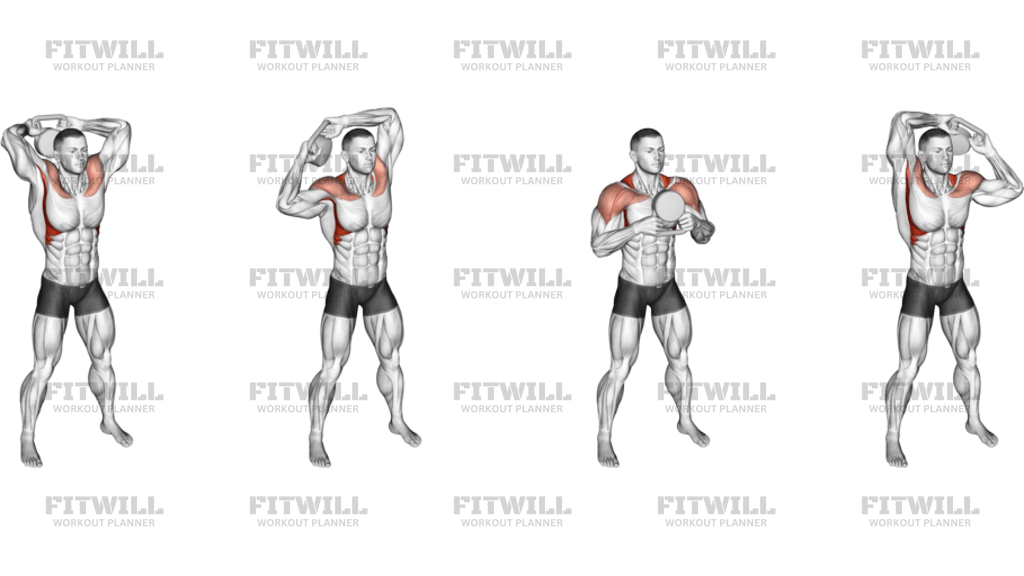
Instructions
- Stand tall with your feet about hip-width apart and hold the kettlebell by the horns with both hands in front of your chest.
- Bend your elbows and raise the bell to one side of your face, keeping it close instead of letting it drift away from your body.
- Set your ribs over your pelvis, soften your knees, and brace before the bell starts moving behind your head.
- Circle the kettlebell around the back of your head in a smooth arc, letting the elbows guide the path instead of flaring wide.
- Keep the bell clear of the neck as it passes behind your head, and avoid jutting your chin forward to make room for it.
- Bring the kettlebell around the other side until it returns to the front of your chest under control.
- Reverse the circle on the next rep or complete an equal number of reps in each direction.
- Keep breathing steady through the rotation, exhaling as the bell passes the most demanding part of the arc.
- Lower the kettlebell to chest height, reset your stance, and stop the set if the circle becomes uneven or the shoulders start shrugging.
Tips & Tricks
- Start lighter than you think you need; the quality goal is a smooth halo, not a heavy lift.
- Keep the bell close to the temples and crown of the head so the shoulders do the work instead of the arms reaching wide.
- If the bell brushes the neck or your elbows flare out, shorten the circle and slow the tempo.
- Keep your chin level and your eyes forward so you do not chase the kettlebell with your head.
- Do not let the ribs pop up when the bell goes behind your head; that usually means the load is too heavy.
- Move both shoulders evenly around the head rather than favoring one side and twisting through the torso.
- If one direction feels smoother, still train the opposite direction with the same light load and range.
- A soft grip is enough once the kettlebell is secure; squeezing too hard often makes the shoulders shrug.
- Treat this as a warm-up or accessory drill and stop the set the moment the circle turns choppy.
Frequently Asked Questions
What does Kettlebell Around Head Rotation train?
It mainly trains shoulder control, upper-back stability, and trunk resistance to rotation while the arms guide the kettlebell around the head.
Is Kettlebell Around Head Rotation the same as a halo?
Yes, this is a halo-style kettlebell movement where the bell circles around the head in a controlled path.
How should I hold the kettlebell for this exercise?
Hold the kettlebell by the horns with both hands in front of your chest, then keep the bell close as it travels around the head.
Should my elbows stay bent the whole time?
Yes. A steady bend keeps the kettlebell path compact and helps the shoulders guide the circle instead of the arms reaching too far.
What is the biggest mistake in Kettlebell Around Head Rotation?
Letting the bell drift wide and arching the ribs to fake the range is the most common problem. Keep the circle tight and the torso stacked.
Can beginners do Kettlebell Around Head Rotation?
Yes, as long as they start very light and keep the movement pain-free. It should feel smooth and controlled, not forced.
Why do I feel this in my neck?
Usually the kettlebell is too heavy, the shoulders are shrugging, or the head is reaching forward. Lighten the load and keep the chin stacked over the chest.
Should I rotate in both directions?
Yes. Train both directions so the shoulders and trunk control the circle evenly, even if one side feels more natural at first.
What can I substitute if this bothers my shoulders?
A lighter kettlebell, a shorter halo range, or a simple shoulder circle drill without load is a safer option until the motion feels clean.