Smith Shrug
The Smith Shrug is a shrug performed with the bar of a Smith machine instead of a free-weight barbell. You stand facing or side-on to the machine, hold the bar against your thighs with an overhand grip, and elevate your shoulders straight up toward your ears before lowering them under control. Because the bar travels on fixed vertical rails, the movement stays locked to one path with no balancing demands on your part.
The main muscle at work is the upper trapezius, the diamond-shaped muscle that runs from the base of your skull and upper spine out to your shoulder blades. The middle traps assist as the shoulder blades rotate upward, and your forearms and grip work statically the whole time to hold the bar. Your legs and lower back stay quiet, which is exactly the point: nothing else has to support the load.
That fixed bar path is what makes this version worth using. With a free barbell, the weight drifts forward or backward as you fatigue and your balance shifts. On the Smith machine the bar cannot drift, so you can focus purely on driving your shoulder blades up, and you can train close to failure without a spotter since you can rotate the bar into the hooks at any point. It is a solid choice for lifters who want to load the traps heavily without adding stability work on top of it.
Setup matters more than it looks. The bar should rest at roughly mid-thigh height when you unlatch it, your feet should sit about hip-width directly under the bar, and your grip should be just outside your thighs. Standing too far from the machine tilts your torso and shifts tension away from the traps, so take a moment to line yourself up before the first rep.
Execution is simple but easy to rush. Keep your arms long and relaxed, then shrug the shoulders vertically upward as high as they will go without bending the elbows or leaning back. Pause briefly at the top, lower the shoulders all the way down for a full stretch, and reset your grip tension between reps. A common use case is as a finishing movement after deadlifts or rows, or as a standalone trap builder on shoulder day, typically for sets of 8 to 15 reps.
The main safety points are to keep the movement strictly vertical, avoid rolling the shoulders backward in big circles, and never bounce out of the bottom. The Smith machine lets you use heavy loads, so earn that weight with clean reps rather than letting your ego set the pin.
[ Workout Log & Planner ]
Put your next workout in Fitwill
Keep your plan and training log ready when you are.


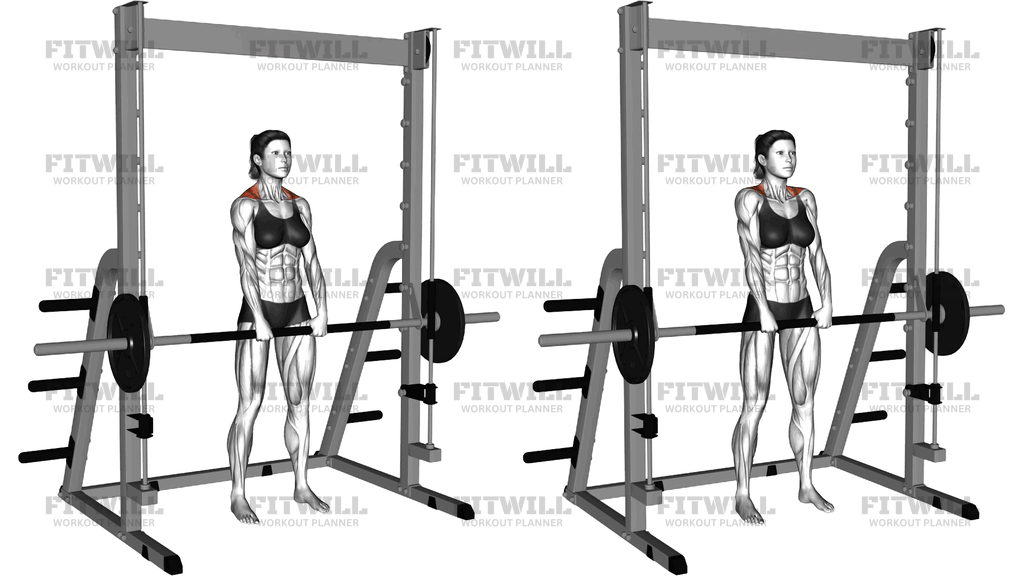
Instructions
- Set the Smith machine bar at about mid-thigh height and load plates evenly on both sides.
- Stand facing the machine with your feet hip-width apart, positioned so the bar hangs directly in front of your thighs.
- Grip the bar with an overhand grip, hands just outside your thighs, and rotate the bar to release it from the safety hooks.
- Stand tall with your chest up, a neutral neck, and a light brace through your core; let your arms hang fully straight with a slight bend in the knees.
- Exhale and shrug your shoulders straight up toward your ears as high as possible, keeping your elbows locked and your torso still.
- Hold the top position for a one-second squeeze, focusing on lifting the shoulder blades rather than just rearing the head back.
- Inhale and lower the bar under control until your shoulders drop to a full, relaxed stretch at the bottom.
- Pause briefly at the bottom, re-tighten your grip, and begin the next shrug without bouncing.
- After your final rep, rotate the bar back into the safety hooks before releasing your hands.
- Reset your stance between sets so the bar path stays directly in front of your thighs every rep.
Tips & Tricks
- Do not bend your elbows to help the bar up; if your arms bend, the weight is likely too heavy for your traps to move alone.
- Avoid rolling your shoulders in circles at the top or bottom. Straight up and straight down keeps tension on the upper traps and spares your shoulder joints.
- Keep your head neutral and eyes forward. Craning the neck back to fake extra height is one of the most common faults on the Smith Shrug.
- Chalk up or use a secure grip, because grip failure ends the set before your traps do. Straps are acceptable on your heaviest sets.
- Lower the bar slower than you lift it. The stretch at the bottom is where a lot of the trap development happens.
- Do not stand with your feet behind the bar. If the bar hangs forward of your thighs, your shoulders get pulled into a rounded position as you shrug.
- Use the fixed rails to your advantage by pausing at the top for a full second. The machine holds the weight for you, so the pause costs nothing in balance.
- Set the safety hooks low enough that a shrug rep never collides with them, but keep them engaged so you can re-rack instantly if your grip slips.
- Start lighter than you think you need. The Smith machine removes balance work, so weights can climb fast and the lower back can still take subtle abuse if you lean back under load.
Frequently Asked Questions
Which muscles does the Smith Shrug work?
The upper trapezius is the prime mover, with the middle trapezius and levator scapulae assisting as the shoulder blades elevate. Your forearms and grip work isometrically to hold the bar throughout the set.
Is the Smith Shrug good for beginners?
Yes, it is one of the friendlier shrug variations for beginners because the fixed bar path removes the balance and coordination demands of a free barbell. Start with a light weight to learn the vertical shrug pattern before adding load.
How is the Smith Shrug different from a barbell shrug?
The Smith machine bar travels on vertical rails, so you never have to stabilize the weight side to side or front to back. You can focus entirely on squeezing the traps and can safely re-rack the bar at any point, though you give up some natural bar path freedom.
Where should I set the bar height before starting?
Set it around mid-thigh so you can unlatch it while standing tall with straight arms, without rounding over or rising onto your toes to reach it. Most Smith machines let you adjust in small increments, so test one rep unloaded first.
Should I roll my shoulders during the movement?
No, keep the motion a straight vertical shrug. Shoulder rolling adds rotation under heavy load without extra trap benefit and is a common source of unnecessary shoulder and neck strain.
Why do my forearms burn before my traps feel anything?
Grip and forearm endurance is often the limiting factor on shrugs. Chalk, a hook grip, or lifting straps let you keep the load in your traps instead of losing the set to your hands.
Can I replace the Smith Shrug with dumbbell shrugs?
Yes, dumbbell shrugs are the closest free-weight substitute and add a balance and grip challenge. The Smith version is better when you want maximum trap loading with zero stabilization requirements or no spotter.
How high should I shrug at the top?
Lift your shoulders as high toward your ears as your range allows while keeping your arms straight and torso still. If your head tilts back or your elbows bend, you have passed the point where the traps are doing the work.
Is it safe to go heavy on the Smith Shrug?
The fixed path and instant re-rack hooks make it safer than a heavy barbell shrug, but the weight still loads your spine and grip. Use a weight you can lower under control for every rep and never sacrifice range to add plates.
How many reps and sets should I do?
The traps respond well to moderate loads and higher volume, so 3 to 4 sets of 8 to 15 reps with a pause at the top works well. Place the movement after deadlifts or rows so it does not fatigue your grip before the bigger lifts.