Smith Back Wide Shrug
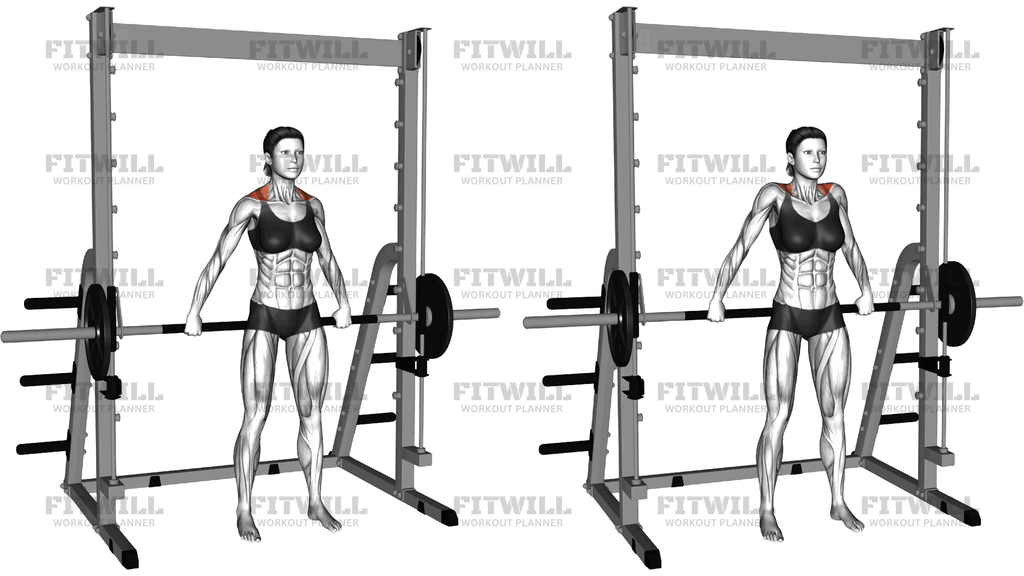
The Smith Back Wide Shrug is a vertical shrug performed inside a Smith machine with the bar held in front of your thighs using a grip noticeably wider than shoulder width. Because the bar travels on fixed rails, the exercise removes balance and stabilization demands from the equation and lets you focus entirely on driving the shoulder girdle upward. The wide hand placement changes the pull slightly compared with a standard shrug, encouraging the shoulders to rise more straight up toward the ears rather than rolling inward, which many lifters find more comfortable on the upper traps and neck area.
This movement primarily targets the upper trapezius, the diamond-shaped muscle that runs from the base of the skull and along the upper spine out to the collarbone and shoulder blade. The middle traps and rhomboids assist as the shoulder blades lift and slightly adduct at the top, and the forearms and grip work isometrically to hold the bar throughout the set. Because the machine guides the path, the lower body and lower back contribute very little, making this a clean, isolated way to load the traps.
The Smith machine setup matters for two reasons. First, the fixed bar path means you can position your feet exactly where you want them and know the bar will stay in the same vertical line every rep, which is helpful for learning what a proper shrug feels like. Second, the safety catches and easy bar rotation let you train the traps to a challenging level without a spotter, since the worst case is simply lowering the bar back onto the stops. Set the bar at roughly mid-thigh height so you can unrack it with a soft bend in the hips and knees rather than a deep lean.
To execute the movement well, stand tall with your feet about hip width, grip the bar wide with straight arms, and think about pushing the bar down into the floor with your hands while shrugging your shoulders straight up toward your ears. The elbows stay locked and the arms stay long; if they bend, the arms start stealing work from the traps. Pause briefly at the top, then lower the bar under control until you feel a gentle stretch through the upper traps before starting the next rep.
This exercise fits well as a primary trap builder on upper body or pull days, or as a finisher after rows and pulls when the traps are already warmed up. It is also a practical choice for lifters who find free-weight barbell shrugs awkward due to balance or grip limitations, since the machine handles the stability work. Keep the loads moderate at first, prioritize a full range from a stretched bottom to a high, controlled top, and avoid anything resembling a rolling shoulder motion, which adds little and can irritate the shoulder girdle.
[ Workout Log & Planner ]
Put your next workout in Fitwill
Keep your plan and training log ready when you are.


Instructions
- Set the Smith machine bar at approximately mid-thigh height and load an even amount of weight on both sides.
- Step inside the machine so the bar sits in front of your thighs, with feet about hip width apart and toes pointing forward.
- Rotate the bar to release it from the hooks and take a wide overhand grip, hands well outside shoulder width, arms fully straight.
- Stand tall with a soft bend in the hips and knees, chest up, and brace your core to keep your torso from swaying.
- Exhale and shrug your shoulders straight up toward your ears as high as possible, keeping your elbows locked and arms long.
- Hold the top position for a one-second squeeze, focusing on lifting the shoulder girdle rather than bending the arms.
- Inhale and lower the bar under control until your shoulders drop fully and you feel a mild stretch in the upper traps.
- Pause briefly at the bottom to reset your posture, making sure you are not leaning back or bouncing out of the stretch.
- Complete your reps, then rotate the bar forward and re-rack it securely on the hooks before letting go.
Tips & Tricks
- A wide grip only works if the arms stay straight; the moment the elbows bend, the biceps take over and the shrug becomes a cheat curl. Lock your elbows before you start the set.
- Do not roll your shoulders backward or forward. With a wide Smith machine setup, a straight vertical shrug is safer and hits the upper traps better than circling, which commonly causes shoulder-girdle irritation.
- If your grip gives out before your traps do, use lifting straps. The fixed bar path means you are not training stabilization anyway, so straps cost you nothing here.
- A common mistake is loading heavy weight and cutting the range to a few inches of movement. Reduce the load until you can go from a full stretch at the bottom to a genuinely high shrug at the top.
- Keep your head in a neutral position and look straight ahead. Craning the chin upward to chase height takes work away from the traps and strains the neck.
- Because the bar path is fixed, your feet placement determines your torso angle. Stand too far forward or back and the bar will drag across your thighs or pull you off balance; adjust your stance until the bar tracks just in front of your legs.
- Control the lowering phase for at least a full second. The eccentric is where the traps get a strong stretch stimulus, and dropping the bar turns the set into half a repetition.
- If you feel the work in your neck instead of the top of your shoulders, you are likely elevating with a rounded upper back. Retract slightly and think about shrugging the shoulder blades up and together, not just the shoulders toward the ears.
Frequently Asked Questions
What muscles does the Smith Back Wide Shrug work?
The upper trapezius is the prime mover, with the middle traps and rhomboids assisting as the shoulder blades lift. The forearms and grip work isometrically to hold the wide-grip bar throughout the set.
Why use a wide grip instead of a shoulder-width grip on this shrug?
The wider hand position tends to keep the shoulders from rolling forward and inward, encouraging a straighter vertical shrug. Many lifters also find it reduces awkward twisting at the shoulder joint under heavy loads.
Is the Smith Back Wide Shrug good for beginners?
Yes, it is one of the more beginner-friendly ways to load the traps because the machine fixes the bar path and removes balance demands. Start light, learn the full range from a stretched bottom to a high top, and progress gradually.
How high should I set the bar on the Smith machine?
Set it around mid-thigh so you can unrack with a slight bend in the hips and knees and stand fully upright before the first rep. Too low and you have to lean over; too high and you lose the stretch at the bottom of each rep.
Should my elbows bend during the movement?
No. The elbows stay locked and the arms stay long for the entire set. Any elbow bend turns the movement into a partial upright row and shifts work away from the traps.
Can I replace barbell shrugs with the Smith Back Wide Shrug?
In most programs, yes. You trade a small amount of stabilizer and grip demand for a fixed path and easier safety, which suits hypertrophy-focused trap training well. If your goal includes grip strength under load, keep some free-weight shrug variations in the mix.
Why do I feel this more in my neck than my shoulders?
That usually means the shoulders are creeping up with a rounded upper back, or the head is tilting to help the lift. Keep the chin neutral, chest tall, and think about elevating the shoulder blades up and slightly together rather than forcing the ears toward the shoulders.
Is it safe to do this exercise without a spotter?
Generally yes, because the Smith machine bar can be rotated back onto its hooks at any point and the safety stops catch the weight if you lose grip. Just make sure the stops are set below your bottom position before you start the set.
How many reps and sets should I do?
For trap hypertrophy, 3 to 4 sets of 10 to 15 reps with a controlled lowering phase and a brief top hold works well. Because the range of motion is short, prioritize quality of contraction over maximum load.