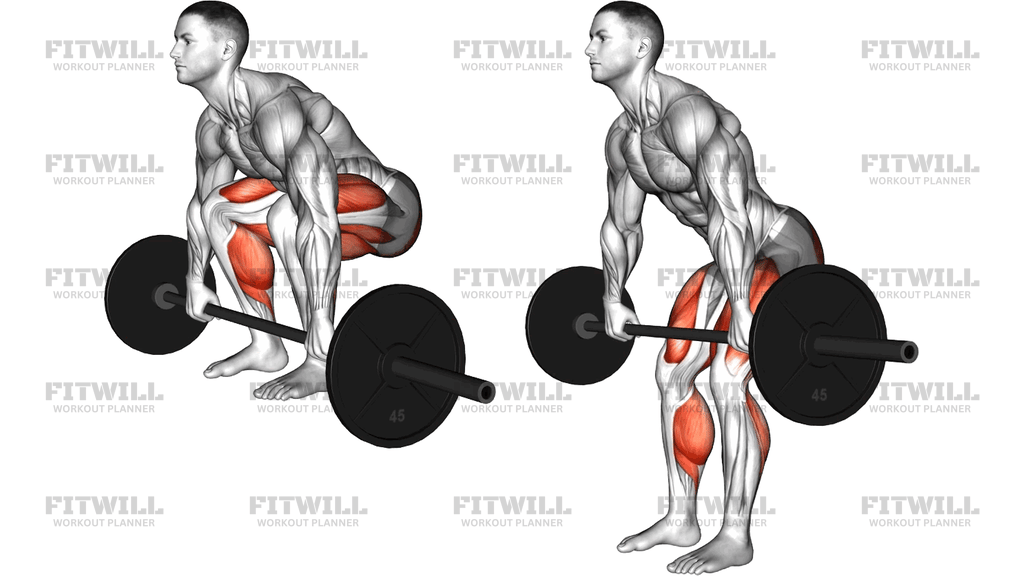
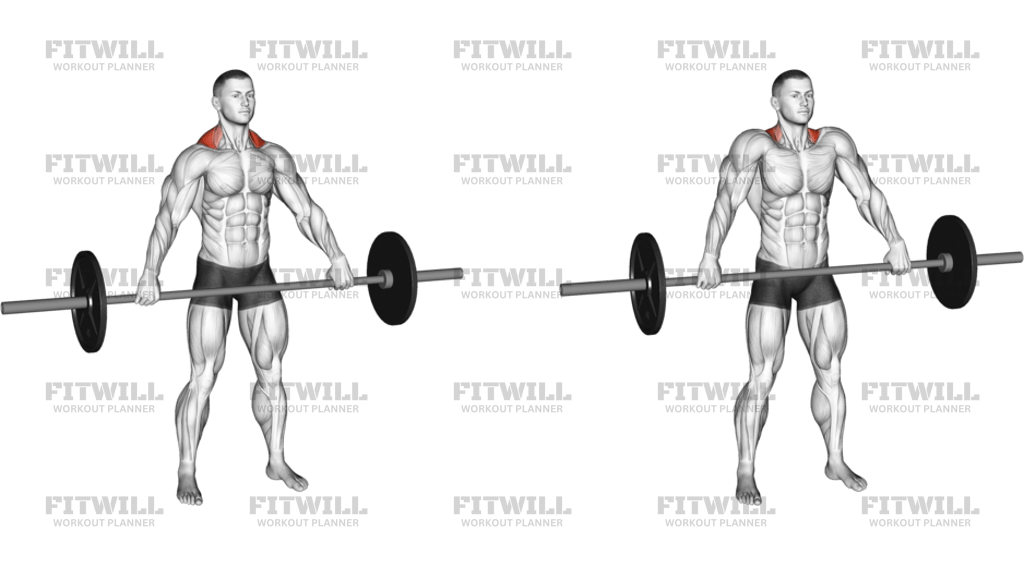
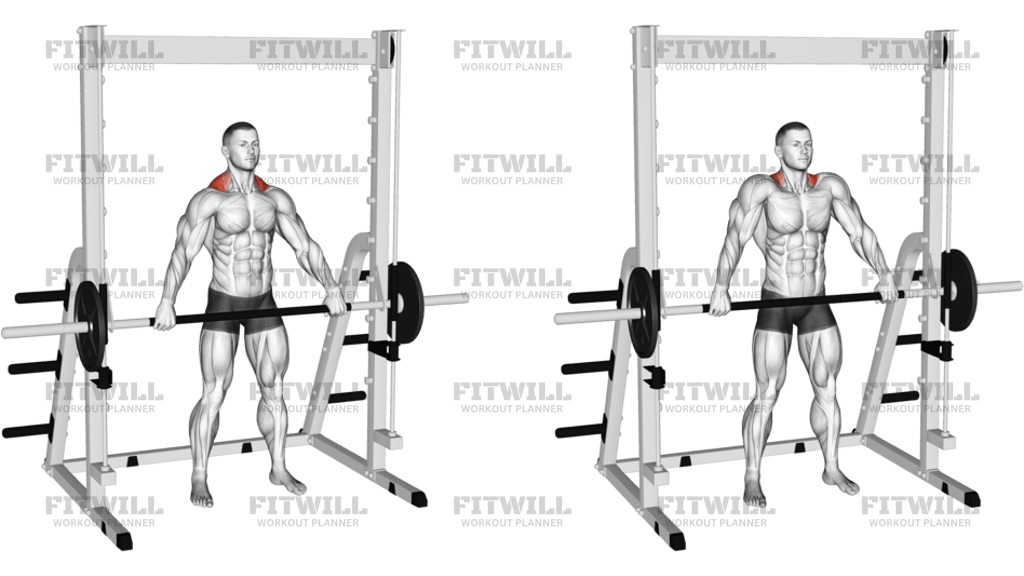
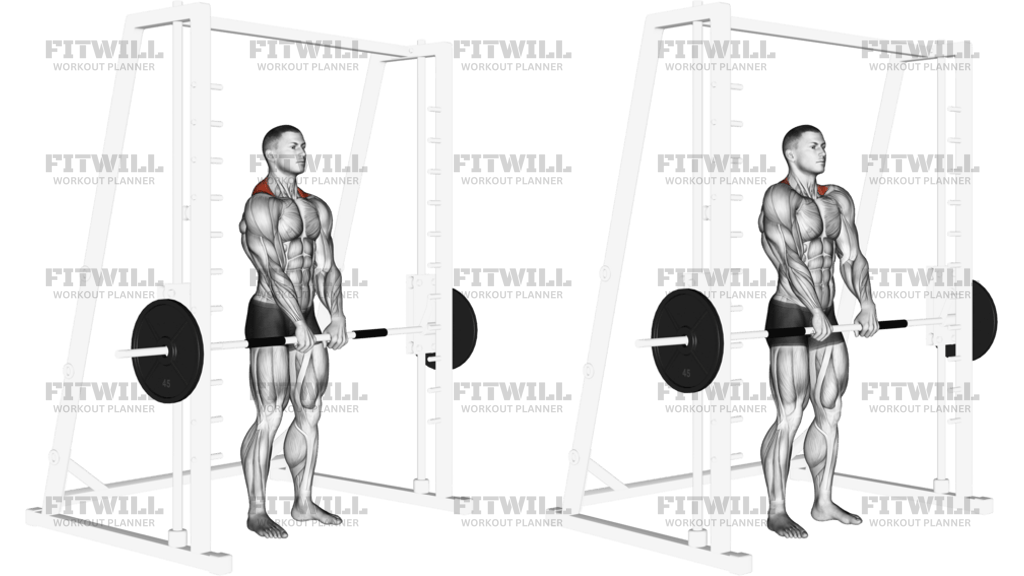
Trap Bar Standing Shrug
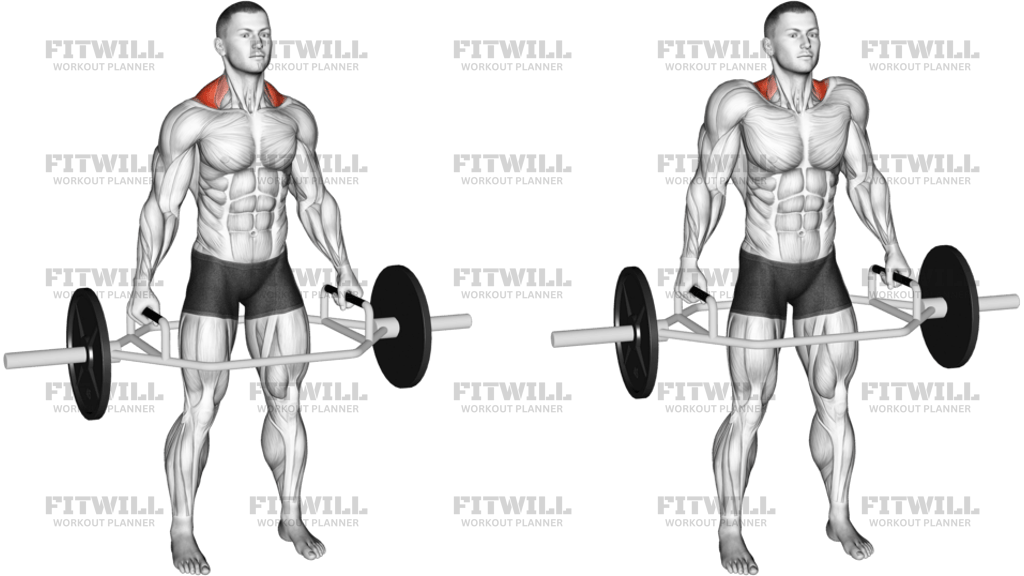
The Trap Bar Standing Shrug is a straightforward upper-back builder performed with a trap bar, also called a hex bar, loaded with plates and held at your sides while you stand upright. From that position, you elevate your shoulders straight up toward your ears, pause briefly at the top, and lower the bar back down under control. Because the weight hangs at your sides rather than in front of or behind your body, the movement stays close to your midline and puts very little rotational stress on the shoulders or lower back.
This exercise primarily targets the upper trapezius, the diamond-shaped muscle that runs from the base of your skull and upper spine out to your collarbone and shoulder blade. The middle traps, rhomboids, and levator scapulae assist as the shoulder blades lift, while your forearms and grip work hard the entire time just to hold onto the bar. Compared to a barbell shrug, the neutral grip and side-by-side handle position tend to feel more comfortable at the shoulder joint and make it easier to keep the load balanced evenly between both sides.
The trap bar setup matters more than it might seem. Standing inside the hex frame with the handles at your sides keeps the center of mass directly in line with your hips and spine, which means you can usually handle heavier loads here than with dumbbells without your posture breaking down. That makes it a solid choice for lifters who want to build trapezius size and strength, strongman-style athletes who need robust upper-back endurance for carries and holds, and anyone whose grip gives out before their traps do with dumbbell shrugs.
To execute it well, stand tall with your feet about hip-width apart inside the bar, grab the middle handles with a neutral grip, and brace your core before each rep. Lift your shoulders vertically toward your ears without bending your elbows, rolling your shoulders, or leaning back. The path is short, only a few inches of travel, so the quality of the squeeze matters far more than how high you can heave the weight. Lower the bar slowly and let your traps stretch fully at the bottom before starting the next rep.
In practice, this movement slots in nicely at the end of a pull or upper-body day, typically for sets of eight to fifteen reps. Because the setup is simple and the technique is easy to learn, it also works well for beginners who want to strengthen the muscles that support the neck and shoulder girdle. The main safety points are keeping your arms relaxed and straight, avoiding jerky bouncing reps, and choosing a weight you can lower with control rather than one you can only hoist upward.
[ Workout Log & Planner ]
Put your next workout in Fitwill
Keep your plan and training log ready when you are.


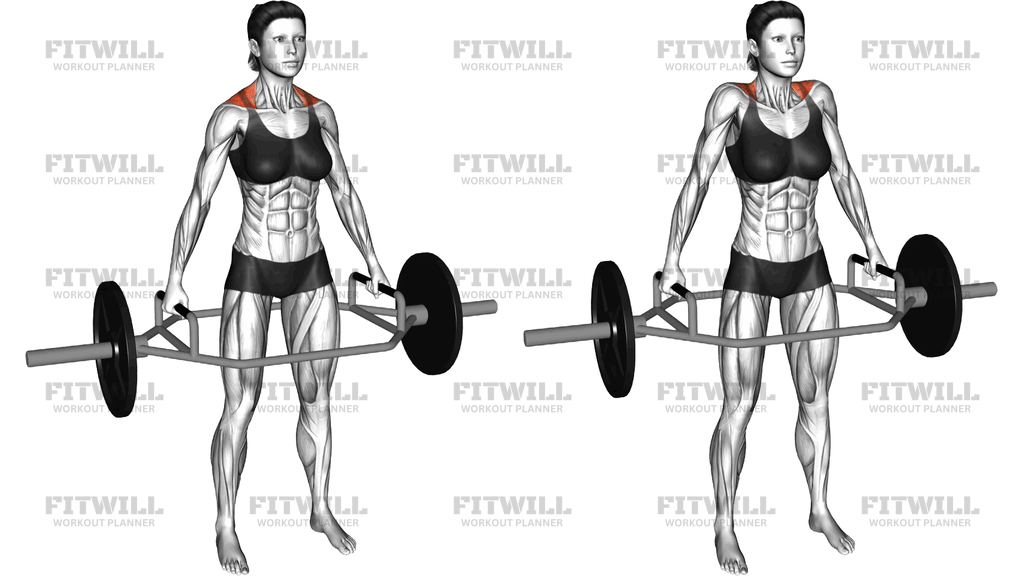
Instructions
- Stand inside the trap bar with your feet about hip-width apart and the loaded bar centered so both sides carry an even amount of weight.
- Grip the middle handles with a neutral grip, palms facing your body, and stand up so the bar hangs at full arm's length at your sides.
- Set your feet flat on the floor, keep your chest tall, and look straight ahead with your neck in a neutral position.
- Brace your core and keep your arms fully straight and relaxed; all of the upcoming movement comes from your shoulder girdle, not your elbows.
- Exhale and shrug your shoulders straight up toward your ears as high as you can without bending your elbows or leaning back.
- Squeeze your traps hard at the top and hold the peak position for a one-count.
- Inhale and lower the bar slowly until your traps return to a full stretch and your shoulders drop back to the starting height.
- Pause briefly at the bottom so the weight is completely still, then start the next rep from that dead-stop position.
- Keep your torso vertical throughout; if you find yourself rocking the bar or bending your knees to generate momentum, reset and lighten the load.
- After your final rep, lower the bar to the floor with control and release your grip on the handles.
Tips & Tricks
- Keep your elbows locked out for every rep; the moment your elbows bend, your arms start stealing work from your traps.
- Do not roll your shoulders backward or forward in circles. Straight up and straight down is the intended path, and rolling just adds unnecessary shoulder joint wear with no extra trap work.
- If your grip fails before your traps feel worked, use lifting straps. Holding heavier weight at your sides is one of the big advantages of the trap bar version, so do not let your forearms cap the exercise.
- A common mistake is bouncing the plates at the bottom to launch the next rep. Dead-stop each rep and pull from stillness so your traps, not momentum, do the lifting.
- Keep your chin level and avoid poking your head forward as you shrug. Pushing your head around changes which muscles do the work and can strain the neck.
- The range of motion on this exercise is genuinely short. If you are moving the bar a long distance, you are probably rocking your torso; watch that the plates rise only a few inches per rep.
- Chalk or a secure grip helps because the bar should hang passively from straight arms, not be actively squeezed and pulled up by the hands.
- Set the plates down between sets instead of holding the bar while resting, so your lower back and grip get a full recovery before the next set.
Frequently Asked Questions
Which muscles does the Trap Bar Standing Shrug work?
The upper trapezius is the primary mover, with the middle traps, rhomboids, and levator scapulae assisting as the shoulder blades elevate. Your forearms and grip stay heavily involved just holding the loaded bar at your sides.
Is the Trap Bar Standing Shrug good for beginners?
Yes. The bar hangs naturally at your sides from a neutral grip, the movement path is short and simple, and there is little technique to coordinate, so most beginners can learn it safely with a light load in their first session.
How is a Trap Bar Shrug different from a Barbell Shrug?
With a trap bar, the weight sits at your sides along your midline with a neutral grip, which is easier on the shoulder joints and keeps the load balanced evenly. A barbell sits in front of or behind your body and can pull you slightly off-center, especially with heavy loads.
How heavy should I go on the Trap Bar Standing Shrug?
Choose a weight you can lift smoothly without jerking, leaning back, or bouncing off the bottom. Because the setup is stable, most lifters can use more weight here than with dumbbells, but the trap muscles respond to a hard squeeze and controlled lowering, not just heavy plates.
Why does my grip give out before my traps fatigue?
Holding a heavy bar at arm's length loads the forearms continuously, so grip failure is common on this exercise. Use lifting straps once your grip becomes the limiting factor so the trapezius muscles remain the target.
Should I roll my shoulders during the shrug?
No. The shoulders should travel straight up toward the ears and straight back down. Shoulder rolling adds no meaningful trap activation and simply introduces extra movement at the shoulder joint.
How many sets and reps should I do?
Two to four sets of eight to fifteen reps works well for most lifters, either at the end of a pull day or an upper-body session. Heavier sets of six to eight are also common for trap bar shrugs since the position supports substantial loading.
What can I use if I do not have a trap bar?
Dumbbell shrugs are the closest substitute since the weight also hangs at your sides with a neutral grip. A barbell shrug or a shrug on a cable machine are other options, though each shifts the load position slightly relative to your body.
Is it safe to do shrugs with a history of neck discomfort?
Keep the loads modest, avoid pushing your head forward or sideways during reps, and stop if you feel sharp discomfort in the neck. Since the traps and levator scapulae attach to the neck, anyone with ongoing neck issues should get clearance before loading this movement heavily.