Hyperextension (On Bench)
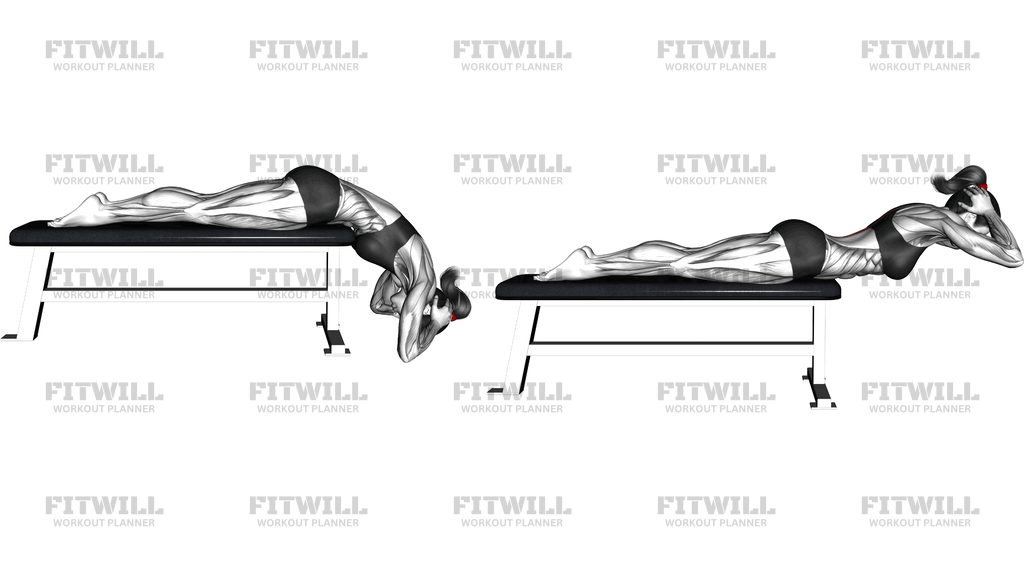
The Hyperextension (On Bench) is a bodyweight back exercise performed on a flat bench, where you lie face down with your hips supported on the pad and your upper body hanging off the end, then raise your torso up until your body forms a straight line. It is a simple setup that turns an ordinary bench into an effective tool for training spinal extension without needing a dedicated hyperextension or Roman chair station.
The main muscle at work is the erector spinae, the group of muscles running along the lower back that keeps your spine upright and controlled. Because your torso works against gravity from a hanging position, the glutes and hamstrings also contract hard to stabilize the hips, and the muscles of the mid back and core help control the descent. The hands are placed behind the head or at the temples, so nothing pulls on the neck and the arms simply stay out of the way.
Setup matters a great deal on this version. Your hip bones, not your thighs or your waist, should rest on the edge of the bench, and your legs stay long on the bench behind you with your weight anchored through them. If your hips sit too far forward, you lose stability; too far back, and the movement turns into an awkward leg exercise. Getting this contact point right is what allows the lower back to hinge cleanly through a safe range.
To execute the movement well, lower your torso toward the floor under control, inhale, then exhale as you lift your chest until your shoulders, hips, and heels line up. Stop at a straight body line rather than cranking upward into an exaggerated arch. The lift comes from the back and hips working together, not from yanking the head up or swinging the torso.
This exercise suits lifters who do not have access to a 45-degree hyperextension bench, home gym trainees working with minimal equipment, and anyone who wants direct lower back work to support deadlifts, squats, and everyday lifting. It is easy to scale: crossed arms over the chest make it easier, while holding a plate against the chest adds resistance once bodyweight feels routine.
Keep the range moderate and the tempo slow, especially at first. The lower back responds best to controlled repetitions with a brief pause at the top, not fast bouncing. If you feel the work shifting into your hamstrings cramping or your neck straining, adjust your position on the bench before adding reps.
[ Workout Log & Planner ]
Put your next workout in Fitwill
Keep your plan and training log ready when you are.


Instructions
- Set a flat bench in clear space and lie face down along it so the edge of the pad sits directly under your hip bones, with your legs fully supported on the bench and your upper body hanging off the end.
- Point your toes into the pad or hook your feet over the far edge of the bench so your lower body is anchored and your hips stay pinned to the bench.
- Place your hands lightly behind your head or at your temples with your elbows flared out, and let your torso hang down toward the floor as the starting position.
- Brace your abdominals and squeeze your glutes before you begin the rep so your pelvis does not tilt freely.
- Exhale and raise your torso by contracting your lower back, lifting your chest until your head, shoulders, hips, and heels form one straight line.
- Pause for a beat at the top without over-arching or throwing your head back.
- Inhale and lower your torso slowly back toward the floor, keeping the movement smooth instead of free-falling.
- Complete your repetitions, then carefully slide your body back onto the full length of the bench to rest.
- Breathe in on the way down and out on the way up, keeping a steady rhythm throughout the set.
Tips & Tricks
- If your hamstrings cramp, your hips are probably positioned too far forward on the bench, shifting the effort away from your lower back and into your legs.
- Keep your hands resting on the back of your head rather than pulling it forward or cranking it up, since the neck should stay neutral from start to finish.
- Stop at a straight body line at the top; arching far beyond horizontal adds stress to the spine without extra muscle benefit.
- Cross your arms over your chest if the hands-behind-head version feels too hard, which shortens the lever and makes each rep easier to control.
- Lower for two to three seconds each rep. Dropping your torso quickly and bouncing out of the bottom is the most common way this exercise goes wrong.
- Squeeze your glutes at the top of each rep to reinforce the hip position and keep the pelvis from tipping.
- If the bench slides or feels unstable, push it against a wall or rack so the pad edge stays fixed under your hips.
- Once bodyweight reps feel easy for twelve to fifteen controlled reps, hug a small plate to your chest rather than increasing speed or range.
Frequently Asked Questions
Which muscles does the Hyperextension (On Bench) work?
The erector spinae of the lower back are the primary movers, with strong support from the glutes and hamstrings. The mid back and abdominals also work to control the torso through the range.
How is the Hyperextension (On Bench) different from a Roman chair hyperextension?
A Roman chair anchors your feet and lets your whole body hang from the hips, while this version keeps your legs supported on a flat bench and only your upper body moves. The bench version is generally gentler and easier to set up with standard gym equipment.
How far down should I lower my torso?
Lower until your torso hangs comfortably toward the floor with a slight stretch along your lower back, usually around 45 to 90 degrees from the bench depending on your mobility. Stay in control rather than chasing the deepest possible hang.
Should I go above a straight line at the top?
No, lifting to a straight line from head to heels is enough to fully work the lower back and glutes. Arching far beyond horizontal loads the spine at its end range for little extra training benefit.
Where exactly should my hips sit on the bench?
The pad edge should sit right under your hip bones so your pelvis can hinge freely while your thighs stay supported on the bench. Too far forward reduces stability and shifts work into the hamstrings; too far back limits your range.
Is this exercise suitable for beginners?
Yes, it uses only bodyweight and a bench, so beginners can learn it safely with a short range and slow tempo. Start with eight to ten controlled reps and cross your arms over your chest if the full version feels difficult.
Can I add weight to the Hyperextension (On Bench)?
Yes, once bodyweight reps feel easy, hug a small weight plate or dumbbell against your chest with both arms. Hold it securely and keep the same slow tempo, since a loose weight can pull you off balance.
What can I use if I do not have a bench?
A stability ball can substitute, with your hips on the ball and your feet against a wall for anchoring, or you can perform floor-based back extensions on an exercise mat. Both train the same muscles with a shorter range of motion.
Why do my hamstrings cramp during this exercise?
Cramping usually means your hips have slid too far forward on the pad, so the hamstrings are working hard to hold your position. Shift back until the pad edge sits under your hip bones and squeeze your glutes to take the load off your hamstrings.