Resistance Band Standing Lat Pulldown
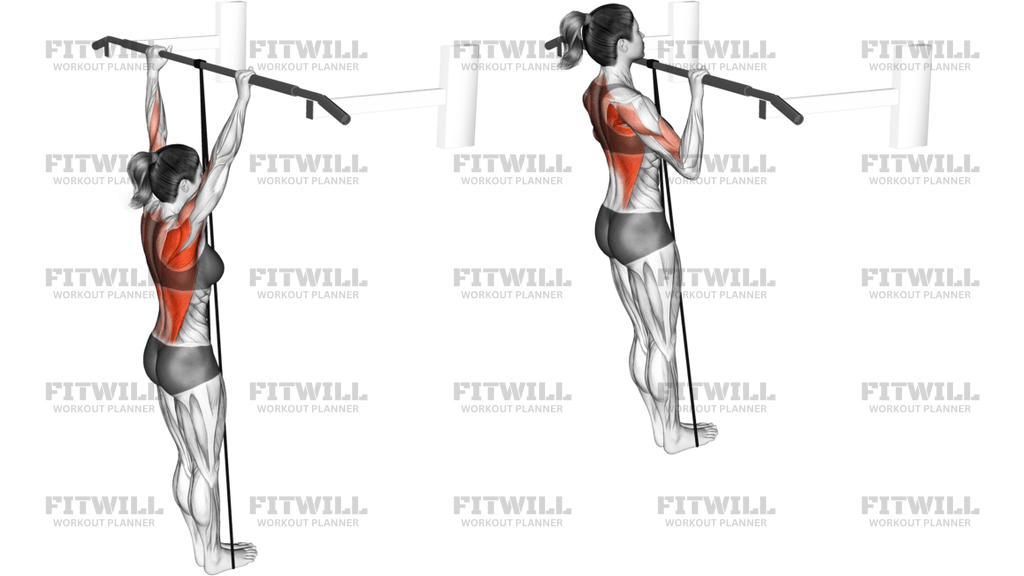
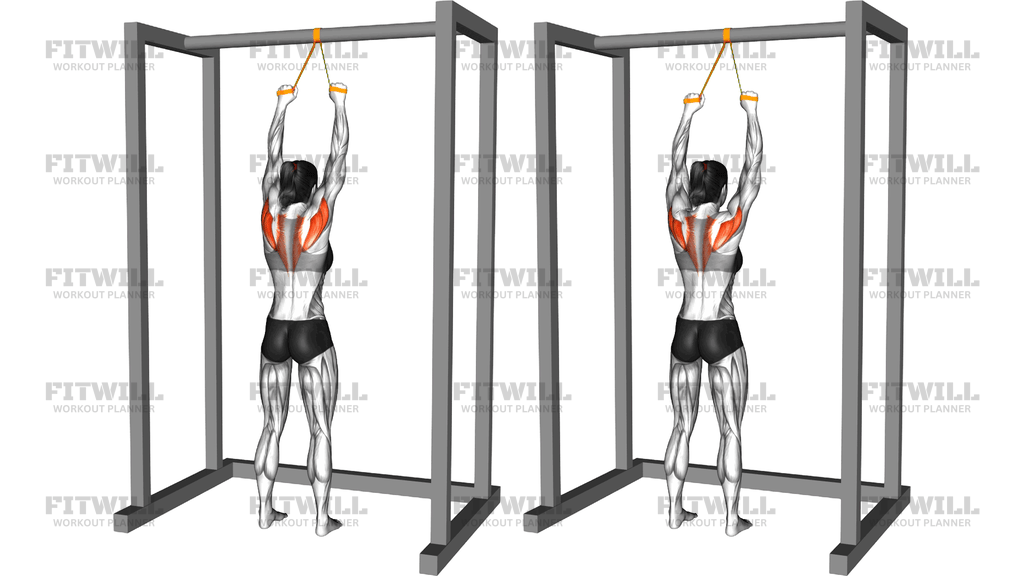
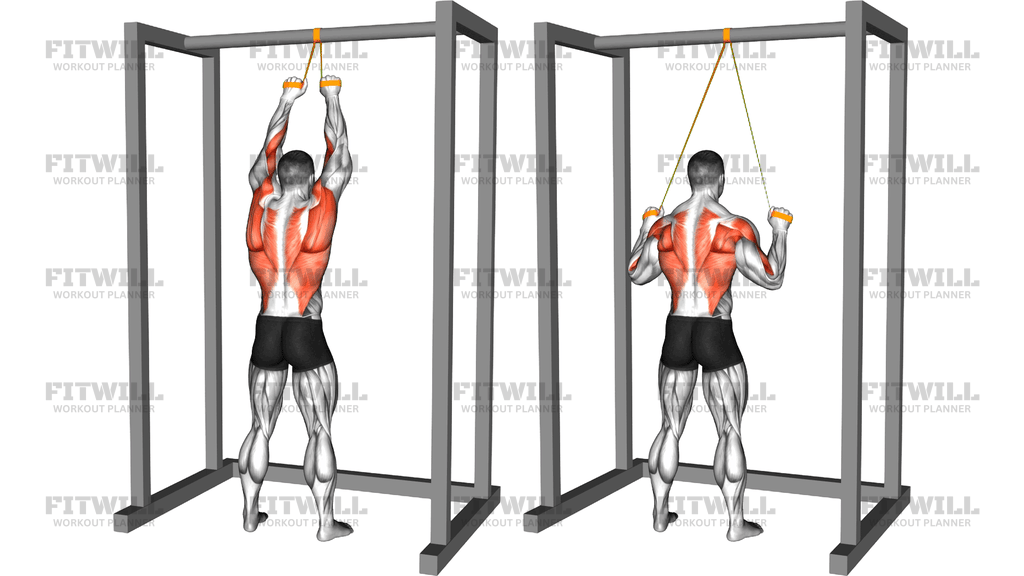
The Resistance Band Standing Lat Pulldown is a vertical pulling exercise that replicates the lat pulldown machine without needing one. A resistance band is anchored overhead to a pull-up bar or rack, and you stand facing away from the anchor, gripping the two ends of the band wide. From a fully stretched overhead position, you pull your elbows down and slightly out until your hands reach roughly shoulder height, then control the band back up.
This movement suits anyone who trains at home, travels, or wants to add pulling volume without a cable stack. It is also a practical option for people working toward pull-ups, since it trains the same overhead pulling pattern with an adjustable load. Because the band's tension increases as it stretches, the resistance peaks right where the lats are shortened at the bottom, which encourages a strong, deliberate squeeze rather than swinging the weight through the range.
The primary muscles worked are the lats, the large muscles of the back that drive the arms down from overhead. The biceps assist as the elbows bend, while the rear shoulders, rhomboids, and mid and lower traps stabilize and retract the shoulder blades as the pull finishes. Your grip and forearms stay active the whole time, and your core works to keep your torso upright while your arms move independently of it.
Setup matters more here than on a machine. The band must be securely anchored at a point above your head, and you need enough distance from the anchor that the band is already taut when your arms are overhead. Standing also means your body is the stabilizer: if you arch your lower back or lean back to help the pull, you steal work from the lats. Keep the torso tall and let the shoulders and arms do the job.
To execute well, start with arms fully extended and a wide grip on the band. Initiate each rep by drawing the shoulder blades down before the elbows follow, pull until the hands are beside the shoulders with elbows pointing down and slightly out, pause briefly, then return under control until the arms are straight again. The descent should take about twice as long as the pull.
Common use cases include home back workouts, warm-up activation before heavier pulling, high-rep finishers after lat pulldowns or pull-ups, and rehab-friendly upper-body training where machine weights feel too fixed. Check the band and anchor point for wear before every session, and step back into position gradually so the band never snaps slack or overloads your grip at the top.
[ Workout Log & Planner ]
Put your next workout in Fitwill
Keep your plan and training log ready when you are.


Instructions
- Anchor a resistance band securely over a pull-up bar or the top of a power rack, looping it so the two ends hang down at an even length.
- Stand facing the anchor with your back to the pull direction, feet about hip-width apart, and grip one end of the band in each hand using a wide, overhand grip.
- Step back until the band is taut with your arms fully extended overhead, then raise your chest and set your shoulders down away from your ears.
- Brace your core and keep a slight bend in the knees so your torso stays tall and upright throughout the set.
- Start the pull by drawing your shoulder blades down and together, then drive your elbows down and slightly out to the sides.
- Continue pulling until your hands are level with your shoulders and your elbows point toward the floor, squeezing your lats at the bottom.
- Pause for a beat in the contracted position, keeping tension in the band rather than letting it rest.
- Slowly release upward, letting the arms extend fully overhead while resisting the band's pull back up.
- Exhale as you pull down and inhale as you return to the overhead stretch.
- Complete your reps, then step carefully toward the anchor to release tension from the band before letting go.
Tips & Tricks
- If your shoulders shrug up at the bottom of each pull, the band is too heavy or your grip is too narrow; drop the resistance or widen your hands so the lats do the work.
- Standing lat pulldowns fail most often at the torso: leaning back turns this into a row and loads the lower spine, so imagine a string holding the crown of your head tall.
- Keep the band path outside your shoulders. If your hands drift inward toward your head, you lose the wide-elbow position that targets the lats.
- Do not fully relax at the top. Stopping just short of complete slack keeps constant tension on the lats and protects against the band snapping taut.
- Chalk or use handles if your grip gives out before your back does; long band lengths with heavy tension are brutal on the forearms.
- Because band tension is highest at the bottom, control the last third of the pull instead of yanking your hands down for momentum.
- Test the anchor with a few light pulls before your working set. A band slipping off a smooth pull-up bar mid-rep is the main safety risk in this exercise.
- Shorten the band or choke it higher on the bar to scale difficulty rather than standing farther back, which changes the pulling angle.
- If one side pulls faster than the other, slow down and count a one-second pause at the bottom of every rep to keep both arms even.
Frequently Asked Questions
What muscles does the Resistance Band Standing Lat Pulldown work?
The lats are the primary movers, with the biceps, rear shoulders, rhomboids, and mid and lower traps assisting. The grip and forearms also work to hold the band throughout each rep.
Is the Resistance Band Standing Lat Pulldown good for beginners?
Yes, it is one of the most beginner-friendly vertical pulls because the load scales with band choice and there is no machine setup required. Start with a light band and master the shoulder-blade-down cue before adding resistance.
How do I anchor the band for the Resistance Band Standing Lat Pulldown?
Loop the band over a sturdy pull-up bar or the top beam of a power rack so both ends hang evenly, and stand facing the anchor with your back to the pull direction. Confirm the anchor is rated for pulling and that the band cannot slip off the bar.
Should I stand close or far from the anchor point?
Step back until the band is already taut with your arms overhead, but not so far that you have to fight the band just to hold the start position. Distance fine-tunes the starting tension; the pulling angle should stay close to vertical.
Why do I feel the Resistance Band Standing Lat Pulldown more in my biceps than my back?
This usually means your elbows are leading with the forearms and your shoulders are shrugging. Focus on pulling with your elbows toward your ribs and starting each rep by depressing your shoulder blades.
Can the Resistance Band Standing Lat Pulldown replace the machine lat pulldown?
It covers the same movement pattern and can substitute well when you have no cable stack, though the resistance curve differs, peaking at the bottom instead of staying constant. Many lifters use both to complement each other.
How does the standing position change this exercise compared to a seated pulldown?
Standing removes the seat and thigh pads, so your core and posture control your torso position. This adds a stability demand, but it also makes it easier to cheat by arching back, which is why staying tall matters so much.
How many reps and sets should I do of the Resistance Band Standing Lat Pulldown?
Two to four sets of 10 to 15 reps works well for most people, since band resistance rises through the range and higher reps keep the movement controlled. Adjust band thickness rather than adding excessive reps once the set becomes easy.
Is it safe to let go of the band mid-set?
No, always release tension by stepping toward the anchor first, then hand the ends off or let them hang. Letting go of a stretched band while standing away from the anchor can cause it to snap back toward you.