Resistance Band Bent Over Reverse Fly
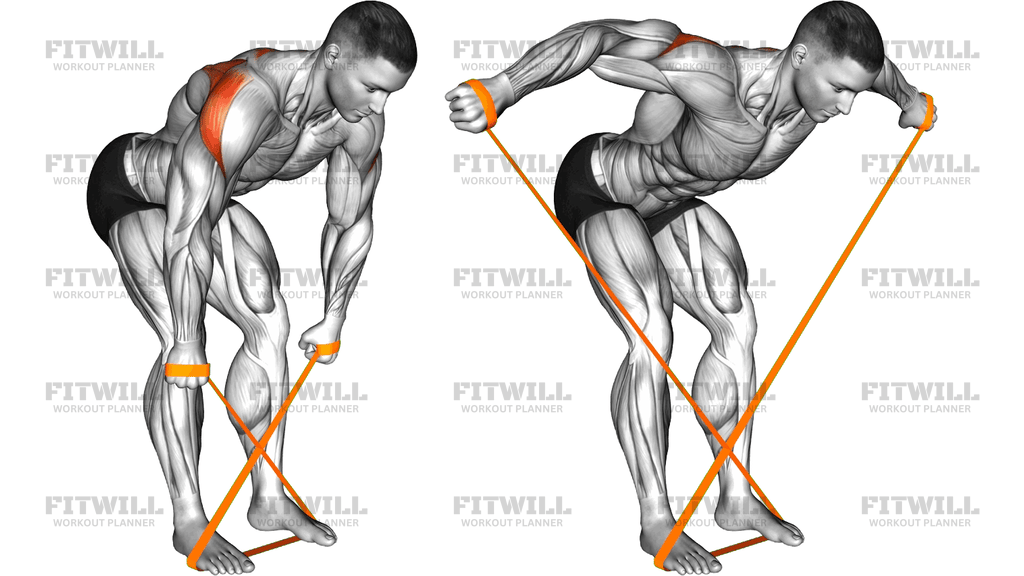
The Resistance Band Bent Over Reverse Fly is a hinged, bent-over movement that trains the rear deltoids and upper back by sweeping the arms out wide against band tension. You stand on the middle of a band, hinge forward at the hips until your torso is close to parallel with the floor, and raise your arms out to the sides until they reach roughly shoulder height before lowering them back down with control. Because the band is anchored under your feet, the tension rises as your arms travel upward, which matches the strength curve of the rear delts nicely.
This exercise fills a gap in most training programs. Pressing and front-raise variations hammer the front of the shoulders, while the rear delts and the muscles between the shoulder blades often get comparatively little direct work. Weak rear delts contribute to the rounded, forward-rolled shoulder posture that comes from long hours of sitting, typing, and driving, so anyone who benches, presses, or works at a desk has good reason to train this area deliberately.
The setup is what makes or breaks this movement. Standing on the band secures the anchor, and gripping the crossed ends puts tension on the band from the very first inch of the raise, so there is no dead spot at the bottom. The hip hinge matters just as much: your torso angle determines whether the resistance travels through the rear delts or drifts into the traps and lower back. A stable, braced hinge also protects your spine while your arms move independently of it.
To execute it well, keep a slight bend in the knees, push your hips back, and let the band hang vertically beneath your shoulders before you start. From there, lead with the elbows and open the arms outward in a wide arc rather than pulling the band toward your hips. Pause briefly at the top, then resist the band on the way down instead of letting it snap your arms back. The whole set should feel like your shoulder blades are drawing together and down, not like your arms are flapping.
This movement suits lifters who want balanced shoulder development, desk workers addressing posture, and anyone training at home with minimal equipment. It pairs naturally with rows and pulls, works well as a warm-up activation before pressing days, and can be used as a finishing movement with light tension and higher repetitions. Because band tension is scalable and the setup requires only a band and floor space, it is easy to program for almost any training level.
[ Workout Log & Planner ]
Put your next workout in Fitwill
Keep your plan and training log ready when you are.


Instructions
- Place a flat resistance band on the floor and stand on the middle of it with both feet, positioned about hip-width apart.
- Cross the band in front of your shins and take the opposite handle or end in each hand, so your left hand holds the band coming from your right foot and vice versa.
- Hinge forward at the hips with a slight knee bend until your torso is angled close to 45 degrees or a bit lower, arms hanging straight down with light tension already on the band.
- Brace your core, keep your neck neutral by looking at the floor a foot or two ahead of your feet, and roll your shoulders back so they are not shrugged toward your ears.
- Exhale and raise both arms out to the sides in a wide arc, leading with the elbows and keeping a soft, fixed bend at the elbow joints.
- Stop when your arms reach roughly shoulder height and form a straight line across your back; squeeze your shoulder blades together for a beat at the top.
- Inhale and lower your arms slowly back down along the same wide arc, fighting the band's pull rather than letting it drop your arms.
- Complete all repetitions with your torso angle unchanged, then stand up tall by driving your hips forward and step off the band one foot at a time to reset.
Tips & Tricks
- If you feel the work shifting into your traps and neck, you are shrugging. Consciously press your shoulder blades down toward your hips as the arms rise.
- Bending the elbows during the rep turns this into a row. Keep the elbow angle fixed from start to finish so the rear delts, not the biceps and lats, do the moving.
- Do not hinge up and down with each rep. If your torso rises as the arms lift, the band is too heavy or you are pulling with your trunk; switch to a lighter band.
- Stopping well short of shoulder height usually means the band tension is winning. Reducing resistance and pausing for one full second at the top builds better control than cutting the range.
- Crossing the band as shown keeps constant tension at the bottom of the rep. If you grip the ends on the same side as each foot, the band goes slack before the movement starts.
- The band should be anchored securely under the middle of both feet. Standing near the edge of the band risks it slipping out and snapping up toward your face.
- Keep your weight balanced over mid-foot rather than shifting onto your toes; the hinge position plus forward band pull can tip you forward if your weight drifts.
- Use lighter tension and higher reps here than you would for rows. The rear delts are a small muscle and respond better to strict form than to heavy, jerky swings.
Frequently Asked Questions
Which muscles does the Resistance Band Bent Over Reverse Fly work?
The rear deltoids are the primary movers, supported by the rhomboids and mid and lower traps, which pull the shoulder blades together. The erector spinae and core work isometrically to hold the bent-over position.
Why is the band crossed under my feet in this exercise?
Crossing the band and gripping the opposite ends puts tension on from the moment your arms leave the hanging position, so the rear delts work through the full range. It also keeps the band from sliding side to side under your feet.
Is the Resistance Band Bent Over Reverse Fly suitable for beginners?
Yes, provided you start with a light band and focus on the hip hinge before adding reps. Beginners often need a few sessions just to hold the bent-over position comfortably while moving the arms.
How far should I raise my arms at the top?
Aim for arms level with your shoulders, forming a T shape with your torso. Going higher tends to shift work into the upper traps and adds little for the rear delts.
My lower back gets tired before my shoulders do. What should I change?
Your hinge is probably too deep or your core is not braced. Raise your torso to a shallower angle, squeeze your abs before the first rep, and if fatigue persists, split the set into shorter blocks with a brief stand-up between them.
Can I replace the band with dumbbells for this movement?
Yes, a dumbbell bent-over reverse fly is the closest free-weight substitute. The difference is that dumbbells are hardest at the start of the raise while the band is hardest at the top, so the two versions complement each other.
How do I choose the right band strength?
Pick a band you can control for 12 to 15 strict reps with a pause at the top and no torso swing. If your form breaks down or your arms drop short of shoulder height, go lighter rather than fighting the tension.
Should I keep my elbows bent or straight during the raise?
Keep a small, fixed bend in the elbows for joint comfort, but do not let it change during the rep. Actively bending the elbows as you lift converts the movement into a row and takes work away from the rear delts.
Is it safe to do this exercise with a history of shoulder or back issues?
The movement uses light loads and a controlled arc, which many people tolerate well, but you should clear any existing shoulder or back condition with a qualified professional first. Start with very light tension and a shallow hinge, and stop if you feel sharp pain.