Standing Alternate Glute Kickback
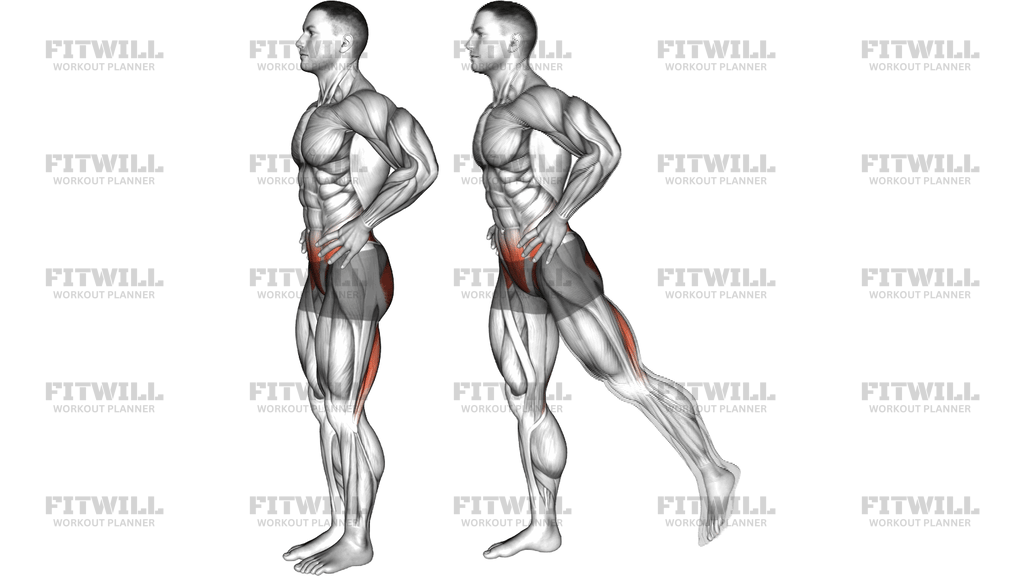
The Standing Alternate Glute Kickback is a bodyweight isolation movement performed from an upright standing position. You balance on one leg while sweeping the other leg directly behind you and lifting the foot a few inches off the floor, then lower it back down and switch sides. The illustration shows the exact setup: torso tall, hands resting on the hips for balance, weight-bearing knee soft, and the working leg extending back with only a slight bend at the knee. It is a simple movement on the surface, but the tall posture and controlled hip extension are what make it effective.
This exercise primarily targets the gluteus maximus, the large muscle responsible for extending the hip, with the hamstrings assisting on the drive back. Because you are standing on one leg, the standing glute and outer hip of the support side also work hard to keep your pelvis level, and your core stabilizes the spine against the tendency to lean forward. That balance demand is part of the value: you are training hip extension and single-leg stability at the same time, without any equipment.
Setup matters more than most people expect. Because there is no cable or pad guiding the leg, the working hip is free to cheat by rotating open, hiking up, or overarcheing the lower back. Keeping both hips square, ribs stacked over the pelvis, and the lift coming from the hip joint rather than the low back ensures the glutes do the work. A short range with a deliberate squeeze at the top beats a big swing every time.
To perform it well, stand with feet hip-width apart, shift your weight onto one leg, and place your hands on your hips. Sweep the free leg straight back behind you, reaching the heel away and squeezing the glute as the foot lifts, then lower it under control. Complete your reps on one side or alternate legs rep by rep, keeping the movement smooth and quiet rather than bouncy.
This drill suits beginners learning to feel their glutes, lifters using it as a warm-up before squats or hip thrusts, and anyone training at home with no equipment. It is also a useful low-load option for people who want to rebuild hip extension without loading the spine. Keep the reps moderate, the tempo slow, and expect the balance component to be the limiting factor at first.
[ Workout Log & Planner ]
Put your next workout in Fitwill
Keep your plan and training log ready when you are.


Instructions
- Stand tall with your feet hip-width apart and place your hands on your hips.
- Shift your weight onto your right leg and unlock that knee slightly so you are stable and not locked out.
- Brace your core lightly and keep your chest up, ribs stacked over your pelvis, and both hips facing forward.
- Sweep your left leg straight back behind you, letting the knee bend only slightly as the hip extends.
- Lift the foot until you feel your left glute fully contract, keeping the range short enough that your torso does not lean forward.
- Pause for a beat at the top and squeeze the glute rather than pushing for extra height.
- Lower the foot back toward the floor under control without letting it touch down between reps, or reset your balance between reps if needed.
- Exhale as you kick back and inhale as you lower the leg.
- Complete your set on one side, or alternate legs rep by rep, then repeat on the other side.
Tips & Tricks
- If your torso pitches forward as the leg goes back, the range is too long or you are arching your lower back to fake hip extension; cut the height of the lift in half and re-brace.
- Watch for the working hip opening out to the side, which shifts work away from the glute; think about keeping both hip points aimed straight ahead throughout the set.
- A common mistake is kicking the leg up with momentum so the foot flies and drops; the leg should travel back and up on a two-second count and return just as slowly.
- If you wobble badly on the standing leg, soften the support knee a touch more and find a fixed point at eye level to stare at before each rep.
- Keep the hands on the hips rather than letting the arms dangle; this gives you feedback, because you will feel the hip hike up under your hand if your pelvis starts tipping.
- Do not let the lower back arch and the ribcage flare at the top of the kickback; the glute squeeze should be what stops the leg, not spinal extension.
- If balancing is still rough, stand next to a wall with one fingertip lightly touching it for balance, and progress to hands-free as your stability improves.
- Pause for a full second at the top of each rep instead of chasing a higher leg lift; the contraction, not the height, is the point of this exercise.
Frequently Asked Questions
Which muscles does the Standing Alternate Glute Kickback work?
The gluteus maximus of the kicking leg is the primary muscle, with the hamstrings assisting on the drive back. The standing leg's glutes and outer hip, plus your core, work to keep you balanced and your pelvis level.
How high should I lift my leg during the Standing Alternate Glute Kickback?
Only high enough to feel a strong glute contraction, usually just a few inches behind you. If your back arches or your torso leans forward to gain height, the lift has gone too far.
Is the Standing Alternate Glute Kickback good for beginners?
Yes, it is a low-load, low-skill entry point for learning to extend the hip with the glutes. Beginners should expect the balance challenge to be the hardest part for the first few sessions.
Can I do the Standing Alternate Glute Kickback without any equipment?
Yes, the standard version is entirely bodyweight and needs nothing but floor space to stand on. If you want more resistance later, versions with an ankle strap and cable exist, but they are a separate exercise.
Why do I feel the Standing Alternate Glute Kickback in my lower back?
That usually means your lumbar spine is arching to lift the leg instead of the glute extending the hip. Shorten the range, brace your abs lightly, and focus on squeezing the glute to move the leg.
How does the Standing Alternate Glute Kickback differ from a quadruped donkey kick?
Both train hip extension, but the standing version adds a single-leg balance demand and removes the floor support under your torso. The quadruped version is easier on balance, while the standing version challenges hip stability more.
Should I complete all reps on one leg or alternate legs on the Standing Alternate Glute Kickback?
Either works; finishing one side first makes it easier to feel each glute working, while alternating rep by rep keeps the balance demand symmetrical. Match total reps per side either way.
How many reps and sets of the Standing Alternate Glute Kickback should I do?
Two to three sets of 10 to 15 controlled reps per leg is a solid starting point. Because the resistance is only your leg, prioritize tempo and the top-position squeeze over high numbers.
What can I use for balance if I'm unsteady during the Standing Alternate Glute Kickback?
Stand beside a wall, chair, or rack and rest one fingertip on it for light support. Keep most of your weight off the support so the standing-leg glutes still have to stabilize you.
Is it safe to do the Standing Alternate Glute Kickback every day?
For most people, yes, since the load is light and the range is short. If your hip or lower back feels irritated, reduce volume and check that you are not arching the spine to lift higher.