Resistance Band Monster Walk
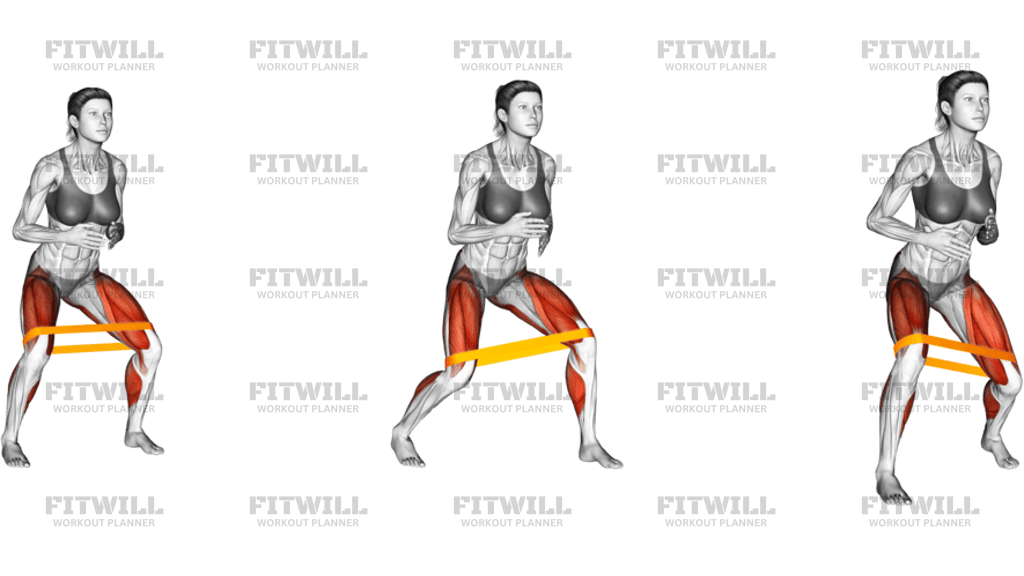
The Resistance Band Monster Walk is a lateral and forward stepping drill performed with a loop band anchored around both ankles while you hold a low, athletic stance. Unlike the upright band walk, the monster version keeps your hips lowered and your torso leaned slightly forward for the entire set, which is where the "monster" strut comes from. Every step has to fight the pull of the band, so your hip muscles stay under constant tension from the first step to the last.
This movement primarily targets the gluteus medius and the small stabilizing muscles on the outside of the hip, with strong supporting work from the gluteus maximus, quads, and hamstrings holding the squat position. Because the band sits at the ankles rather than above the knees, the leverage is harder and the hips have to work through a longer lever arm. Your core also contributes by keeping your torso steady as your legs move.
The Resistance Band Monster Walk is a favorite in warm-ups for squats, deadlifts, and running-based sports, and it is equally useful in rehab-style programming for anyone rebuilding hip stability. Runners, lifters with knees that cave inward, and people who sit long hours and have "sleepy" hips all benefit from it. It requires almost no space and a single loop band, making it an easy addition to any session.
Setup matters more than most people expect. The band should sit flat around both ankles with light tension when you stand at shoulder width, your stance should be wide enough that the band never goes slack, and your hips need to stay down in a shallow squat rather than rising as you fatigue. If your stance narrows or your torso pops upright, the band stops doing its job and the drill loses most of its value.
To execute it well, step sideways under control, drag the trailing foot toward the lead foot without letting it snap in, and keep constant pressure against the band in both directions. Move slowly enough that you feel the outside of each hip working, and breathe steadily throughout. Most lifters do best with sets of 10 to 20 steps per direction, treating this as a quality movement drill rather than a burnout exercise.
[ Workout Log & Planner ]
Put your next workout in Fitwill
Keep your plan and training log ready when you are.


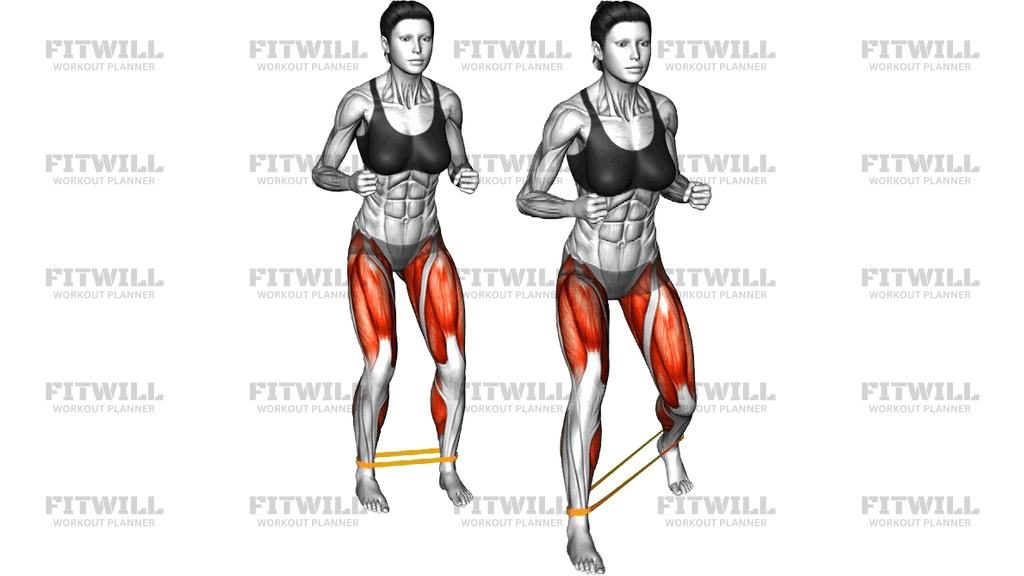
Instructions
- Place a loop resistance band flat around both ankles, positioned just above the ankle bones so it cannot slide down onto your feet.
- Stand with your feet about shoulder-width apart so the band has light tension, then step your feet out slightly wider until you feel steady resistance.
- Sink into a shallow squat with your hips pushed back, chest angled slightly forward, and hands loosely in front of your body for balance.
- Brace your core and keep your weight spread across the whole foot, with your knees pushed out over your toes instead of collapsing inward.
- Take a controlled step sideways with your lead foot, stretching the band further, then step the trailing foot toward it until you return to your starting width.
- Keep the trailing foot from dragging or snapping against the band; place it down with the same tension you started with.
- Continue stepping in one direction for your target number of steps, then reverse and lead with the opposite leg to work both sides evenly.
- Exhale on each step outward and inhale as you bring the trailing foot in, keeping your breathing rhythm steady.
- Keep your hips low for the entire set; if you need to rest, stop, stand up out of the band, and reset your stance before continuing.
Tips & Tricks
- The most common mistake is letting the hips rise into a tall stance as the set gets hard; if you feel your torso coming upright, pause and reset in the low position rather than grinding out sloppy steps.
- Watch for the trailing foot being yanked inward by the band. Control it on the way in just as much as the lead step going out, or the inner thigh takes over the work.
- If the band rolls or pinches at your ankles, widen your stance a touch. Too little base width is the usual culprit, not the band itself.
- Choose a band tension that lets you complete all steps without your knees diving inward. A band that is too heavy teaches the exact caving pattern this drill is meant to fix.
- Keep your steps modest. Overstretching into a huge sideways step often causes the pelvis to tilt and the lower back to take over.
- Push your knees slightly outward throughout, not just on the stepping leg. Both legs should be actively pressing against the band at all times.
- Do this drill early in your workout as activation, or between sets of squats and deadlifts as a low-fatigue way to keep the hips engaged.
- If you feel it more in your thighs or the front of your hips than the sides of your glutes, sit back a little more into your hips and shorten your step length.
- Barefoot or in flat shoes both work, but avoid running shoes with soft, unstable soles that make the foot placement harder to feel.
Frequently Asked Questions
What muscles does the Resistance Band Monster Walk work?
It primarily targets the gluteus medius and other hip stabilizers on the outside of the hip, with the gluteus maximus, quads, and hamstrings working to hold the low stance. The core helps keep your torso steady as you step.
Why is the band placed at the ankles instead of above the knees in the Monster Walk?
An ankle placement creates a longer lever arm, which makes the hips work harder and rules out the knee-caving compensation. It is a more demanding version than the above-knee band walk.
Is the Resistance Band Monster Walk suitable for beginners?
Yes, as long as you start with a light band and keep the squat shallow. Beginners often progress faster by mastering controlled, small steps before adding band tension or depth.
How many steps should I do per set of the Resistance Band Monster Walk?
Ten to twenty steps per direction is a solid working range. Stop the set when your step quality drops or your hips rise out of the low stance, not when you reach a number.
Why do my knees cave inward during the Monster Walk?
This usually means the band is too heavy or your glutes are not staying engaged. Drop to a lighter band, focus on pressing both knees outward, and reset your stance whenever you feel the collapse.
Can I use the Resistance Band Monster Walk as a warm-up?
It is one of the best warm-up drills for lower body days because it wakes up the hip stabilizers before squats, deadlifts, or running without creating much fatigue.
What can I substitute if I do not have a loop band for the Monster Walk?
You can tie a long resistance band into a loop, or perform lateral squat walks with no band, though you will lose the outward resistance that makes the drill effective. Side-lying hip abductions are another option for the same muscles.
How far apart should my feet stay during the Resistance Band Monster Walk?
Keep a base roughly shoulder-width or slightly wider at all times. If your feet come close enough for the band to go slack between steps, you have narrowed your stance too much.
Is it safe to do the Monster Walk if I have cranky knees?
Most people tolerate it well because it is low load, but keep the squat shallow and stop if you feel pinching or pain rather than muscle effort. When in doubt, check with a qualified professional first.