Resistance Band One Arm Bent Over Row
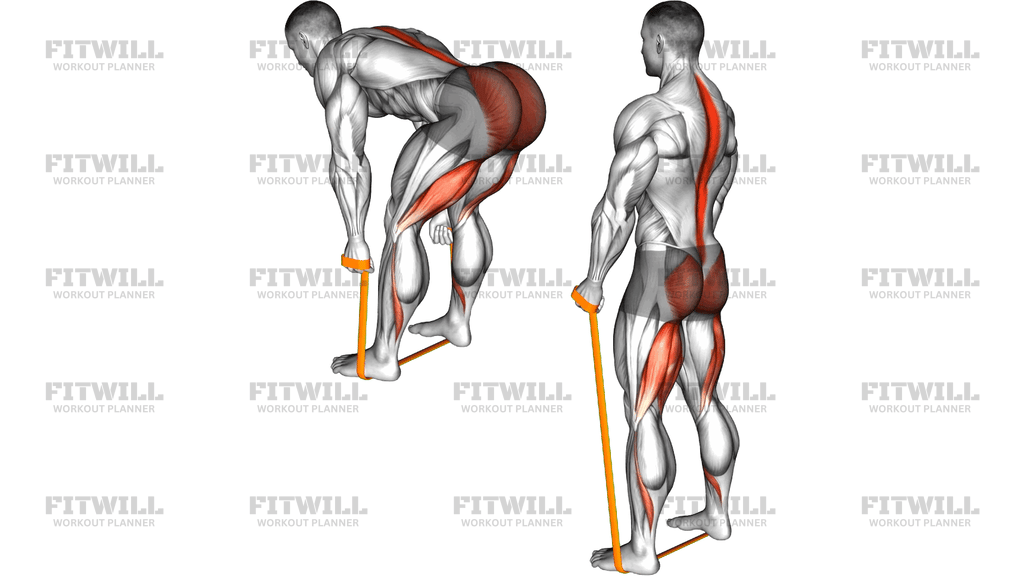
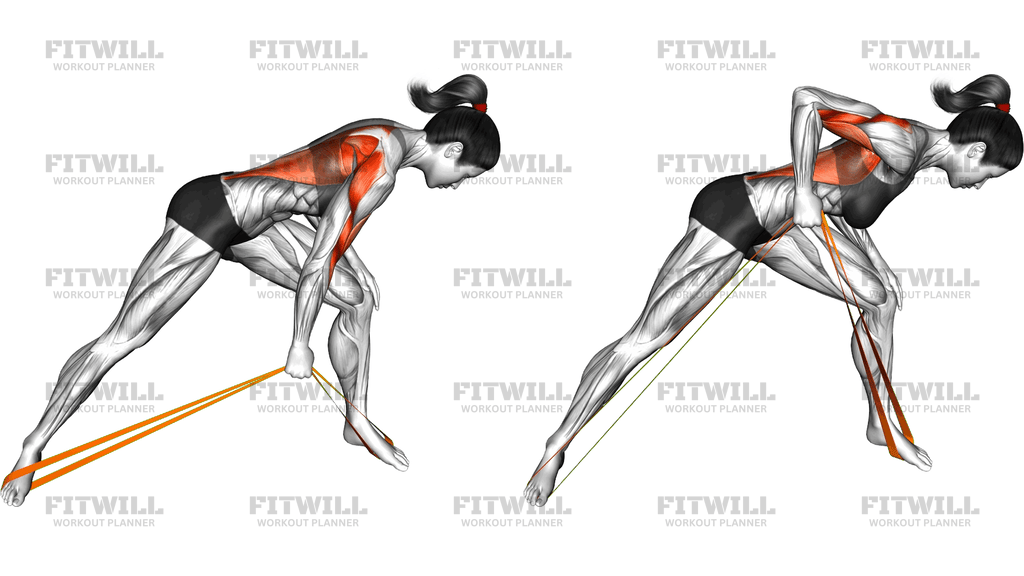
The Resistance Band One Arm Bent Over Row is a unilateral pulling exercise performed in a staggered stance with the band anchored under your front foot. You hinge forward at the hips, brace one hand against your front thigh or knee, and row the band up with the free hand, pulling your elbow back alongside your ribs. The one-sided setup lets you focus entirely on each side of your back, which makes it easier to feel the lats and upper back working and to spot left-to-right differences in strength.
Because the band is secured under your lead foot, resistance increases as you pull, and you can scale the challenge instantly by gripping closer to or farther from the anchor point. This makes the exercise a good fit for home training, warm-ups, and anyone who wants back work without dumbbells or a cable station. It is especially useful for lifters rebuilding after time off, desk workers who need more upper-back pulling, and people whose weaker side tends to get dragged along by the stronger one during two-arm rows.
The main muscles working are the lats, rhomboids, and middle traps, with the rear shoulders and biceps assisting on each pull. Your hamstrings, glutes, and lower back hold the hinge position isometrically the whole time, so the exercise also builds endurance in the muscles that keep your spine stable in a bent-over posture. The hand braced on the front leg adds a point of support that helps many people hold a hinge position more comfortably than they can during a free-standing two-arm row.
Good setup matters here more than with most band exercises. The amount of slack in the band determines your starting tension, and your hinge angle determines whether the pull targets your back or drifts into an awkward shoulder shrug. Set your feet, create tension before the first rep, and keep your torso fixed in place so the only thing moving is the working arm.
To execute it well, pull your elbow up and back toward your hip rather than straight up toward your shoulder, and finish each rep by squeezing your shoulder blade toward your spine. Lower the handle under control so the band's tension pulls your arm back to full extension without yanking your torso forward. If you have to rock your body or swing the handle to finish a rep, the band is too heavy or you have drifted past the point where your form can hold.
A few practical safety points: keep the band securely anchored under your front foot before each set, check it for wear or small tears, and never release a stretched band under tension. Keep your neck relaxed and your gaze a step or two in front of your feet rather than craning up. If your lower back fatigues before your arm does, reduce the band tension or shorten your sets.
[ Workout Log & Planner ]
Put your next workout in Fitwill
Keep your plan and training log ready when you are.


Instructions
- Stand in a staggered stance with your left foot forward and flat on the floor, and loop the middle of the resistance band securely under that front foot.
- Hold one end of the band in your right hand with a neutral grip (palm facing in), and let your right arm hang straight down toward the floor.
- Hinge forward at the hips until your torso is roughly 45 degrees or lower, place your left hand on your left thigh or knee for support, and soften both knees.
- Slide your grip along the band until there is light tension with your right arm fully extended, and brace your core as if bracing for a light punch.
- Row by driving your right elbow up and back toward your hip, keeping it close to your ribs, until your hand is near your lower chest or waist.
- At the top, squeeze your shoulder blade back and down toward your spine for a brief pause without shrugging your shoulder toward your ear.
- Lower your hand slowly back to full arm extension, letting the band stretch your lat at the bottom while keeping your torso angle unchanged.
- Exhale as you pull the handle up, and inhale as you lower it back down with control.
- Complete all repetitions on the right side, then re-anchor the band under your right foot, switch your stance, and row with your left arm.
- Between sets, release band tension fully before letting go, then stand up out of the hinge to reset.
Tips & Tricks
- Create tension before the first rep, not during it: if your arm is slack at the bottom of each rep, your muscles rest between reps and the set feels easier than it should.
- If your torso rises as you pull, the band is too strong or you are pulling too far; shorten the range slightly or grip the band closer to your foot to reduce tension.
- Watch for the elbow flaring out wide toward the ceiling, which shifts work to the rear shoulder; keep it tracking back near your ribs to keep the lats and rhomboids as the drivers.
- Avoid shrugging the working shoulder at the top of the rep. If your upper trap bunches up near your ear, think of pulling with your elbow and tucking the shoulder blade down first.
- The supporting hand is for balance, not for lifting your torso. If you find yourself pushing hard off your front knee to finish reps, drop the band tension instead.
- Keep your back flat and your hips square to the floor. Rotating your chest open toward the working arm shortens the pull and hides a weak side.
- Staggered stance wobbly? Widen your base slightly and shift a little more weight onto the front leg before you pick up the band.
- Control the lowering phase for a two-count. The band pulls your arm down fast on the eccentric, and rushing it turns a back exercise into an arm swing.
- Check the band under your foot before every set; a band that slides off a sweaty shoe mid-rep can snap back toward your face.
Frequently Asked Questions
Which muscles does the Resistance Band One Arm Bent Over Row work?
The lats, rhomboids, and middle traps do most of the pulling, with the rear shoulders and biceps assisting. Your lower back, glutes, and hamstrings work isometrically to hold the bent-over position.
Why is this row done one arm at a time instead of with both arms?
The single-arm setup lets you brace your free hand on your front leg, which makes the hinge easier to hold, and it exposes and corrects side-to-side strength differences that a two-arm row can hide.
How do I adjust the difficulty of the Resistance Band One Arm Bent Over Row?
Grip the band closer to your front foot for less tension or farther up the band for more, or switch to a heavier band. Standing taller also shortens the range and reduces the load.
How far forward should I hinge over my front foot?
Aim for a torso angle of roughly 45 degrees or a bit lower, with your weight over the middle of your front foot and a flat back. The exact angle matters less than keeping it identical from the first rep to the last.
My lower back gets tired before my arm does. What should I change?
Your hinge is probably too deep for your current strength or you are rounding as you fatigue. Raise your torso slightly, lighten the band, and do shorter sets so your positioning holds.
Can beginners do the Resistance Band One Arm Bent Over Row?
Yes, and it is actually a friendly first row because the free hand supports the torso and the band tension is easy to scale. Start with a light band and master the hinge before adding resistance.
What can I use instead of a resistance band for this movement?
A single dumbbell or kettlebell row from the same staggered, hand-supported stance works the same pattern. The band version simply adds rising tension toward the top of each rep.
Should my elbow stay close to my body or flare out?
Keep your elbow tracking back near your ribs with your palm facing in. Flaring it wide turns the row into more of a rear-shoulder movement and reduces the work on your lats.
How many reps and sets should I do per side?
Start with 2 to 3 sets of 10 to 15 reps per arm. Because the weaker side should set the pace, always finish your sets on the weaker arm first or match its rep count on the stronger side.
Is it safe to anchor the band under my foot for this exercise?
Yes, as long as the band is in good condition and fully under the middle of your front foot. Inspect it for cracks or thin spots before each set, keep tension on it throughout the movement, and release tension fully before letting go.