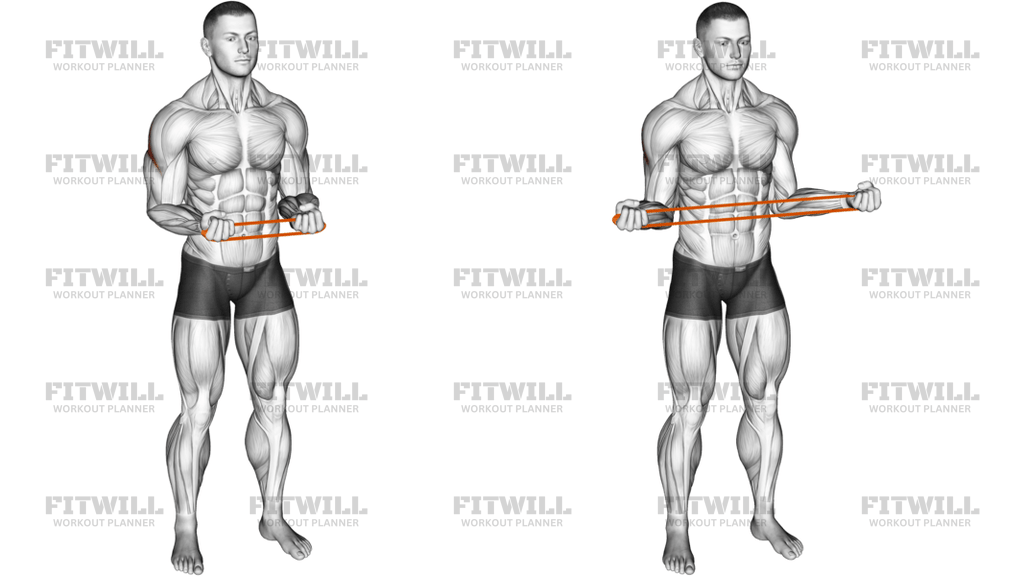
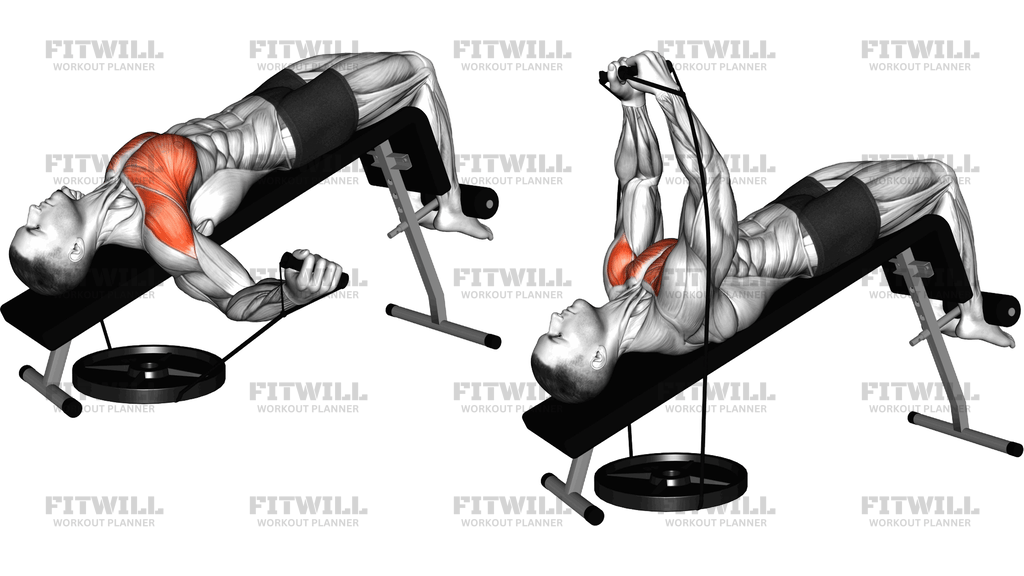
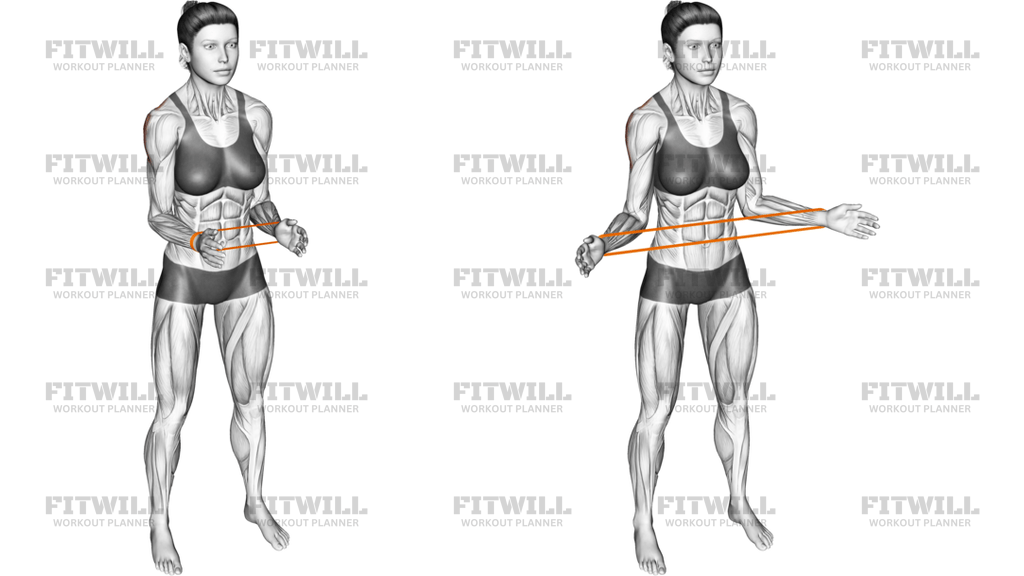
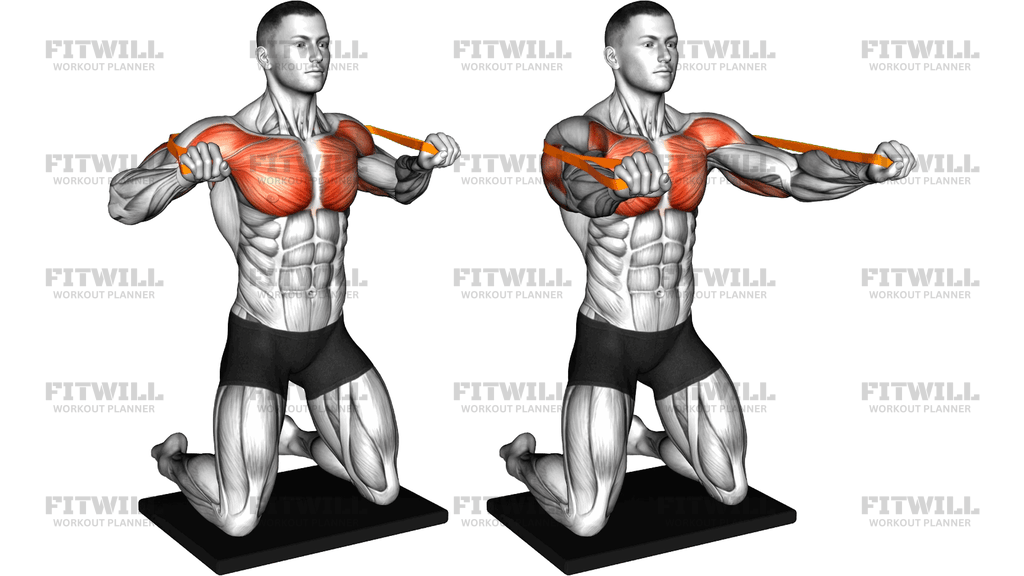
Band Decline Press
The Band Decline Press is a chest-building press performed on a decline bench with a resistance band instead of free weights. The band is anchored under a heavy plate or sturdy object on the floor behind your head, and you press the handles up and slightly forward from chest level until your arms are extended over your lower chest. Because the bench angles your head below your hips, the pressing line shifts toward the sternal, lower portion of the pectorals, which is the same reason lifters use decline barbell and dumbbell presses.
This movement suits lifters who want targeted lower-chest work without loading the shoulder joint with a barbell, home trainers with limited equipment, and anyone who wants a press where tension stays smooth from start to finish. Unlike a dumbbell decline press, the band provides the greatest resistance at the top of the rep, when your arms are extended, and lightens off near the bottom. That resistance profile lets you train hard through lockout without needing a heavy load overhead or a spotter.
The primary muscles worked are the lower fibers of the chest, with real contributions from the triceps and front delts as they extend the arms and stabilize the press. Your grip and shoulder stabilizers also work to control the band's pull throughout each rep. Feet hooked under the bench rollers keep your body from sliding down the decline, and a braced torso keeps the press stable.
Setup quality determines whether this exercise feels great or awkward. Anchor the band securely under a heavy plate directly in line with the bench, check that both sides of the band are even, and position yourself so the band runs alongside your torso rather than across your face or neck. Lie back with your head supported on the bench, take a grip slightly wider than shoulder width, and start with the handles at your lower chest, elbows around 45 degrees from your torso.
Execution is simple but deserves attention: press the handles up and slightly toward each other until your arms are straight over your lower chest, squeeze briefly, then lower with control until the handles are back at chest level. Avoid bouncing out of the bottom or letting the band snap your arms back up. Because band tension drops quickly as you near the anchor, the hardest part of controlling the rep is the lowering phase, not the press.
Use the Band Decline Press as a main chest movement on home training days, as a higher-rep finisher after heavy barbell or dumbbell pressing, or as a joint-friendly substitute during periods when pressing with weights bothers your shoulders. Increase difficulty by using a thicker band, doubling the band around the anchor, or slowing the lowering phase for two to three seconds on each rep.
[ Workout Log & Planner ]
Put your next workout in Fitwill
Keep your plan and training log ready when you are.


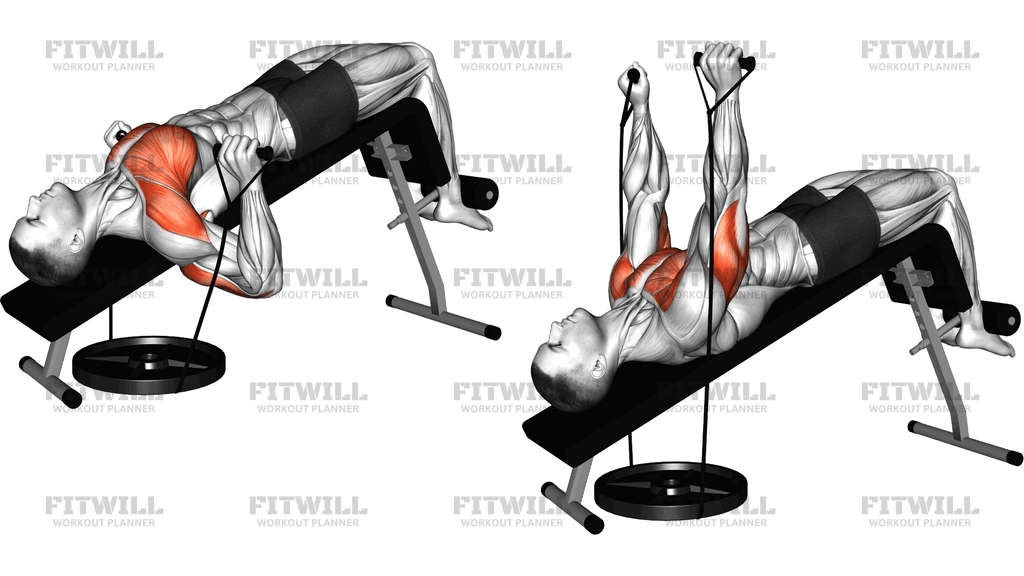
Instructions
- Place a heavy weight plate or similar solid anchor on the floor behind the head end of a decline bench, and loop a resistance band under it so both ends extend upward with equal length.
- Set the bench to a decline angle, sit on it facing away from the anchor, and hook your feet securely under the ankle rollers so your body cannot slide down.
- Grip one band handle in each hand and lie back until your head and upper back are fully supported on the bench, letting the band run along the outside of your arms and torso.
- Position the handles at your lower chest with elbows bent and tucked roughly 45 degrees from your torso, and check that both sides of the band have similar tension.
- Brace your core lightly and pull your shoulder blades down and back so your upper back stays planted on the bench.
- Exhale and press both handles up and slightly inward until your arms are extended over your lower chest, stopping just short of locking the elbows hard.
- Pause for a moment at the top and squeeze your chest while the band tension is highest.
- Inhale and lower the handles under control back to your lower chest, resisting the pull of the band as your elbows travel down and slightly out.
- Complete all reps with even tension on both sides, then sit up carefully, release one handle at a time, and step clear of the band before letting go of the anchor.
Tips & Tricks
- If the band slips off the anchor mid-set, the plate is too light; use a plate heavy enough that the band cannot drag it, and check it before every set.
- Keep the band path outside your shoulders. If it runs across your face or neck when you lie back, shift your body slightly toward the anchor or re-grip lower on the handles.
- Elbows drifting outward to a near-horizontal position is the most common fault on decline presses; keep them at about 45 degrees to protect the shoulders and keep the line of press over the lower chest.
- Do not let the band pull your arms up fast on the way down. A two-second lowering phase keeps the chest, not momentum, doing the work.
- Your lower back should stay in contact with the bench. If your torso arches off the pad as you press, the band is too strong or you are losing your brace.
- Stop each rep just short of slamming the elbows into full lockout at the top; this keeps continuous tension on the triceps and chest instead of dumping it into the joints.
- If one side feels easier, you probably grabbed unequal lengths of band. Adjust the loops under the anchor so both sides match before starting.
- Warm up your shoulders with a lighter band first; the decline angle plus band tension at the top can feel sharp if you jump straight to a heavy band cold.
- Grip the handles firmly but not white-knuckle tight, since excess grip tension tends to pull your shoulders forward out of the retracted position.
Frequently Asked Questions
What muscles does the Band Decline Press work?
The sternal or lower portion of the chest does most of the work, supported by the triceps and front delts. The decline angle shifts the pressing line below nipple level, which emphasizes the lower chest compared with a flat press.
Is the Band Decline Press good for beginners?
Yes, it is one of the safer decline pressing options because the band lightens at the bottom of the rep and there is no heavy weight over your face. Beginners should start with a light band and focus on keeping elbows at about 45 degrees from the torso.
How do I anchor the band for the Band Decline Press?
Loop the band under a heavy weight plate or another immovable object on the floor behind the head of the decline bench. Test the anchor by pulling the handles toward your chest before you lie back fully.
Why does the band feel easiest at the bottom of the rep?
Band resistance increases as the band stretches, so tension peaks with your arms extended at the top and decreases as you lower the handles to your chest. This is the opposite of a dumbbell, which is heaviest at the bottom.
Can I do the Band Decline Press without a decline bench?
A decline bench is strongly preferred because the angle defines the exercise and the foot rollers hold you in place. Lying flat on a bench changes the pressing line and turns the movement into a band floor or flat press rather than a decline press.
What should I do if my shoulders feel uncomfortable on this exercise?
Check that the band runs outside your shoulders rather than across them, keep your elbows closer to your torso, and reduce the band tension. If discomfort persists, switch to a flat or slight-decline angle with a lighter band.
How can I make the Band Decline Press harder?
Use a thicker band, loop the band twice around the anchor, or pre-stretch it by shortening the length between the anchor and your hands. Slowing the lowering phase to three seconds also increases the challenge without extra equipment.
How does the Band Decline Press compare to a decline barbell press?
Both emphasize the lower chest, but the band version peaks in resistance at lockout, needs no spotter, and is easier on the elbows and shoulders. The barbell version allows heavier absolute loading, so many lifters use the band press for higher reps or as a substitute at home.
How many sets and reps should I do?
Two to four sets of 10 to 15 reps works well for most lifters, since band tension at the top makes heavier low-rep sets hard to gauge. Rest about 60 to 90 seconds between sets.