Band Squat Row
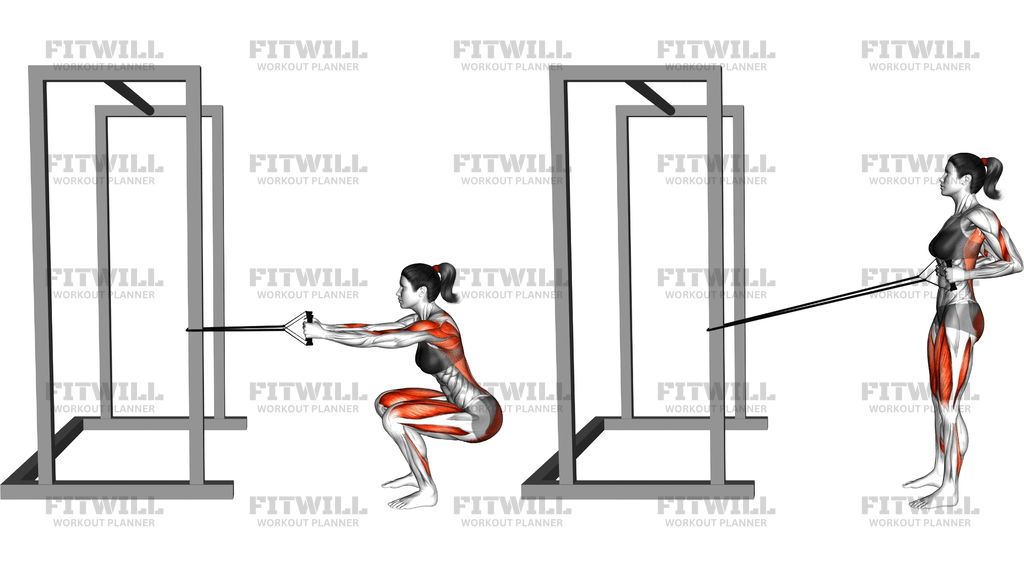
The Band Squat Row combines two fundamental patterns into one continuous movement: a bodyweight squat and a horizontal band row. You anchor a resistance band at roughly chest height to a rack or sturdy post, face the anchor, and hold the handle with both hands. From there, you squat down with your arms extended in front of you, then stand up while pulling the handle in toward your lower chest or upper stomach. As you lower back into the next squat, your arms extend again, so every rep flows squat, row, squat, row without stopping.
This combination makes the exercise a genuine full-body effort. The squat portion loads the quads, glutes, and hamstrings while the core works to keep your torso upright against the pull of the band. The row portion targets the upper back, particularly the rhomboids and mid-traps, along with the rear shoulders and biceps. Because the band's tension increases as you stand and pull, the hardest part of the row arrives right when your legs are finishing their drive, which teaches you to coordinate the lower and upper body rather than treating them as separate systems.
The Band Squat Row is especially useful for people training at home or in a small gym, since it needs nothing more than a band, a handle, and a solid anchor point. It is a smart choice for lifters who want more training density from a single exercise, for beginners learning to connect hip and back mechanics, and for anyone whose lower-body sessions have historically neglected pulling work. It also works well as a warm-up primer before heavier squats or rows, because it raises the heart rate while rehearsing both movement patterns with light resistance.
Setup details matter more here than in a standard squat or row. The anchor height determines how much you lean forward at the bottom and how the band tension feels through the row, so take a minute to adjust it before adding reps. Your distance from the anchor sets the starting tension; standing too close leaves the band slack in the squat, while standing too far turns the exercise into a constant tug-of-war that pulls you onto your toes. Expect to experiment for a session or two before the setup feels automatic.
Execution quality comes down to timing and torso control. The row should finish as your hips and knees reach full extension, not after, and the band tension should never be what decides how deep you squat. Keep your chest up, ribs stacked over your pelvis, and let your legs, not your lower back, absorb the band's pull at the bottom. If you notice your torso pitching forward as you pull or your heels lifting in the squat, reduce the band tension and rebuild the pattern with a lighter setup.
As with any banded movement, inspect the band before each session for small tears or thin spots, and always secure the anchor to something rated for pulling forces. A band slipping free under tension is the main safety risk with this exercise, and it is entirely preventable with a quick check and a stable attachment point.
[ Workout Log & Planner ]
Put your next workout in Fitwill
Keep your plan and training log ready when you are.


Instructions
- Anchor a resistance band at approximately chest height to a power rack, squat stand, or other sturdy attachment point, and clip a V-bar handle or triangle grip to the free end.
- Face the anchor and grip the handle with both hands, then walk back until the band has moderate tension with your arms fully extended in front of you at roughly chest height.
- Set your feet about shoulder-width apart with toes turned out slightly, and distribute your weight evenly across your whole foot.
- Brace your core, lift your chest, and keep your shoulders pulled down away from your ears before you begin the first rep.
- Push your hips back and bend your knees to lower into a full squat, letting your arms extend forward as the band stretches, with your torso staying as upright as the band pull allows.
- Drive through your heels and mid-foot to stand up, and as your hips extend, pull the handle in toward your lower chest by driving your elbows back past your ribs.
- Squeeze your shoulder blades together briefly at the top, with your body fully standing and the handle touching your torso.
- Reverse the movement in one controlled motion: extend your arms forward as you simultaneously lower back into the squat, keeping the band taut the entire time.
- Exhale as you stand and row, inhale as you lower and reach your arms back out, keeping the breath steady throughout the set.
- Complete all reps in a continuous rhythm, then step toward the anchor and release the handle with tension off the band before letting go completely.
Tips & Tricks
- The most common mistake is rowing and standing as two separate steps, which turns the set into a squat followed by a standing row. Blend them so the handle reaches your torso right as your hips lock out.
- If the band drags you forward onto your toes at the bottom of the squat, you are standing too far from the anchor or the band is too heavy. Step in slightly or switch to a lighter band.
- Avoid letting your lower back round as your arms reach forward in the squat. The forward reach should come from your shoulders, not from collapsing your chest toward your thighs.
- Keep your elbows tracking close to your body during the row. Flaring them wide shifts work away from the upper back and irritates the shoulders over time.
- Control the return rather than letting the band snap your arms forward. The eccentric pull on your torso is where many people lose their upright position.
- Your heels should stay glued to the floor through the whole squat. If they lift, widen your stance slightly or elevate your heels on a small wedge before blaming the band.
- Choose a band tension that lets you reach full depth with your arms extended. A band that is too heavy shortens your squat and turns the movement into a half-depth pulling drill.
- Check the anchor point and band for wear before every session. A band that slips or snaps mid-rep under full tension is the one real hazard with this exercise.
- If your grip fatigues before your legs or back, wrap the band ends around your hands one extra turn or use a handle with a wider grip surface.
Frequently Asked Questions
What muscles does the Band Squat Row work?
It trains the quads, glutes, and hamstrings through the squat while the row hits the upper back, rear shoulders, and biceps. Your core works throughout to hold your torso upright against the band's pull.
Is the Band Squat Row good for beginners?
Yes, provided you start with a light band and master the timing before adding tension. Beginners often benefit from practicing the squat and the row separately for a few sessions before blending them.
How high should I anchor the band for the Band Squat Row?
Chest height is the standard setup and matches the geometry shown in the movement. Lower anchors pull you forward more at the bottom, so start at chest height and only adjust if the band feels awkward.
Why do my heels lift when I squat with the band pulling me forward?
The band tension is either too heavy or you are standing too far from the anchor, so it drags your weight onto your toes. Step closer or reduce the resistance until you can keep your whole foot planted.
Can I do the Band Squat Row without a handle attachment?
Yes. You can grip the band ends directly or loop the band around your hands, though a V-bar or triangle handle gives you a more secure grip and keeps your wrists in a neutral position during the row.
Should the row happen before or after I stand up?
Neither before nor after, but during. The handle should arrive at your torso exactly as your hips and knees reach full extension, which is what makes this a single coordinated lift rather than two exercises stacked together.
How many reps should I do of the Band Squat Row?
Because band tension ramps up as you stand, moderate rep ranges of 8 to 15 work well for strength and muscle. Higher rep sets are effective for conditioning, as long as your squat depth and row position do not degrade.
What can I substitute if I do not have a resistance band?
A cable machine with a handle set at chest height allows the same squat-and-row pattern. Without any equipment, a squat combined with a separate row using dumbbells or suspension straps covers the same patterns, just not simultaneously.
Is it safe to pull the band while my arms are extended in the squat?
Yes, as long as the tension is appropriate and your back stays neutral. Problems arise when people use a band so heavy that it rounds their torso forward at the bottom, so scale the resistance to your depth, not the other way around.
How do I know if my band is anchored securely enough?
Give the band a firm test pull facing the anchor before your first rep, and only attach it to a rated rack upright, beam, or purpose-built anchor. Never hook a band to a doorknob, unweighted rack, or anything that could tip or slide toward you.