Band Decline Fly
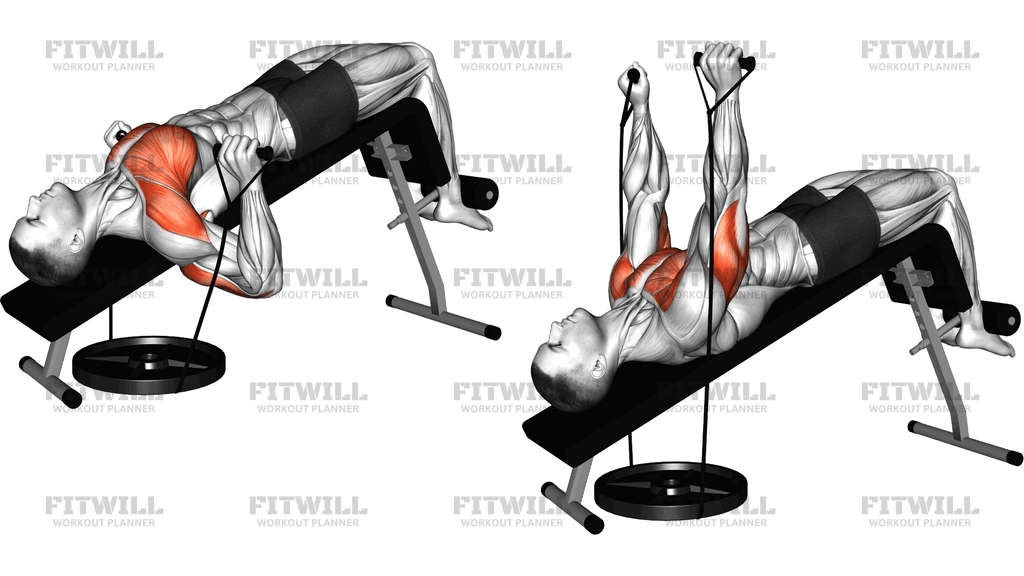
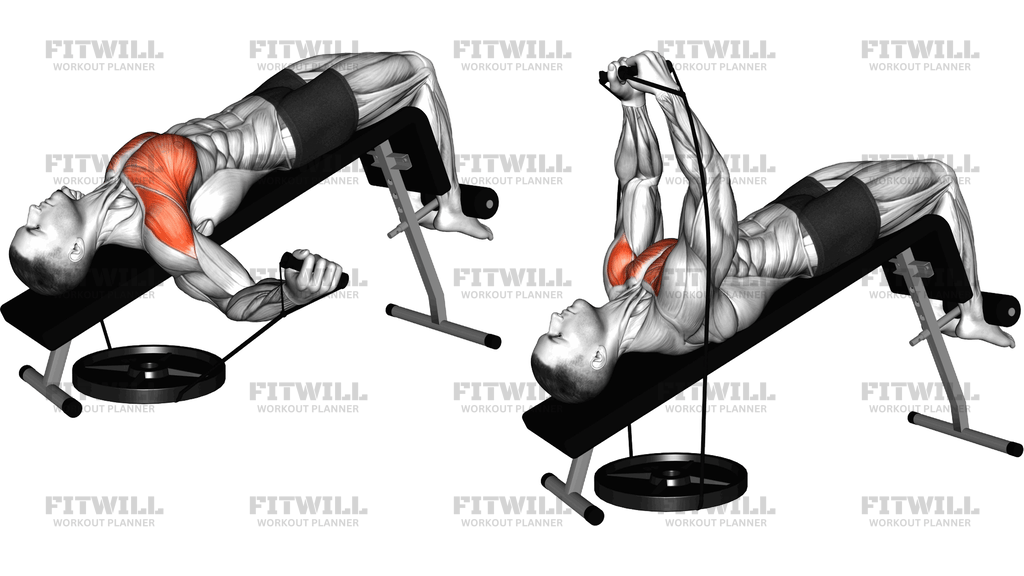
The Band Decline Fly is a chest isolation exercise performed while lying face-up on a decline bench, with a resistance band anchored low behind you and held in each hand. Because the bench is angled so your head sits lower than your hips, the press path and fly arc shift toward the lower portion of the chest, making this a useful way to emphasize the sternal head of the pectorals without needing cables or dumbbells.
The setup is simple but worth getting right: the band runs from an anchor point at or near floor level, often secured under a heavy weight plate, up to handles gripped in each hand. You lie back on the decline bench with your ankles hooked under the foot pads, arms extended toward the ceiling above your lower chest, and then open your arms out wide in a controlled arc until you feel a stretch across the chest, before squeezing the handles back together over the midline.
This movement suits lifters who train at home or travel with minimal equipment, since a band and a decline bench replicate what a cable crossover or decline dumbbell fly would do. It is also a smart choice for people who find free-weight decline presses uncomfortable, because the band's resistance is smooth and the tension is lowest at the stretched position, which is where the shoulder joint is most vulnerable in a fly.
The primary muscles worked are the lower chest fibers, with the front delts assisting throughout the arc and the triceps and biceps working isometrically to hold the arm position. Because the elbows stay mostly fixed and the motion happens at the shoulder joint, this is a true fly pattern rather than a press, so the emphasis stays on horizontal adduction of the arms.
Execution quality comes down to a few things: keeping a slight, soft bend in the elbows for the whole rep, resisting the band on the way out instead of letting it snap your arms wide, and finishing each rep with a deliberate squeeze rather than just clashing the handles together. Since the band tension increases as your hands come together, the hardest part of the rep is at the top, which is the opposite loading profile of a dumbbell fly and one of the main reasons to use bands for this pattern.
As for safety, the decline position means your head is lower than your torso, so come up slowly between sets if you are prone to dizziness, and always confirm the band anchor is secure before you lie back. Start with a lighter band than you think you need, because the eccentric portion of a fly can get away from you quickly when the band is under significant stretch.
[ Workout Log & Planner ]
Put your next workout in Fitwill
Keep your plan and training log ready when you are.


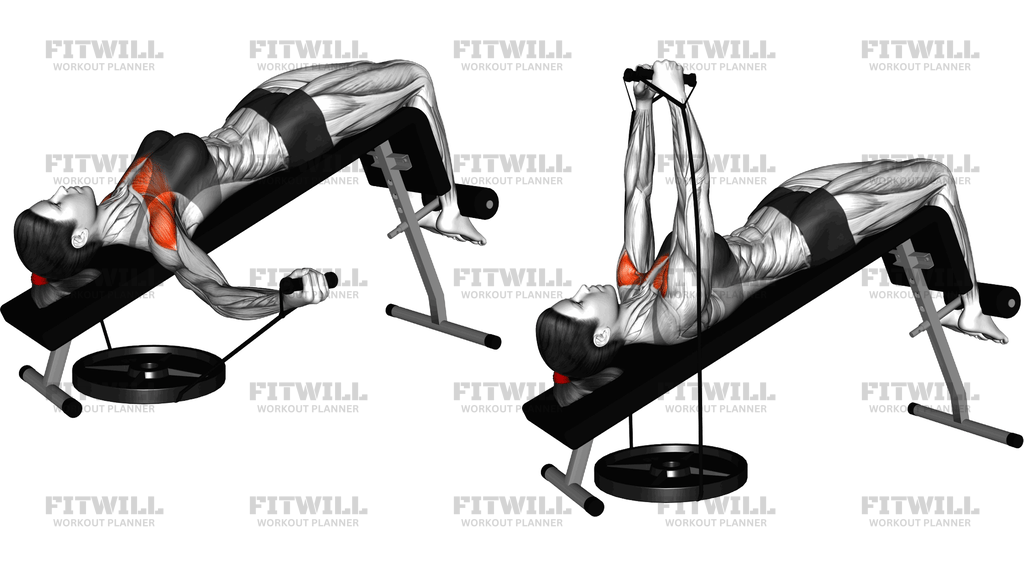
Instructions
- Anchor a resistance band low to the ground behind the head of the decline bench, securing it under a heavy weight plate or a sturdy low anchor point, and attach a handle to each end.
- Sit on the decline bench, hook your feet securely under the ankle pads, then lie back so your head is lower than your hips and your upper back is supported on the pad.
- Grip one handle in each hand with a neutral grip, palms facing each other, and press both handles straight up so your arms are extended over your lower chest.
- Brace your core lightly and keep your shoulders pulled down away from your ears, maintaining contact between your back and the bench.
- With a soft bend in both elbows, open your arms out to the sides in a wide arc, lowering until you feel a stretch across the lower chest and front delts.
- Pause briefly at the widest point without letting the band yank your arms deeper, then sweep the handles back up and together over your chest.
- Squeeze the handles toward each other at the top, keeping the arc slightly toward your hips so the emphasis stays on the lower chest.
- Exhale as you bring the handles together and inhale as you open your arms back out under control.
- Complete all reps with the same elbow bend and arc, then sit up carefully before releasing the handles so the band does not snap back toward you.
Tips & Tricks
- Choose a band that lets you reach the stretched position without your shoulders lifting off the bench; if your elbows flare behind your torso line and your back arches, the tension is too high.
- Do not fully lock out your elbows at the top, as the rising band tension combined with straight arms pushes the stress into the elbow joint rather than the chest.
- If the band slips or slides during the set, anchor it under a heavier plate or move the anchor point directly in line with the bench's center so the pull stays even on both sides.
- Keep the arc traveling slightly down toward your hips rather than straight overhead, since the decline angle plus a low anchor is what biases the lower chest fibers.
- Avoid shrugging as fatigue builds; if your shoulders creep up toward your ears, stop the set and reset your shoulder blades before continuing.
- Lower your arms in three to four seconds instead of dropping them quickly, because the band will actively pull your arms wide at the stretched position.
- Check that your feet are fully hooked under the ankle pads before starting, since the band's downward pull can slide you down the bench during the set.
- If one side feels stronger, slow down and watch your hands to make sure both arms travel the same arc, as bands can hide small left-right imbalances.
- Stand up slowly after your final set, because the decline angle plus blood pooling in the shoulders can cause a brief head rush.
Frequently Asked Questions
What muscles does the Band Decline Fly work?
The primary muscle is the lower chest, specifically the sternal head of the pectoralis major. The front delts assist through the arc, and the triceps work isometrically to hold the arm position.
Why use a decline bench instead of a flat bench for this fly?
The decline angle tilts your torso so your arms adduct along a path that emphasizes the lower chest fibers. On a flat bench the same movement would spread the work more evenly across the whole pec.
Is the Band Decline Fly good for beginners?
Yes, as long as you start with a light band. The band's tension is lowest at the stretched position, which makes it more forgiving on the shoulders than a heavy dumbbell decline fly.
How do I anchor the band correctly for the Band Decline Fly?
Secure it to a low, stable point at or below bench level behind your head, commonly under a heavy weight plate on the floor. Test the anchor by pulling the handles before you commit to lying back.
Why is the hardest part of the rep at the top instead of the bottom?
Band resistance increases as the band stretches, so tension peaks when your hands come together over your chest. This is the reverse of a dumbbell fly, where gravity loads the stretched position most.
Should my elbows be bent or straight during the Band Decline Fly?
Keep a soft, fixed bend of roughly ten to fifteen degrees throughout. Straightening the arms at the top shifts stress to the elbows, while bending more and more as you fatigue turns it into a partial press.
What can I use instead of a resistance band for this exercise?
A cable machine with low pulleys and a decline bench is the closest substitute, offering the same low anchor and constant tension. Dumbbells on a decline bench also work, but the load profile at the stretch differs.
How far should I lower my arms on each rep?
Open until you feel a comfortable stretch across the chest, roughly level with or slightly below the bench, and no further. If your shoulders roll forward or lift off the pad, you have gone past your useful range.
Is the Band Decline Fly safe for the shoulders?
Generally yes when the range is controlled and the elbows stay slightly bent. The main risks are an unstable band anchor, too much tension at the stretch, and letting the band snap your arms wide on the way out, so address all three before loading up.