Static Glutes Contaction (Isometric)
Static Glutes Contraction (Isometric) is a floor-based isolation exercise performed lying on your back with your legs extended straight and your arms relaxed at your sides. Instead of moving through a range of motion, you simply squeeze your glute muscles as hard as you can, hold the contraction for a set period, and then release. The image shows the exact position: a flat supine posture, heels and legs resting on the floor, head neutral, with all of the work happening invisibly inside the hips.
Because there is no movement, this exercise is one of the safest ways to learn what a genuine glute contraction feels like. Many people squat, bridge, or lunge without their glutes doing much of the work, letting the hamstrings or lower back take over. Lying flat with straight legs removes almost every other strategy: you cannot push through your feet, you cannot hyperextend your spine, and you cannot use momentum. The only way to create tension is to actively clamp the glutes, which makes this a classic tool for building the mind-muscle connection before progressing to glute bridges, hip thrusts, or single-leg work.
It is especially useful for beginners, for people recovering time away from training who want a low-load re-entry point, and for anyone who has been told their glutes are "sleepy" during hip-dominant lifts. It also fits well into warm-ups: a few hard five-to-ten-second squeezes primes the glutes for squats, deadlifts, and running far better than generic mobility drills. Because it is done on the floor with no equipment beyond an optional mat, it can be performed almost anywhere, including at home or during travel.
Setup matters more than it looks. Lying flat on your back with legs fully extended places the pelvis in a neutral position, so any squeezing you do comes purely from the glutes rather than from tilting the hips or arching the lower back. Keep your head relaxed, shoulders loose, and let your feet fall naturally outward. When you contract, the sensation should be a firm clenching in both buttocks; your hips may rise a centimeter or two off the floor as the glutes shorten, which is fine, but you should not be actively lifting or bridging.
Execution is simple but easy to do lazily. Breathe out as you build the squeeze, hold a strong but not straining contraction for the target time, then let the tension go completely before the next rep. Avoid clenching your jaw, shrugging your shoulders, or holding your breath, all of which are common when people try to squeeze as hard as possible. Quality here means a clean, isolated glute contraction and a full release between holds, not maximal effort with a tensed-up whole body.
A typical starting dose is five to eight holds of five to ten seconds, resting briefly between each. As control improves, lengthen the holds or increase the number of sets. The main safety point is comfort in the low back: if lying flat with straight legs bothers your spine, bend your knees slightly or place a small towel under them. This exercise should never produce pain in the hips or back, only muscular effort in the buttocks.
[ Workout Log & Planner ]
Put your next workout in Fitwill
Keep your plan and training log ready when you are.


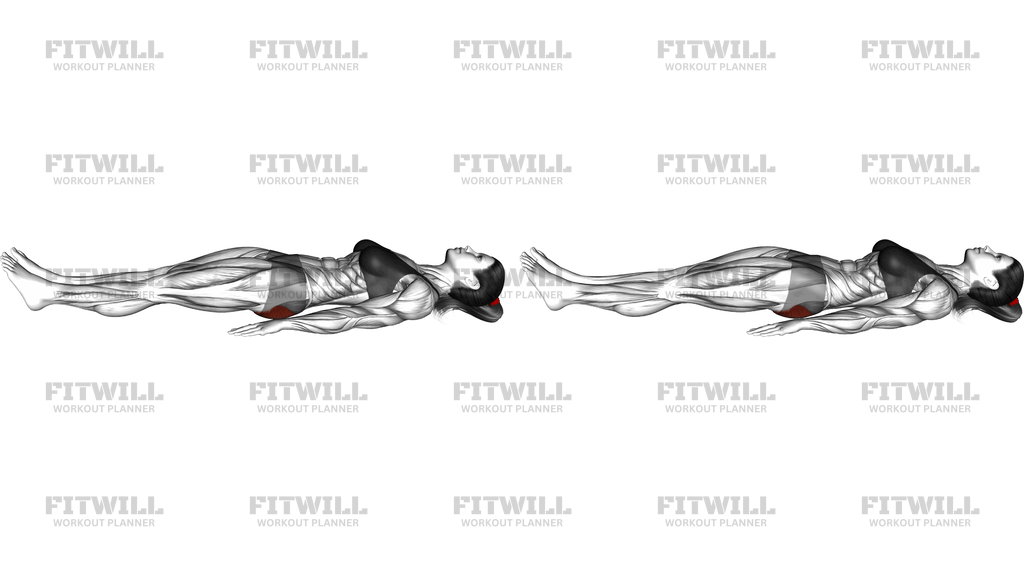
Instructions
- Lie on your back on an exercise mat or the floor, with both legs extended straight and your arms resting at your sides, palms down.
- Let your head and neck relax, and allow your feet to fall slightly outward so your hips are in a neutral, comfortable position.
- Take a normal breath in and gently brace your abdominals so your pelvis stays level against the floor.
- Exhale and squeeze both glutes firmly, as if trying to hold a coin between your buttocks, without pushing your feet into the floor.
- Hold the contraction at its strongest point for five to ten seconds, keeping your shoulders, jaw, and hands relaxed.
- Let your hips rise only slightly if the glute shortening naturally lifts them; do not actively bridge or push upward.
- Release the squeeze completely and feel the glutes go slack for a moment before starting the next hold.
- Keep breathing steadily throughout each hold instead of holding your breath.
- Complete five to eight holds per set, then reset your lying position before the next set if your posture has shifted.
Tips & Tricks
- If you feel your hamstrings or thighs cramping or taking over, soften your legs entirely and picture the squeeze starting only in the buttocks.
- A frequent mistake is turning the hold into a mini bridge by driving the heels down; with straight legs and relaxed feet, there is nothing to push against, so keep the feet passive.
- Place a folded towel under your knees if lying flat with straight legs strains your lower back; the glute squeeze itself stays exactly the same.
- Do not clench harder by tensing your neck, shoulders, or hands; if you notice your upper body tightening, drop the intensity of the squeeze by about twenty percent and rebuild it.
- Aim for a crisp on-off feeling: full contraction, full release. Holding a weak squeeze continuously teaches less than a decisive squeeze followed by a complete reset.
- Check your pelvis with your hands during the first few holds; if your ribs flare up or your back arches away from the floor, reduce the effort and re-brace lightly.
- Use this as a warm-up primer before glute bridges, hip thrusts, squats, or deadlifts rather than only as a standalone exercise, so the learned contraction carries over.
- If you cannot feel anything happening, lightly tap or place a hand on each buttock during the squeeze; the sensory cue makes it much easier to confirm the glutes are actually working.
Frequently Asked Questions
Which muscles does the Static Glutes Contraction (Isometric) work?
The gluteus maximus is the primary muscle working, with the gluteus medius assisting to keep the hips stable. The hamstrings may contribute lightly, and your core works just enough to keep the pelvis neutral.
Is this exercise good for beginners who cannot feel their glutes?
Yes, it is one of the best starting points. Because you are lying flat with straight legs, there is no way to cheat with momentum or leg pushing, so the glutes have to do the contracting themselves.
Why are the legs kept straight instead of bent like in a glute bridge?
Straight legs remove the ability to push through your feet, which is the most common way people borrow tension from their thighs and lower back. This forces a pure, isolated glute squeeze with no movement involved.
How long should I hold each glute contraction?
Five to ten seconds per hold works well for most people. Start on the shorter side with a strong squeeze, and only lengthen the holds once you can keep the contraction clean without other muscles tensing up.
Should my hips lift off the floor during the hold?
A slight rise of one or two centimeters is natural as the glutes shorten, and that is fine. What you want to avoid is deliberately pushing up into a bridge, which changes the exercise and brings the hamstrings and lower back into play.
Can I do Static Glutes Contraction (Isometric) every day?
Generally yes, since the load on the body is very low and there is no eccentric muscle damage. Treat it like a practice drill: a few sets of quality squeezes daily will build the mind-muscle connection faster than occasional long sessions.
What is the most common mistake with this exercise?
Turning it into a full-body clench, with a tight jaw, shrugged shoulders, and held breath. The fix is to drop the intensity slightly, keep the upper body loose, and focus all the effort into the buttocks while breathing normally.
What can I use instead if lying flat bothers my lower back?
Bend your knees slightly or place a cushion under them while keeping the same glute squeeze. A standing or seated glute squeeze is another workable substitute, though the supine position makes it easiest to confirm the glutes are working in isolation.
How does this help my squats and hip thrusts?
It teaches you to recruit the glutes on command, which carries over when you load the hips in dynamic lifts. Doing a set before training helps ensure the glutes, rather than the thighs or lower back, initiate movements like bridging and squatting.
Is it normal to feel a cramp in the glutes or hamstrings during holds?
A mild glute cramp can happen when the muscle is unaccustomed to sustained squeezing and usually fades with practice. If the hamstrings cramp instead, relax your legs completely and restart with a lower-intensity squeeze focused only on the buttocks.