Floor W Raise
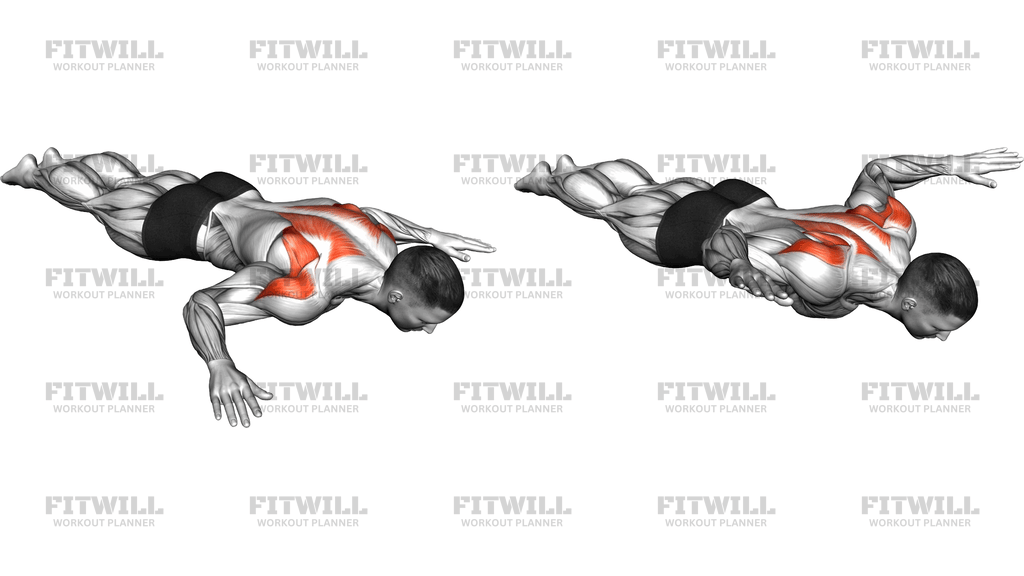
The Floor W Raise is a prone shoulder-blade exercise performed lying face down on the floor with your arms bent so each arm forms a W shape. From that position you lift your forearms and hands toward the ceiling by pulling your shoulder blades down and together, then lower them back down under control. Because there is no equipment involved and the floor itself limits your range, it is one of the safest ways to train the muscles that control the shoulder blades.
The movement primarily targets the lower trapezius, with strong support from the rhomboids and rear deltoids. These muscles are often weak relative to the front of the shoulder in people who sit at a desk, type, or spend a lot of time driving. Strengthening them helps balance the shoulders, supports healthy scapular movement during pressing and pulling, and is a common inclusion in shoulder rehab and postural programs.
Setup matters more here than in most exercises because the floor removes momentum from the equation. Lie fully face down with your forehead close to or resting on the ground, elbows bent roughly 90 degrees, and upper arms angled out slightly from your ribs so the W shape is clear. If your arms are too far overhead you turn it into a Y raise, and if they are tucked too close to your body it becomes a different movement entirely.
To execute it well, start each rep from the ground, gently draw your shoulder blades down toward your hips and toward each other, and let your forearms and hands rise as a result. Keep your chest and head relaxed on the floor rather than lifting the torso, and avoid shrugging your shoulders toward your ears. The lift is usually small, often just a few inches of clearance, and that is perfectly normal.
This exercise fits well as a warm-up before upper-body training, as an accessory on back or shoulder days, and as a low-load option for anyone rebuilding shoulder-blade strength. Typical programming is two to three sets of eight to fifteen slow reps, holding the top position for a second or two to reinforce the muscle contraction.
The main safety consideration is keeping the lift coming from the shoulder blades rather than the neck or lower back. If you feel strain in your neck, reduce the height of the lift and focus on the downward pull of the blades. Move slowly enough that you could pause at any point during the rep.
Fitwill
Log Workouts, Track Progress & Build Strength.
Achieve more with Fitwill: explore over 9600 exercises with images and videos, access built-in and custom workouts, perfect for both gym and home sessions, and see real results.
Start your journey. Download today!




Instructions
- Lie face down on an exercise mat or the floor with your legs extended, the tops of your feet relaxed down, and your forehead resting on or just above the ground.
- Bring your arms out to the sides and bend your elbows about 90 degrees so your upper arms and forearms form a W shape, palms facing down or slightly turned toward each other.
- Let your shoulders relax completely toward the floor for a moment so your starting position is neutral, not already shrugged.
- Gently brace your abdominals to keep your ribcage heavy against the floor throughout the set.
- Pull your shoulder blades down toward your hips and toward your spine, letting your forearms and hands rise off the floor as a result of that pull.
- Pause at the top for one to two seconds with your arms as high as they comfortably go, keeping your neck long and your chest in contact with the floor.
- Lower your arms slowly back to the floor, releasing the shoulder-blade squeeze without letting your shoulders shrug up.
- Exhale as you lift your arms and inhale as you lower them, keeping the breathing rhythm steady.
- Complete your rep count, then rest before the next set, shaking out your shoulders between sets if needed.
Tips & Tricks
- The lift in a Floor W Raise comes from the shoulder blades, not from hoisting your hands up, so if your arms rise but your blades barely move, reset and lead with the downward-and-together squeeze.
- Keep your chest and head still; lifting the torso turns this into a back extension and takes tension away from the lower traps.
- Check your thumb direction: turning your thumbs slightly toward the ceiling tends to bias the rear deltoids, while palms down with a blade-first pull keeps the emphasis on the lower trapezius.
- A common mistake is letting the elbows drift back toward the ribs, which shrinks the W into an incomplete shape; set your arm angle again before each set if it keeps collapsing.
- If you feel it in your neck, you are likely shrugging. Drop your chin slightly, lengthen the back of your neck, and lift to a lower height.
- Keep the range small and honest. A controlled two-inch lift with a strong squeeze beats a big swing that recruits momentum from your trunk.
- Tempo is the main progression tool here: add a three-second hold at the top or slow the lowering phase to four seconds before adding any external load.
- If your forehead lifts during the pull, you are tilting your head back; keep it resting lightly on the mat to stay honest with the movement.
Frequently Asked Questions
What muscles does the Floor W Raise work?
The primary muscle is the lower trapezius, with the rhomboids, middle trapezius, and rear deltoids assisting. Together they control the shoulder blades, which is why the lift is driven by the blades rather than the arms.
How high should my arms lift during the Floor W Raise?
Only as high as your shoulder blades allow without shrugging or arching. For many people this is just a few inches off the floor, and a small clean lift is more effective than a large one done with compensation.
Is the Floor W Raise suitable for beginners?
Yes. It is a body-weight, low-load movement that is easy to learn, which is why it appears in beginner shoulder programs and in early-phase shoulder rehabilitation work. Focus on the squeeze rather than the height of the lift.
Why do I feel the Floor W Raise more in my neck than my shoulder blades?
That usually means your upper traps are taking over and shrugging toward your ears. Relax your shoulders to the floor before each rep, keep your chin slightly tucked, and lift only a small distance until the shrug habit fades.
How does the W position differ from a Y raise?
In the W position your elbows are bent about 90 degrees close to your sides, which biases the lower trapezius and rhomboids. A Y raise uses straight arms overhead, which shifts more work toward the middle and lower traps and the deltoids.
Can I do the Floor W Raise without a mat?
Yes, a mat simply adds cushioning for your ribs, hips, and forehead. On a hard floor, a small towel under the forehead makes the hold position more comfortable.
What can I use instead of the Floor W Raise?
Prone Y raises, prone T raises, and wall slides train overlapping shoulder-blade musculature. If lying face down is uncomfortable, a seated band pull-apart with a downward emphasis is a reasonable substitute.
How many reps and sets of the Floor W Raise should I do?
Two to three sets of eight to fifteen slow reps with a one- to two-second hold at the top works well for most people. Because the load is low, quality of the squeeze matters far more than hitting a high rep number.
Should my palms face down or up in the Floor W Raise?
Palms down with a blade-first pull keeps the emphasis on the lower traps, which is the standard setup. Rotating the thumbs toward the ceiling is a useful variation if you want to feel more in the rear deltoids.